
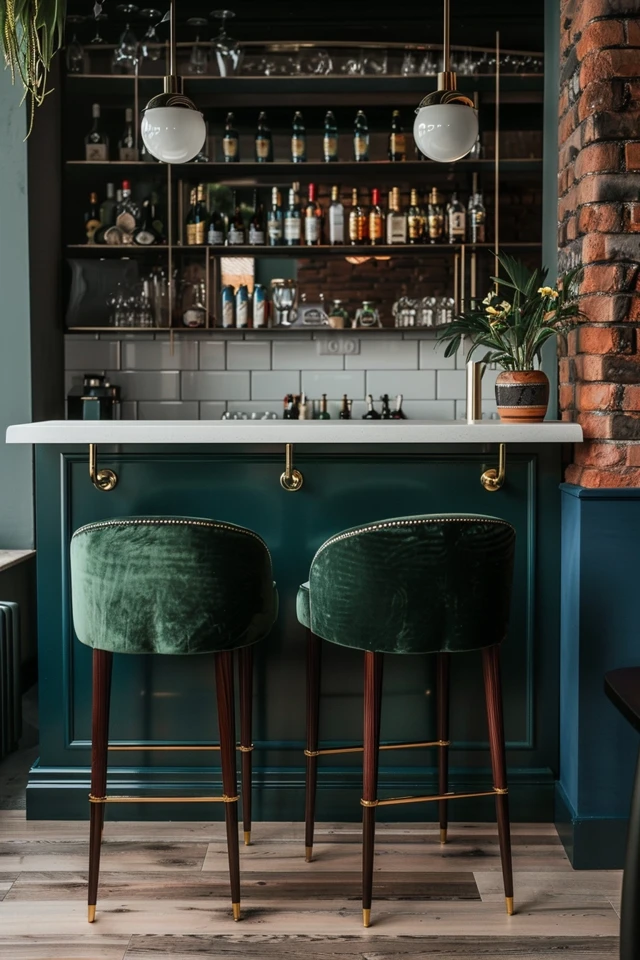
5 Home Bar Interior Design Ideas for Small Spaces
Everyone loves the idea of a dedicated home bar. It evokes images of sophisticated entertaining, mood lighting, and the ritual of crafting the perfect cocktail at the end of a long week. However, the reality for many homeowners and renters is that square footage is a luxury we often cannot spare.
The good news is that you do not need a sprawling basement or a dedicated room to create a stunning beverage station. In my years designing city apartments and cozy bungalows, I have found that small spaces often force the most creative solutions. A compact bar can actually feel more intimate and curated than a massive one.
If you are looking for visual inspiration, check out our curated Picture Gallery at the end of this post.
1. The “Built-Up” Alcove Bar
One of the most effective ways to integrate a bar into a small living room or dining area is to utilize vertical space within an existing niche. Many older homes have awkward setbacks next to fireplaces, while newer builds often have small recessed areas intended for media units.
Instead of filling this space with generic bookshelves, treat it as a jewel box. By building a base cabinet at the bottom and floating shelves above, you create a distinct zone that feels architectural rather than cluttered.
Designer’s Note: The “Wet” vs. “Dry” Decision
In a small space, I almost always advise clients to stick to a “dry bar.” Adding a sink (a wet bar) requires plumbing rough-ins that can cost thousands of dollars and eat up valuable cabinet storage for the pipes. Unless you have a kitchen line on the direct opposite side of the wall, a dry bar is more practical. It offers more storage for bottles and requires zero permit work.
Key Dimensions to Know
When designing an alcove bar, scale is everything. If you install a base cabinet, the standard depth is 24 inches, but in a small room, that can feel too heavy.
I often use semi-custom cabinets reduced to a 15-inch or 18-inch depth. This is deep enough to store liquor bottles and glassware but shallow enough to preserve floor space.
Ensure your countertop overhangs the cabinet doors by at least 1 inch. For the shelves above, space them 14 to 16 inches apart. A standard wine bottle is roughly 12 inches tall, so this clearance allows you to grab a bottle comfortably without knocking it against the shelf above.
Common Mistakes + Fixes
Mistake: Making the alcove too dark.
Fix: Install a mirrored backsplash. In a tight niche, a mirror doubles the visual depth and reflects the light from your bottles. It instantly makes a cramped corner feel like a high-end commercial bar.
2. The Console Table “Trayscape”
If you are a renter or simply not ready to commit to built-in carpentry, the console table method is your best friend. This approach relies on furniture rather than architecture. It is flexible, mobile, and can be moved to a different room if your layout changes.
The secret to making a console table look like a deliberate bar—and not just a table with clutter on it—is the “Trayscape” method. You must corral your items. Placing bottles directly on the wood surface looks messy and risks damaging the finish with spills.
What I’d Do in a Real Project
1. Select the Console: I look for a piece that is at least 30 inches high. Anything lower feels like a coffee table and requires too much bending.
2. The Tray Rule: I place a large, structured tray (leather, brass, or lacquer) on one side of the console. This holds the active liquor bottles.
3. The Anchor: On the opposite side, I place a tall table lamp. Lighting is critical for ambiance. A bar without a glow is just a storage shelf.
4. The Middle Ground: I use the center space for a stack of cocktail books or a decorative ice bucket.
The Material Palette
Since this is a standalone piece, you can afford to be bold with materials. Burl wood, high-gloss lacquer, or marble-topped metal consoles work beautifully.
If you are worried about durability, look for a console with a stone or glass top. Citrus juice and red wine are acidic and will etch wood finishes instantly. If you love a wood piece, have a local glass shop cut a piece of tempered glass to sit on top for protection.
3. The Closet Conversion (The “Pocket Bar”)
We all have that one coat closet that becomes a dumping ground for vacuum cleaners and old coats. Converting a reach-in closet into a pocket bar is a massive trend because it allows you to hide the clutter when not in use.
To do this, remove the closet doors entirely or, if space permits, switch them to bi-fold doors that tuck away neatly.
The “Dark & Moody” Technique
Because a closet is an enclosed box, it is the perfect place to experiment with dark colors. I often paint the entire interior—walls, ceiling, and shelves—in a deep charcoal, navy, or forest green.
When you open the doors (or if you leave it open), it creates a dramatic focal point that contrasts with the rest of the lighter room.
Lighting the Cave
A closet conversion fails without lighting. It will simply look like a dark hole in the wall. You rarely have hardwired electrical boxes inside closets, so you have two options:
- The Pro Route: Hire an electrician to drop a junction box for a small pendant light or hardwired picture light at the top.
- The Renter Route: Use rechargeable, motion-sensor LED puck lights under the shelves. They attach with magnets and offer a surprising amount of glow.
Checklist for Closet Bars
- Storage Zones: Use the floor for a wine fridge or heavy case storage.
- Work Surface: Install a shelf at counter height (36 inches) to serve as the mixing station.
- Backdrop: Wallpaper the back wall. Since it is a small surface area, you can splurge on a high-end textured or patterned paper without breaking the budget.
4. The Floating Wall Bar
When floor space is literally zero—meaning you cannot sacrifice even 12 inches for a cabinet—you go strictly vertical. A floating wall bar consists of wall-mounted wine racks and shallow shelving.
This design relies heavily on hardware. The hardware itself becomes the decor.
Structural Integrity is Non-Negotiable
This is the most critical safety rule I can teach you: Liquor is heavy. A single liter of liquid weighs over 2 pounds. A shelf holding 10 bottles plus glassware can easily exceed 30 pounds.
You must anchor floating shelves into wall studs. Do not rely on drywall anchors, no matter what the packaging says. If the studs do not align with where you want the center of the bar to be, use a mounting cleat or install a decorative wood backing panel that spans the studs, and then mount the shelves to that panel.
Styling Shallow Shelves
For a floating bar, keep shelves shallow—roughly 6 to 8 inches deep. This is enough for a single row of bottles.
The “Top-Heavy” Visual Rule:
- Top Shelf: Place lighter items here, like glassware or small decorative objects.
- Middle Shelf: Place your primary liquor bottles here for easy reach.
- Bottom Area: If possible, mount a wall-hanging wine rack below the lowest shelf to visually anchor the arrangement.
Glassware Selection
Since everything is on display, your glassware must be cohesive. In small spaces, I avoid massive red wine balloons. Instead, I source stackable tumblers and stemless wine glasses. They save vertical space and look uniform when lined up.
5. The Dead Corner Strategy
Every room has a “dead corner”—that awkward triangle of space between a sofa and a wall, or near a window where nothing quite fits. This is prime real estate for a corner bar.
You have two main options here: a triangular corner cabinet or a tall, round bistro table.
The Corner Cabinet
Vintage corner cabinets are often readily available at antique stores because they are hard to fit in modern layouts. They are perfect for small home bars.
Look for a unit with glass doors on top and solid doors on the bottom. Hide the ugly mixologist tools and backup tonic water in the bottom. Display your crystal and premium scotch in the top.
The High-Top Table
If you want a more social vibe, place a small, round high-top table (pub height, 40-42 inches) in the corner. It serves as a mixing station during parties and a place to set a laptop during the day.
Space Planning Rule: You need at least 24 inches of clearance around the table if you plan to put a stool there. If you don’t have that clearance, skip the stool and treat it as a standing-only mixing station.
Designer’s Note: Managing Visual Clutter
Corners can trap shadows. If you place a bar in a corner, you must add a lamp or a sconce. A dark corner filled with glass bottles will just look like a pile of recycling. Light makes it look like a destination.
Materials and Finishes that Elevate Small Bars
In a small space, the quality of materials matters more because you are closer to them. You don’t need 50 square feet of marble; you might only need 3 square feet. This allows you to use remnants or higher-end materials that would be cost-prohibitive in a large kitchen.
Countertops
If you are building a small custom unit, visit a local stone fabricator and ask to see their “remnant yard.” You can often find stunning pieces of quartzite, soapstone, or marble for a fraction of the cost.
Warning on Marble: Marble etches when it touches acid (lemon, lime, wine). For a bar, this is a guarantee. If you want a pristine look, choose Quartz or Quartzite. If you enjoy the “lived-in” French bistro look, marble is fine, but expect a patina to develop.
Hardware
Swap out standard knobs for unlacquered brass or polished nickel. In a small bar, hardware is the jewelry. A rail system (a metal bar running across the front of a shelf) is a great addition for floating shelves. It prevents bottles from sliding off and adds a distinct professional look.
Final Checklist: Before You Start
Before you buy a single bottle or shelf, run through this designer’s checklist to ensure your small space bar will actually function.
- Electrical Check: Is there an outlet nearby for a lamp, blender, or wine fridge? If not, do you have a plan for battery-operated lighting?
- Sunlight Check: Is the spot in direct sunlight? UV rays will degrade liquor and spoil wine. Pick a shady corner or use UV-blocking window film.
- Measurement Check: Have you measured the tallest bottle you intend to buy? (Grey Goose and St. Germain bottles are notoriously tall). ensure your shelf height accommodates them.
- Surface Check: Is your mixing surface waterproof? If you are using a wood vintage piece, have you added a glass top or a large tray to catch spills?
- Access Check: Does the location block a walkway? Ensure that when a cabinet door or drawer is open, people can still pass by.
Frequently Asked Questions
Do I need a wine fridge in a small bar?
Not necessarily. In a small space, a wine fridge can be bulky and noisy. Unless you are a serious collector holding vintage bottles, a standard wine rack is sufficient. Store white wine in your main kitchen refrigerator and bring it out when serving.
What are the essential spirits for a small bar?
Do not try to stock everything. For a small space, curate based on what you drink. A solid baseline is: one vodka, one gin, one bourbon/rye, one tequila, and one mixing rum. Add Cointreau and sweet vermouth, and you can make 90% of classic cocktails.
How do I organize glassware in a small cabinet?
Use shelf risers. These are wire or acrylic inserts that double your shelf space. You can place highball glasses on the riser and rocks glasses underneath. Also, consider hanging your stemware from a rack mounted to the ceiling of the cabinet to free up shelf space below.
Can I put a bar in the entryway?
Yes! An entryway console is a great place for a bar, provided it doesn’t obstruct traffic. It signals hospitality the moment guests walk in. Just ensure the styling is kept minimal so it doesn’t look cluttered immediately upon entry.
Conclusion
Designing a home bar in a small space is less about renovation and more about intention. It is about claiming a corner, a closet, or a wall and dedicating it to the art of hospitality.
Whether you choose to build a vertical alcove, convert a closet, or simply style a beautiful console cart, the success of the design lies in the details. Focus on lighting, ensure your measurements accommodate real-life bottles, and select materials that can handle a splash or two.
A small bar forces you to edit. It forces you to display only the beautiful bottles and the glasses you actually use. In the end, this creates a setup that is often more stylish and functional than a massive, cluttered wet bar.
Picture Gallery


