
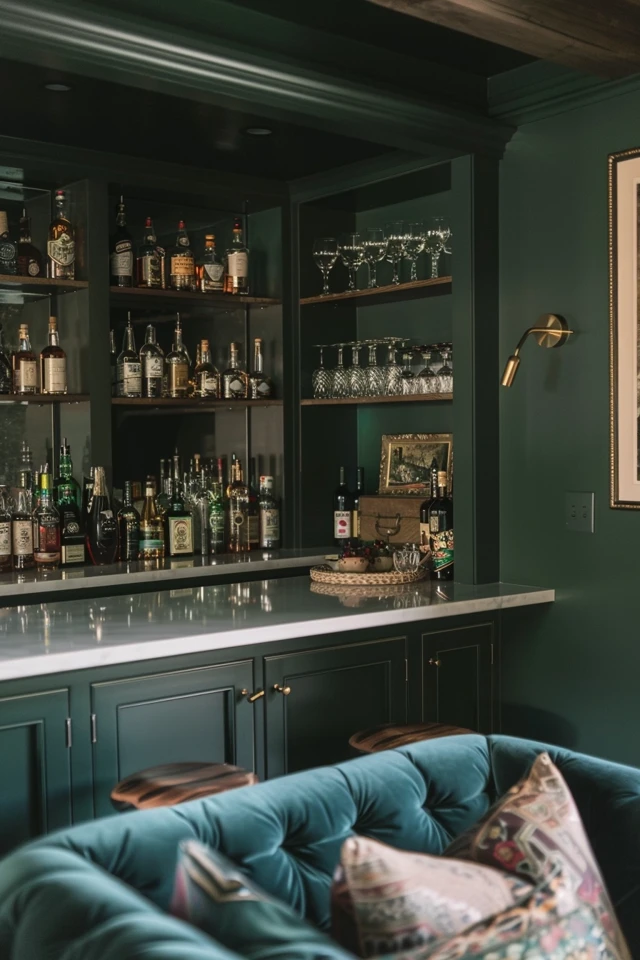
5 Tips for a Built-In Home Bar Design
There was a time when the home bar was relegated to a dusty cart in the corner of the dining room or a dark, wood-paneled corner of a basement rec room. Today, however, the built-in bar has become a central feature of modern entertaining. It serves as a sophisticated anchor point where hosts can craft cocktails and guests can gather without overcrowding the main kitchen work triangle.
In my design practice, I have seen a massive shift toward “entertainment zones.” Clients are asking for dedicated spaces that function just as efficiently as a commercial bar but feel as cozy as a living room. Whether you are remodeling a basement, reclaiming an unused closet, or designing a custom wall in your great room, the principles of flow and functionality remain the same.
Designing a permanent fixture requires careful planning because, unlike a bar cart, you cannot simply wheel it to a new spot if the layout feels off. For plenty of visual inspiration on layouts and finishes, don’t miss the curated Picture Gallery included at the very end of this post.
1. Define the Purpose and Location Early
Before we look at stone samples or brass faucets, we have to determine exactly how you plan to use this space. A “wet bar” includes a sink and running water, while a “dry bar” is strictly for storage and preparation. This decision dictates your location possibilities more than anything else because running new plumbing lines can significantly increase your budget.
If you are renovating on a slab foundation or in a condo, a wet bar might require trenching concrete or complex permitting. In these cases, a dry bar is a practical and cost-effective alternative. However, if you are near a kitchen wall or a bathroom, tapping into existing water lines is much easier.
You also need to consider traffic flow. A bar should be accessible to guests but out of the primary walkway. I always look for “dead zones” in a floor plan—alcoves, spaces under staircases, or transitional hallways between the dining and living rooms.
Designer’s Note: The “Bottle Neck” Effect
I once worked on a project where the client insisted on placing the bar right next to the patio doors. While it seemed like a good idea for summer parties, it created a massive bottleneck during the holidays. Everyone congregated at the bar, blocking the exit.
We fixed this by moving the bar to a recessed niche on the opposite wall. The lesson here is to keep the bar away from major entry and exit points. You want people to linger at the bar, not block traffic behind it.
Common Mistakes & Fixes
- Mistake: Placing the bar too close to the kitchen prep zone.
- Fix: Ensure there is at least 48 to 60 inches of separation between the kitchen island and the bar area so two people can work simultaneously without bumping elbows.
2. Master the Measurements and Cabinetry Logic
Standard kitchen cabinetry rules apply to home bars, but there are nuanced adjustments that make the space feel custom. Standard lower cabinets are 24 inches deep. However, in a hallway or a smaller living area, a 24-inch cabinet can feel bulky and intrusive.
For many home bars, I specify a reduced depth of 18 to 21 inches. This is deep enough to hold wine bottles and glassware but shallow enough to save floor space. If you are installing a beverage fridge or wine cooler, you must check the appliance specifications first. Many under-counter units require a full 24-inch depth, which will dictate your cabinetry footprint.
Upper cabinets are equally important. While solid doors hide clutter, glass-front cabinets are the standard for bars because they display your stemware and liquor bottles. If you choose glass, commit to keeping the interior organized.
Pro-Level Rules of Thumb
- Counter Height: Stick to the standard 36 inches for working surfaces. If you want a raised bar top for seating, that goes to 42 inches.
- Upper Cabinet Clearance: Standard clearance between the counter and the bottom of upper cabinets is 18 inches. For a bar, I often push this to 20 or 22 inches to allow for taller bottles and blenders on the counter.
- Seating Overhang: If your built-in includes a peninsula for seating, you need a minimum of 12 to 15 inches of countertop overhang for knee space.
What I’d Do in a Real Project
If space is tight, I skip upper cabinets entirely. Instead, I use floating shelves made of the same wood species as the lower cabinetry or a metal finish that matches the hardware. This makes the room feel larger and forces the client to edit their glassware collection to just the essentials.
3. Select Materials That Can Handle the “Acid Test”
Home bars see different wear and tear than kitchens. While heat resistance isn’t usually a major concern, acid etching and staining are huge issues. Alcohol, citrus (lemons, limes, grapefruits), and red wine are enemies of porous natural stones.
I love the look of Carrara marble, but I almost never recommend it for a working wet bar. One margarita night with a spilled lime wedge will leave a permanent dull spot (etching) on a polished marble surface. If you must have natural stone, look for a “honed” finish, which hides etching better than polished surfaces, or choose a quartzite.
Quartzite is a natural stone that is harder and more durable than granite but mimics the look of marble. Engineered quartz is another excellent option because it is non-porous and requires zero sealing.
For the backsplash, this is your moment to be dramatic. Since the square footage is low, you can splurge on an antique mirror, a high-end mosaic tile, or a slab of dramatic stone without breaking the bank. An antique mirror is particularly effective in small, windowless nooks because it reflects light and adds depth.
Designer’s Note: The Flooring Transition
Don’t forget the floor immediately in front of the bar. If your bar is in a carpeted basement or living room, install a strip of hard flooring (tile or wood) at least 24 inches wide in front of the cabinetry. You will spill ice, wine, or mixers eventually. cleaning grenadine out of beige carpet is a nightmare you want to avoid.
Common Mistakes & Fixes
- Mistake: Using wood countertops around a wet sink.
- Fix: While wood bar tops are classic, water damages them over time near the faucet. If you want wood, use marine-grade varnish (spar urethane), or use stone near the sink and wood for the serving areas.
4. Appliance Planning and Hardware Layout
The “Holy Trinity” of a home wet bar is the sink, the fridge, and the ice maker. Fitting these into a small footprint requires puzzle-solving skills.
The Sink: You do not need a full-sized kitchen sink. A bar sink (often called a prep sink) usually measures 15 to 18 inches wide. I prefer undermount models because they allow you to sweep crumbs and citrus peels directly into the basin. Go for a deep basin rather than a wide one so you can easily fill pitchers or wash tall glasses.
The Fridge: A dedicated beverage center is better than a standard mini-fridge. Look for “dual zone” coolers if you store both red and white wine. Crucially, pay attention to the door swing. Ensure the fridge door doesn’t hit a wall or another cabinet when opened.
The Ice Maker: This is the ultimate luxury, but it comes with maintenance. A clear ice maker requires a drain line (gravity or pump assist) and regular cleaning to prevent mold. If you don’t have a drain line, you are stuck with a standard freezer unit, which makes cloudy, crescent-shaped ice.
Hardware Considerations
Cabinet hardware is the jewelry of the room. For bars, I like to mix metals or choose a finish that stands out from the nearby kitchen. If your kitchen is nickel, try unlacquered brass for the bar.
However, consider the scale. If you are using smaller drawer fronts, ensure your pulls aren’t too large. For appliance panels (where you cover the fridge with a cabinet door), you must use “appliance pulls.” These are heavier and structurally reinforced to handle the suction force of a refrigerator door.
Designer’s Note: Ventilation is Non-Negotiable
I have seen clients shove a freestanding mini-fridge into a tight cabinet opening to save money. Within six months, the fridge dies. Built-in under-counter refrigerators vent from the front (the toe kick). Freestanding units vent from the back. You cannot put a rear-venting fridge into a built-in cabinet without risking overheating and fire hazards. Always buy a unit rated for “built-in” installation.
5. Lighting the Mood: Layers are Key
A home bar should never feel like a cafeteria. The lighting needs to be moody, adjustable, and layered. We generally aim for a color temperature of 2700K (warm white) or 3000K (neutral white). Anything higher (4000K+) will look like a dentist’s office.
You need three distinct layers of light:
1. Ambient Light: This is the general room light, usually from recessed cans. Put these on a dimmer switch immediately.
2. Task Light: This lights up the countertop so you can slice lemons without cutting your finger. Under-cabinet LED tape lighting is the standard solution here. It should be installed behind the front face frame of the upper cabinet so the diodes aren’t visible.
3. Accent Light: This is for drama. If you have glass shelving, install LED puck lights at the top or channel lighting within the cabinet to illuminate the bottles. If you have a peninsula, drop a pair of small-scale pendant lights over the serving area.
What I’d Do in a Real Project
I typically wire the under-cabinet lighting and the interior cabinet lighting to the same switch, but I separate the overhead pendants. This allows the homeowner to dim the overheads way down for a party while keeping the workspace and display bottles glowing softly.
Also, consider the reflection. If you use a mirrored backsplash, be careful where you place under-cabinet lights. You don’t want to see the reflection of the ugly LED strip in the mirror. You may need to use a diffuser channel to soften the light.
Final Checklist: The “What I’d Do” Summary
Before you sign off on a design or purchase materials, run through this checklist to ensure you haven’t missed a critical functional detail.
- Electrical Check: Do you have outlets on the backsplash for a blender or coffee maker? Are they GFCI protected if near a sink?
- Plumbing Pitch: If adding a sink, do you have the proper slope for the drain line to reach the main stack?
- Clearance Check: Open every appliance door and drawer simultaneously on your floor plan. Do they crash into each other?
- Height Check: Are your tallest liquor bottles too tall for your shelves? Measure your favorite brand (Grey Goose and St-Germain are notoriously tall).
- Surface Durability: Have you accepted that marble will etch, or have you switched to quartz?
- Ventilation: Does your fridge have a front-venting grille?
FAQs
How much does a built-in home bar cost?
Costs vary wildly based on DIY vs. pro labor. A simple dry bar using stock cabinets might cost $2,000 to $4,000. A fully custom wet bar with stone counters, plumbing, and high-end appliances often ranges from $15,000 to $30,000+.
Does a home bar add resale value?
Generally, yes, specifically in finished basements or “bonus” rooms. However, taking up valuable closet space in a bedroom to build a bar can hurt resale value. It must make sense within the floor plan.
Can I build a bar in a rental?
For renters, I recommend a high-quality freestanding piece (like a credenza or sideboard) that mimics a built-in. You can use plug-in sconces above it and removable wallpaper behind it to create a “zone” without losing your security deposit.
What is the minimum size for a home bar?
You can create a functional dry bar in a width as small as 24 to 30 inches (the size of a standard closet). For a wet bar, you generally need at least 48 inches of width to accommodate a small sink and a bit of prep space.
Conclusion
Designing a built-in home bar is one of the most fun projects you can undertake because it is a space dedicated entirely to leisure and hospitality. Unlike a kitchen, which is a workhorse, a bar is a show pony. It allows you to take risks with darker paint colors, moodier lighting, and more glamorous materials.
By paying attention to the unglamorous details—like plumbing clearances, fridge ventilation, and bottle heights—you ensure the space works as good as it looks. The goal is a bar that invites you to mix a drink, dim the lights, and relax.
Picture Gallery


