
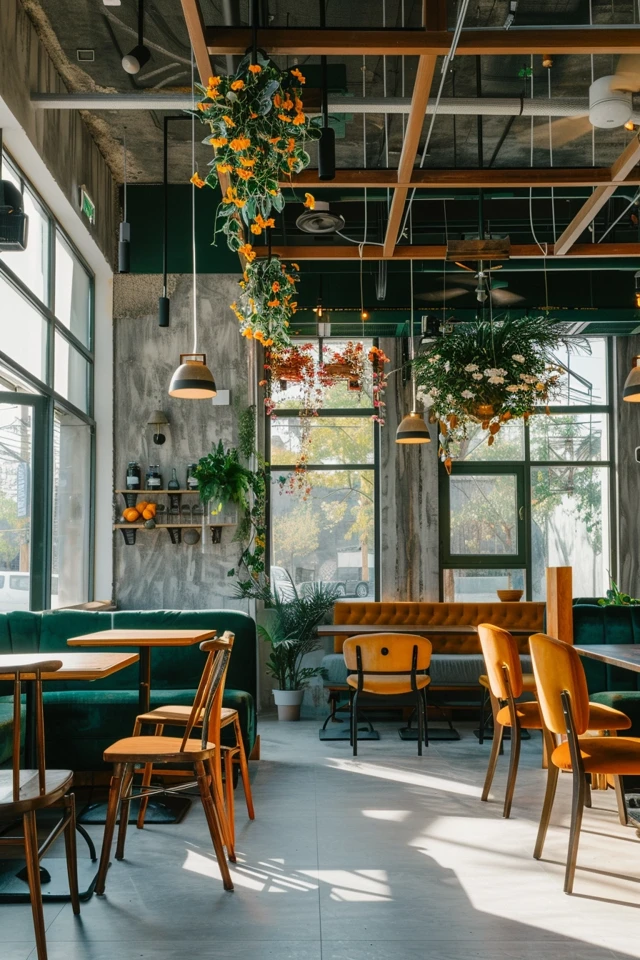
5 Tips for a Stylish Cafe Ceiling Design
When we design commercial spaces, the ceiling is often referred to as the “fifth wall.” In a cafe setting, it is arguably the most critical surface after the floor. It dictates the acoustics, houses the essential mechanical systems, and sets the atmospheric volume of the room.
I have seen countless beautifully furnished cafes that feel uncomfortable simply because the ceiling design was an afterthought. Whether it is harsh lighting glare, deafening echoes from espresso machines, or unsightly HVAC units, the ceiling holds the power to make or break the customer experience.
If you are currently planning a renovation or a new build, you need to look up. For a dose of visual inspiration, don’t miss the curated Picture Gallery at the end of this blog post.
1. Master the Art of the Exposed Industrial Look
The “exposed industrial” aesthetic is a staple in modern cafe design for a reason. It maximizes vertical height and offers an edgy, raw texture that pairs well with coffee culture. However, achieving a polished industrial look requires more than just ripping out the drop-ceiling tiles and walking away.
When you expose the plenum (the space between the structural ceiling and the drop ceiling), you reveal a chaotic web of fire sprinklers, electrical conduits, and HVAC ducts. In my projects, I treat this chaos by unifying it with a single color. This technique, often called “dryfall painting,” helps the mechanical elements recede visually.
If your ceiling height is over 12 feet, painting the entire void black is a classic move. Black creates an infinite depth, making the ceiling feel higher while completely hiding the dust and wires. If your ceilings are lower, between 9 and 11 feet, I recommend white. White reflects light, making the space feel airier, though it requires much tidier cable management since shadows are more visible.
Designer’s Note: The Cable Tray Rule
One lesson I learned early on is that electricians love to run wires diagonally if you don’t stop them. When exposing a ceiling, specify in your drawings that all conduit and cabling must run parallel or perpendicular to the main walls. Rigid conduit looks much better than flexible metal cabling (MC cable) when exposed.
Common Mistakes + Fixes
- Mistake: Ignoring insulation. Without a drop ceiling, you lose a layer of thermal and sound insulation.
- Fix: If the roof deck is uninsulated, spray black or white acoustic thermal insulation directly onto the deck before painting. This prevents the cafe from becoming a greenhouse in summer.
2. Integrate Acoustics into the Aesthetic
Acoustics are the number one complaint in cafe design. Hard surfaces like concrete floors, glass windows, and wood tables bounce sound waves around, creating a “cocktail party effect” where customers have to shout to be heard.
The ceiling is your best defense against noise. You need to aim for a specific coverage ratio. In a standard cafe, I try to cover at least 35% to 45% of the ceiling surface area with sound-absorbing materials.
You do not have to stick to boring acoustic tiles. I love using acoustic baffles—vertical blades of felt or compressed wood wool that hang from the ceiling. Because they hang vertically, they have two sides of surface area to absorb sound, making them twice as efficient as a flat panel glued to the roof.
Another stylish option is Tectum (cementitious wood fiber) panels. They look like compressed straw and have a fantastic organic texture. You can screw these directly into ceiling joists or suspend them as “clouds” over loud areas, like the barista station or the main communal table.
What I’d do in a real project:
- Identify the noise source: I place the densest acoustic treatment directly above the espresso machine and grinders.
- Drop height: I suspend acoustic clouds 12 to 24 inches below the structural ceiling to trap sound waves that bounce off the hard deck above.
- Material choice: I use PET felt (made from recycled plastic bottles) for a sleeker look, or wood wool for a rustic, textural vibe.
3. Use Ceiling Height to Define Zones
In a large cafe, a uniform ceiling height can make the space feel like a cafeteria or a waiting room. Varying the ceiling height is a subtle psychological trigger that tells customers how to behave in different areas.
We use “compression and expansion” to guide the customer journey. The entrance and the ordering counter should feel dynamic and energetic. We often leave these ceilings high and exposed to handle the heat from equipment and the bustle of the line.
Conversely, seating areas benefit from lower, more intimate ceiling planes. I often design a dropped bulkhead or a timber trellis over the seating zone, bringing the perceived ceiling height down to 8 or 9 feet. This creates a sense of shelter and encourages customers to linger and relax.
Realistic Constraints: HVAC
Changing ceiling heights is also a practical way to hide bulky equipment.
- We often drop the ceiling over the service counter (the “back of house” area) to conceal the large fan coil units and grease traps required for the kitchen.
- This allows us to keep the seating area ceiling higher and cleaner.
Designer’s Note: Material Transitions
When transitioning from a high ceiling to a lower one, pay attention to the edge detail. A simple drywall return can look cheap. I prefer to clad the vertical face of the drop in wood veneer or tile to make it look like an intentional architectural feature rather than just a box for ductwork.
4. Layer Your Lighting with Precision
A stylish ceiling is useless if the lighting plan fights against it. In a cafe, lighting needs to be functional for the baristas but ambient for the guests. The ceiling design dictates how you mount these fixtures.
For exposed ceilings, track lighting is your best friend. It is flexible, allowing you to aim spots at menu boards, retail shelving, or art. I recommend using tracks suspended on aircraft cables rather than mounting them flush to the ceiling deck. Dropping the track 12 to 24 inches allows you to bypass obstructions like sprinkler pipes.
For pendant lights over tables, the drop length is critical. A common rule of thumb is to position the bottom of the pendant 30 to 36 inches above the table surface. This creates a pool of light that illuminates the coffee and the laptop without causing eye glare for the person sitting there.
Color Temperature Matters
Always specify 2700K to 3000K bulbs for a cafe. Anything higher (4000K+) looks like a pharmacy. If you have a dark-painted ceiling, you need to account for light absorption. A black ceiling reflects almost no light, so you will need about 20% more lumens (light output) in your fixtures compared to a white ceiling to achieve the same brightness at table level.
Common Mistakes + Fixes
- Mistake: Creating shadows on the barista’s work surface.
- Fix: Position task lighting directly above or slightly in front of the barista, not behind them. Shadows make latte art difficult and cleaning harder.
5. Experiment with Texture and Materiality
If your budget allows, moving beyond paint and acoustic foam opens up a world of texture. The ceiling is a massive canvas that rarely gets touched or scuffed, so you can use materials here that might be too fragile for walls.
One of my favorite treatments for warmth is wood slats. Linear wood systems can be installed on a clip system. They hide the plenum while allowing air to circulate for HVAC return. The linear lines also draw the eye, making a short room feel longer.
For a vintage or maximalist cafe, stamped tin tiles are a timeless choice. They reflect light beautifully and add a historic charm. If real tin is too expensive or heavy, there are excellent faux-tin PVC options that glue directly onto drywall. Once painted, you cannot tell the difference from the floor.
Budget Reality Check
Real wood ceilings are expensive—often $20 to $40 per square foot installed.
- Budget Hack: Use real wood only in key focal areas, like a “cloud” over the main bar.
- Alternative: Use laminate beams or baffles that look like wood but are actually aluminum or wrapped MDF. They are lighter, fire-rated, and cheaper.
Designer’s Note: Fire Codes
Before falling in love with a material like reclaimed barn wood or fabric draping, check the flame spread rating. Commercial codes are strict. Most ceiling materials need to be Class A fire-rated. You can treat raw wood with intumescent varnish to meet code, but it adds to the cost.
Final Checklist: What I’d Do in a Real Project
If I were consulting on your cafe tomorrow, this is the step-by-step logic I would follow to design the ceiling:
1. The Audit
- Check the existing clear height. Is it over 10 feet? If yes, consider exposed. If no, look at tight-to-deck solutions.
- Locate the “uglies.” Where are the HVAC units and drain lines? Can they be moved, or do we need to build a bulkhead to hide them?
2. The Zoning
- Draw a floor plan and overlay the ceiling heights.
- Mark high energy zones (Counter/Entry) and low energy zones (Seating).
- Plan drops or clouds to correspond with the seating layout.
3. The Acoustics
- Calculate the square footage of the ceiling.
- Ensure 30-40% of that area has sound-absorptive material (baffles, spray, or panels).
4. The Layout
- Align everything. Ensure lights, diffusers, and speakers align with the center of tables or aisles.
- Grid it out. Even in an exposed ceiling, I create a visual grid to keep conduits organized.
5. The Finish
- Choose a color that complements the brand.
- Dark for moody/cozy/industrial. Light for scandi/fresh/open.
- Verify the fire rating of all finish materials.
FAQs
What is the cheapest way to finish a commercial ceiling?
The most cost-effective method is “cleaning and painting.” This involves removing old tiles, cleaning the existing ductwork, and spraying the entire deck and mechanicals in a single color (usually black or white). It saves on framing and material costs but requires labor to tidy up the wires.
How low can a cafe ceiling be?
Building codes usually require a minimum of 7 feet 6 inches for habitable spaces, but that feels very oppressive in a commercial setting. I aim for a minimum of 9 feet for general seating. If you have an area that is lower, use it for intimate booth seating or bathrooms, not the main standing room.
Do I need a drop ceiling for the kitchen area?
Yes, usually. Health codes often mandate smooth, washable, non-porous ceiling surfaces in food preparation areas. An exposed ceiling with dusty pipes is generally not allowed directly over food prep zones. We typically install a washable vinyl-faced tile (ACT) or hard lid drywall painted with semi-gloss paint in the kitchen.
How do I handle air conditioning vents in an exposed ceiling?
You use spiral ductwork. Round spiral ducts look much better than rectangular ones. You can leave them galvanized silver for an industrial pop, or paint them to match the ceiling. Make sure to use “double wall” spiral duct if noise breakout is a concern.
Conclusion
Designing a cafe ceiling is a balancing act between the technical and the aesthetic. It has to hide the messy guts of the building while projecting the style and vibe of your brand. It has to dampen the clatter of dishes while reflecting the warmth of your lighting.
By layering your lighting, prioritizing acoustics, and managing your heights, you can transform the “fifth wall” from a utility surface into a defining feature of your interior design. Whether you go for a raw, blacked-out industrial void or a warm, wood-slatted canopy, the ceiling is what wraps the experience together.
Picture Gallery


