
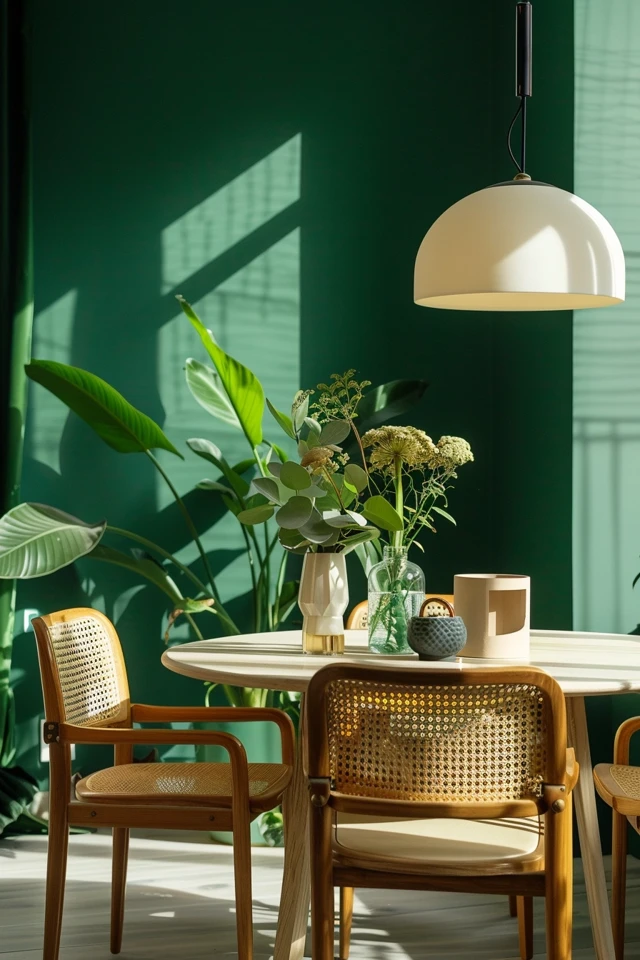
5 Tips for Adding Green to Your Dining Room
Green is arguably the most versatile color in the interior design spectrum because it acts as a neutral in nature. When clients tell me they are afraid of color but want their home to feel alive, I almost always steer them toward green. It bridges the gap between the calm of neutrals and the energy of bolder hues.
However, getting the right shade of green in a dining room requires a careful balance of lighting, texture, and scale. If you are looking for visual inspiration, you can jump right to the Picture Gallery at the end of this post. Otherwise, keep reading to learn the technical details of how to execute this look.
I recently worked on a project where the dining space felt cold and sterile. By introducing a deep olive on the wainscoting and layering in living plants, the room instantly became a place where the family wanted to linger after meals. The following tips break down exactly how to achieve that cohesive, professional look in your own home.
1. Master the Paint Undertones and Lighting
Paint is the most high-impact way to introduce green, but it is also the easiest step to mess up. Green is rarely just “green.” It carries undertones of blue (teal/cool), yellow (olive/warm), or gray (sage/muted). In a dining room, you want a color that looks appetizing under artificial light, as that is when most dinner parties occur.
Start by analyzing the natural light in your room. If your dining room faces north, the light will be cool and blue. A green with gray or blue undertones will look very cold here. For north-facing rooms, lean toward warm olive or moss greens to counteract the chill.
If you have a south-facing room that gets flooded with warm sunlight, you have more flexibility. You can use cooler teals or emeralds without the room feeling icy. However, be careful with very yellow-greens in south-facing rooms, as they can become overwhelming and almost neon when the sun hits them.
Designer’s Note: The Lighting Test
I never specify a paint color without testing it against the flooring and the lighting fixtures. Paint a large swatch (at least 24 inches by 24 inches) on two different walls. Observe it at 8:00 PM with your dining chandelier turned on. If your light bulbs are 3000K (warm white), they will pull the yellow out of the green. If they are 4000K or higher (cool white), they will flatten the color and make it look medicinal.
Common Mistake: Ignoring Light Reflectance Value (LRV)
Homeowners often pick a color from a small chip, only to find it looks almost black on the wall. This is an issue of LRV.
- Low LRV (5-15): These are moody, dramatic greens like forest or hunter green. They absorb light. You need excellent artificial lighting to pull this off.
- Mid LRV (20-40): These are your true colors. They show up clearly as green without being too dark.
- High LRV (50+): These are your pastels and light sages. They reflect light and make the room feel larger.
2. Choose Performance Fabrics for Green Upholstery
If painting the walls feels too permanent, bringing green in through dining chairs is a fantastic alternative. However, dining rooms are high-traffic work zones. Between food spills, wine splashes, and the friction of sitting, your fabric choice is more important than the color.
I always recommend performance velvet or high-quality crypton fabrics for dining chairs. A hunter green velvet is incredibly forgiving. It adds a sense of luxury and depth, but the dark pile naturally hides small stains better than a light linen would.
When selecting upholstery, check the “double rub” count on the fabric swatch. For a dining room that gets daily use, you want a fabric rated for at least 30,000 double rubs. This ensures the fabric won’t bald or pill where people slide in and out of the chairs.
The Rule of Contrast
You must consider the material of your dining table when choosing chair color.
- Dark Walnut or Espresso Tables: Pair these with lighter, brighter greens like sage, chartreuse, or a vivid emerald to ensure the chairs don’t disappear into the table.
- Light Oak or White Tables: These can handle deep forest greens or dark moss tones to ground the space.
What I’d Do in a Real Project
If I am designing for a family with young kids, I avoid fully upholstered chairs. Instead, I choose a wooden chair with a wipeable green leather or faux-leather seat pad. If I am designing for an adult-only space, I love a fully upholstered parsons chair in a deep green mohair for texture.
3. Integrate Living Greenery (Biophilic Design)
Adding literal green through plants is the most authentic way to bring this color into your dining room. In design, we call this biophilia—our innate connection to nature. However, a sad, dying plant is worse than no plant at all.
The placement of greenery in a dining room relies on scale. A common error is placing small, 4-inch pots on the floor or in corners where they get lost. Floor plants need to be substantial to impact the room’s vertical lines.
Floor Plant Guidelines
If you have an empty corner, aim for a tree that is at least 5 to 6 feet tall. A Ficus Audrey or a Bird of Paradise works well here. The planter should be roughly 14 to 16 inches in diameter to visually anchor the tree. If the pot is too small, the tree looks top-heavy and unstable.
Tabletop and Centerpieces
For the dining table itself, low-maintenance is key. You do not want a centerpiece that blocks eye contact across the table.
- The Height Rule: Keep tabletop greenery under 12 inches tall, or go very tall and sparse (like branches) so guests can see through them.
- The Vessel: Use a low, wide bowl filled with moss or succulents for a modern look. This adds green texture without requiring daily watering.
Designer’s Note: Drainage and Floors
Never put a plant pot directly on a hardwood dining floor without a saucer or a cork mat. Moisture will accumulate under the pot through condensation, even if you don’t overwater, and it will ruin your wood floors within months. I always double-pot: the plant stays in its ugly plastic nursery pot with drainage holes, and that entire unit sits inside a decorative, water-tight ceramic planter.
4. Anchor the Room with a Green Rug
A rug is the foundation of the dining room. It dictates the acoustic quality and defines the eating zone. Using a green rug is a clever way to hide crumbs and debris, specifically if you choose a patterned design.
When selecting a green rug, I prefer vintage-inspired patterns or organic geometrics over solid blocks of color. A solid green rug can look like artificial turf if the texture isn’t plush enough. A pattern that mixes olive, cream, and charcoal is much more sophisticated and forgiving.
Sizing Your Rug Correctly
The biggest mistake homeowners make is buying a rug that is too small. In a dining room, the rug rule is non-negotiable.
- The 24-Inch Rule: The rug must extend at least 24 inches (ideally 30 inches) beyond the table on all sides.
- Why it matters: When a guest pulls their chair out to sit down, the back legs of the chair should remain on the rug. If the back legs drop off the edge, the chair becomes uneven, and it is annoying to scoot back in.
Material Selection
For dining rooms, avoid high-pile shags or delicate viscose. Food will get stuck in shag, and viscose stains immediately with water.
- Wool: The gold standard. It is naturally stain-resistant and durable.
- Polypropylene: Great for budget projects or messy families. It can be scrubbed easily.
- Flatweave: Easy to move chairs over, but make sure you use a thick rug pad underneath to prevent slipping.
5. Layer Green through Drapery and Window Treatments
Window treatments are often an afterthought, but they occupy a huge amount of vertical visual space. Green drapery can frame a view of the outdoors, blurring the line between inside and out.
If you have painted your walls a neutral color like white or beige, green curtains add a necessary punch of color without overwhelming the space. I often use a “tone-on-tone” approach as well. For example, if the walls are a pale sage, I might install curtains in a deep forest green. This creates a monochromatic look that feels very high-end and cozy.
Hanging Measurements
To make your dining room ceilings feel higher, do not hang the curtain rod directly on the window frame.
- Height: Mount the rod 4 to 6 inches below the crown molding or ceiling. This draws the eye up.
- Width: Extend the rod 10 to 12 inches past the window frame on each side. When the curtains are open, they should rest against the wall, not cover the glass. This maximizes natural light.
Fabric Weight
In a formal dining room, heavy linen or velvet in a green shade adds acoustic dampening. Dining rooms can be echo-heavy due to the hard table and lack of sofas. Heavy drapery absorbs sound, making conversation easier during dinner parties.
If the room is small, avoid heavy velvet. Instead, opt for a breezy green linen blend. The light filtering through the green fabric will cast a soft, natural glow into the room.
Final Checklist: What I’d Do in a Real Project
If I were managing your dining room redesign, this is the exact order of operations I would follow to ensure the green elements work together:
- Measure the Room: Get the dimensions for the rug and curtain rods first. Nothing else matters if the scale is wrong.
- Select the “Hero” Green: Choose one main green element. Is it the walls? The chairs? Or the Rug? Do not try to make all three the exact same shade.
- Sample Paint: If painting, apply swatches on two walls and check them at night.
- Order the Rug: The rug usually takes the longest to ship and covers the most surface area. It sets the tone for the other colors.
- Select Chairs: Bring a fabric swatch of the chair to the room to see how it looks against the rug and paint samples.
- Install Lighting: Ensure your light bulbs are 2700K or 3000K so the green looks warm, not clinical.
- Add Drapery: Install high and wide to frame the room.
- Style with Plants: Add the living elements last to fill empty corners and breathe life into the composition.
FAQs
Can I mix different shades of green in one room?
Yes, absolutely. In fact, you should. Nature rarely uses just one shade of green. A mix of olive, forest, and sage feels organic. The trick is to vary the textures. If you mix greens, ensure one is glossy (like a plant leaf), one is matte (like paint), and one is soft (like velvet).
Is green suitable for a small dining room?
Green is excellent for small spaces. A dark green can blur the corners of a room, making the boundaries of the space disappear, which creates an illusion of depth. A light green can make the space feel airy and fresh.
How do I add green if I am renting and can’t paint?
Focus on the “movables.” A large area rug, a gallery wall of botanical prints, and upholstered dining chairs can transform the room without touching the walls. Oversized floor plants are also a renter’s best friend for covering up boring white corners.
What metallic finishes go best with green?
Green pairs beautifully with almost all metals. Brass and unlacquered gold look stunning with warm olives and forest greens. Polished nickel and black metals look sharp and modern against cooler teal-greens or sages.
Conclusion
Adding green to your dining room is about more than just picking a trendy color; it is about creating an atmosphere. Whether you choose to envelope the room in moody paint or simply layer in texture through rugs and plants, green brings a sense of balance and life that few other colors can achieve.
Remember to respect the rules of scale, pay attention to your lighting temperature, and prioritize durability for your furniture. By following these guidelines, you will create a space that feels curated and professional, rather than just decorated.
Picture Gallery


