
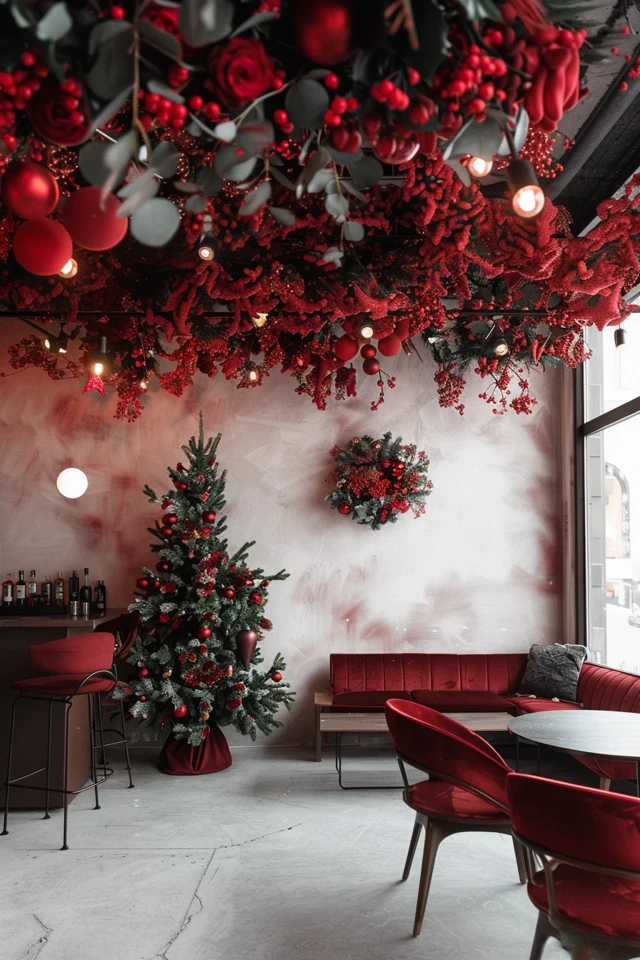
5 Tips for Ceiling Design for Xmas
When we think about holiday decorating, we almost always look down or at eye level. We focus on the tree skirt, the coffee table vignette, or the mantelpiece. However, as an interior designer, I view the ceiling as the “fifth wall” and the biggest missed opportunity in holiday styling.
I recall a specific project for a client living in a tight city apartment with a very active toddler and a large dog. Floor space was precious, and a traditional tree was practically an invitation for disaster. By shifting the focus upward and creating a festive ceiling installation, we saved floor space while making the room feel magical and expansive.
Decorating the ceiling draws the eye up, making small rooms feel taller and large rooms feel more intimate. If you are looking for visual inspiration, please scroll to the bottom because I have curated a stunning Picture Gallery at the end of the blog post.
1. Choose the Right Suspension Method for Your Surface
Before buying a single ornament, you must determine how you will attach decor to your ceiling. The texture and material of your ceiling dictate what is safe and possible. A smooth plaster finish offers different options than a textured popcorn ceiling or exposed beams.
For smooth drywall or plaster, clear adhesive command hooks are the industry standard for lightweight items. However, you must adhere strictly to the weight guidelines. If a hook says it holds half a pound, assume it holds slightly less to be safe.
If you have exposed beams, you are in luck. You can use cup hooks, which screw directly into the wood and offer the most secure hold for heavy garlands. For renters with beams, wrapping floral wire around the beam itself allows you to hang decor without making permanent holes.
Designer’s Note: The “Tug Test” Rule
In my years of installing holiday decor, I have learned that adhesive strips need time to cure. Never hang an ornament immediately after sticking the hook to the ceiling.
Apply the adhesive hook and press firmly for 30 seconds. Then, wait at least one hour (I prefer 24 hours) before hanging anything. Before adding the ornament, give the hook a gentle tug. If it feels loose or pulls the paint, stop immediately. It is better to peel a little paint now than to have a glass bauble shatter on your coffee table later.
Common Mistakes + Fixes
- Mistake: Using duct tape or standard scotch tape on the ceiling.
- Fix: This will either peel off your paint or fail within hours due to gravity. Stick to painter’s tape for very light paper decor, or gaffer tape if it is hidden on top of a beam.
- Mistake: Ignoring the “popcorn” texture.
- Fix: Adhesives do not work on textured ceilings. You must use thumbtacks (for very light items) or small screw-in hooks that penetrate the drywall substrate.
2. Create a “Starry Night” Canopy with Lighting
Lighting is the most impactful way to dress a ceiling because it changes the ambiance of the entire room. A ceiling canopy of lights creates a warm, encompassing glow that feels incredibly cozy. This works exceptionally well in dining rooms or hallways.
To achieve this, you need to decide on a pattern. A “radial” pattern starts from a central point (like a chandelier) and fans out to the corners of the room. A “parallel” pattern runs back and forth across the width of the room.
I recommend using copper wire LED lights (fairy lights) rather than heavy traditional green-wire Christmas lights. Copper wire is lighter, easier to manipulate, and virtually invisible against most ceilings when the lights are off.
What I’d Do in a Real Project
If I were styling your living room, here is the checklist I would follow for a light canopy:
- Measure the distance: I would measure from the center fixture to the wall edges to determine the strand length needed.
- Select the temperature: I strictly use 2700K (Warm White) LEDs. Anything above 3000K looks too clinical and blue for a cozy Christmas vibe.
- Install hooks: I place perimeter hooks every 12 to 18 inches along the top of the wall or crown molding.
- Zig-zag technique: I string the lights back and forth, keeping just enough slack so they drape slightly (about 2 to 3 inches of drop) rather than pulling tight.
3. Dress Your Existing Light Fixtures
If you have a chandelier or a pendant light, you already have the perfect anchor for ceiling decor. This is often the safest route for homeowners who do not want to attach new hardware to the ceiling plaster. The structure is already there and rated to hold weight.
You can transform a standard dining chandelier into a holiday centerpiece by weaving greenery through the arms. However, scale is critical here. If you add too much bulk, the fixture can look top-heavy and block sightlines across the table.
For a modern look, hang individual ornaments from the arms of the chandelier at varying lengths. Use varying sizes of ornaments—mix 2-inch, 3-inch, and 4-inch baubles—to create visual interest.
Safety First: Heat and Weight
You must check the weight rating of your junction box if you plan to add heavy greenery. Most standard boxes support up to 50 pounds. If your chandelier is already heavy (like solid brass or crystal), keep the decor lightweight.
Furthermore, ensure that no flammable materials touch the light bulbs. Even though many people use LEDs now, which run cool, some chandeliers still use incandescent bulbs that generate significant heat. I always leave at least 1 inch of clearance between the bulb and any ribbon or pine needle.
4. Master the Art of Suspended Ornaments
Floating ornaments are a fantastic way to fill vertical space, especially in rooms with high ceilings (9 feet or higher). The goal is to make the items look like they are magically hovering in mid-air.
To achieve the “floating” look, you must use clear fishing line (monofilament). Do not use ribbons for suspension unless the ribbon is part of the design aesthetic. Monofilament disappears visually, leaving only the ornament in focus.
When tying the fishing line, use a triple knot. Fishing line is slippery and tends to unravel if you only use a standard double knot. A dab of clear craft glue on the knot ensures it stays permanent.
Spacing and Height Guidelines
Randomness is harder to achieve than it looks. If you space everything evenly, it looks like a retail store display. You want organic clusters.
- Grouping: Hang ornaments in clusters of three or five at different heights.
- Clearance: This is the most important number: Keep the lowest ornament at least 7 feet (84 inches) off the floor in walking zones.
- Over Furniture: If you are hanging them over a dining table or coffee table, you can go lower. I usually aim for 30 to 36 inches above the table surface, similar to how we hang a chandelier.
5. Incorporate Swags and Ribbons on the Perimeter
If you are nervous about hanging things directly over your head, focus on the perimeter. The area where the wall meets the ceiling (the crown molding or cornice) is a prime location for festive garlands and swags.
A “swag” is when you pin a garland at two points and let it droop in the middle. This brings softness to the hard angles of a room. For a standard 8-foot ceiling, avoid heavy, thick garlands as they can make the ceiling feel lower.
Instead, use thinner cedar garlands or even wide satin ribbons. Pin the ribbon at the corners of the room and let it drape to a center point on the wall, or swag it continuously around the room.
Material Selection for Ceilings
Gravity is your enemy with ceiling decor. Real garlands are heavy because they hold water weight (sap). They also dry out and shed needles, which is a nuisance to clean up from above.
- Faux is friendlier: High-quality faux garlands are lighter and have wired branches that make installation easier.
- Velvet Ribbon: Velvet has a “grip” to it and looks luxurious. It creates a rich texture that contrasts well with smooth ceilings.
- Wired Ribbon: Always use wired ribbon for bows. Unwired satin will flop over and look sad within a day.
Designer’s Note: The Color Palette
Coordinate your ceiling decor with your existing room colors, not just your Christmas tree. If your room is painted a cool gray, bright red and green might look jarring on the ceiling.
I often suggest metallics for the ceiling (gold, silver, champagne). They reflect light from your lamps and make the ceiling feel higher and brighter. Dark colors on the ceiling can make a room feel cave-like, so use them sparingly.
Final Checklist for Ceiling Decor
Before you begin your installation, run through this quick checklist to ensure safety and style.
- Check the height: Have you left 7 feet of clearance in walking paths?
- Test the surface: Did you verify if your ceiling is plaster, drywall, or concrete?
- Weigh the items: Is your hook rated for the weight of the garland + 20% safety margin?
- Secure the ladder: Do you have a spotter to hold the ladder while you work?
- Check the lights: Did you plug in the light strands to check for dead bulbs before hanging them up?
- Fire safety: Is all decor clear of heat sources, vents, and incandescent bulbs?
FAQs
Can I hang decor on a popcorn ceiling?
Yes, but you cannot use adhesive strips. They will not stick to the texture and will likely rip the texture off when they fall. You must use small ceiling hooks that screw into the drywall or framing. Alternatively, use thumbtacks for very lightweight items like paper snowflakes or fishing line.
How do I hide the battery packs for LED lights?
This is a common challenge. I usually hide battery packs inside the decor itself. If you have a wreath or garland, tuck the pack into the foliage and secure it with a zip tie. If you are doing floating lights, you might need to run the wire to the edge of the room and hide the pack behind a curtain rod or on top of a tall cabinet.
Will fishing line damage my ornaments?
Not usually, but it can be sharp. If you are hanging valuable antique glass ornaments, the thin line can put pressure on the metal cap. I recommend using a small loop of ribbon through the ornament cap first, and then tying the fishing line to that ribbon loop. This distributes the weight better.
How do I remove adhesive hooks without peeling paint?
Patience is key. Never pull the hook straight down. You must pull the release tab slowly against the ceiling, parallel to the surface. Pull it much slower than you think is necessary—take a full 10 to 15 seconds to stretch the strip until it releases.
Conclusion
Decorating your ceiling for Christmas transforms a standard holiday setup into an immersive experience. It adds layers of texture and light that standard tree-trimming simply cannot achieve. Whether you choose a simple canopy of fairy lights or an elaborate floating installation of baubles, the key is to respect the architecture of your room and prioritize safety.
Start with a small area, perhaps over your dining table or in the entryway, to test your comfort level with overhead installation. Once you see how much warmth and drama it adds to the space without cluttering your floor, you might find that the “fifth wall” becomes your favorite place to decorate.
Picture Gallery


