
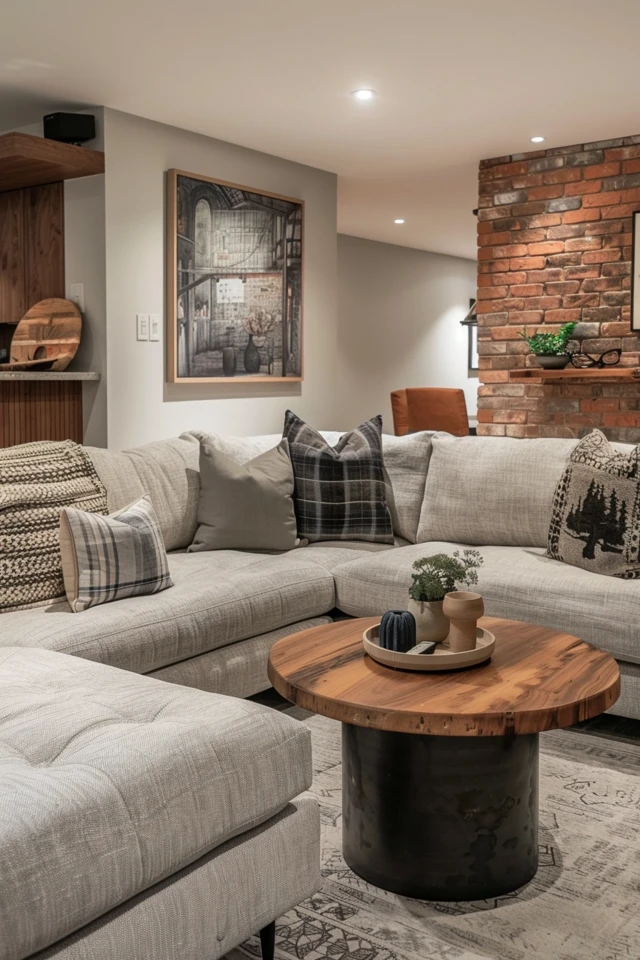
5 Tips for Cozy Basement Living Room Ideas
Basements often get a bad reputation in the design world. They are frequently viewed as dark, damp storage units rather than viable living spaces. However, I have found that a basement actually offers the most potential for creating a truly cozy, cocoon-like atmosphere because you can control the environment completely.
When I walk into a client’s unfinished basement, I don’t see concrete walls and exposed ductwork. I see a blank canvas that is perfect for a media room, a lounge, or a quiet retreat away from the main household traffic. The lack of natural light, which many see as a negative, is actually an asset when trying to build a moody, intimate setting.
If you are looking for visual inspiration, you can jump right to the Picture Gallery at the end of the blog post. Otherwise, keep reading to learn the specific formulas I use to transform subterranean spaces into the most popular room in the house.
1. Master the Art of Artificial Lighting Layers
Lighting is the single most critical element in basement design. Because you cannot rely on sunlight to do the heavy lifting, you must create your own “sun.” Most homeowners make the mistake of installing a grid of recessed can lights and calling it a day.
This approach creates what I call the “interrogation room” effect. It casts harsh shadows and makes the ceiling feel lower. To make a basement cozy, you need three distinct layers of light: ambient, task, and accent.
Start with your ambient light. Recessed lights are fine here, but they must be on a dimmer. A general rule of thumb for spacing recessed lights is to divide the ceiling height by two. If you have an 8-foot ceiling, space your lights roughly 4 feet apart. This ensures even coverage without creating hot spots.
Next, add task lighting. This includes floor lamps near reading chairs or table lamps on end tables. These lights bring the illumination down to eye level, which immediately warms up the room.
Finally, do not skip accent lighting. This is where the magic happens. Use LED strip lights behind a TV, sconces on the wall, or picture lights over artwork. This adds depth to the room and eliminates dark corners.
Designer’s Note: The Kelvin Scale
One of the biggest complaints I hear is that basement light feels “sickly” or “sterile.” This is almost always an issue with the bulb temperature.
For basements, I exclusively recommend 3000K LED bulbs.
Bulbs at 2700K (warm white) can sometimes look too yellow or dingy in a room with no natural light. Bulbs at 4000K or higher (daylight) will look blue and clinical, like a hospital. The 3000K sweet spot mimics clear, bright halogen light and makes finishes look true to color.
Common Mistakes + Fixes
Mistake: Relying on a single ceiling fixture in the center of the room.
Fix: If you cannot rewire the ceiling, use plug-in wall sconces or swag hooks to distribute light sources to the corners of the room.
2. Combat the “Cold Factor” with Heavy Textures
Basements are physically colder than the rest of the house due to the surrounding soil and concrete foundation. Even with good HVAC and insulation, the perception of cold remains. To counter this, your design choices must lean heavily into visual warmth.
I avoid sleek, cold materials like glass coffee tables, chrome finishes, or leather sofas in basements unless they are heavily layered with textiles. Instead, prioritize materials that absorb sound and feel soft to the touch.
Start from the ground up. If you have luxury vinyl plank (LVP) or tile flooring, you need a substantial area rug. Do not use a flat-weave or outdoor rug here. You want a high-pile wool or a dense synthetic blend.
Crucially, you must invest in a thick rug pad. I recommend a felt rug pad that is at least 1/4 inch to 1/2 inch thick. This acts as a thermal break between your feet and the cold subfloor. It also extends the life of the rug significantly.
For furniture, opt for performance velvets, chenille, or boucle fabrics. These fabrics reflect less light and absorb sound, reducing the echo that often plagues basements.
What I’d Do in a Real Project
- Sofa: A deep sectional in a warm charcoal or navy velvet.
- Coffee Table: A large upholstered ottoman with a wooden tray, rather than a hard table.
- Windows: Even if the windows are small high hoppers, I hang floor-to-ceiling drapery. I mount the rod just below the ceiling or bulkheads. This adds softness to the walls and tricks the eye into thinking the windows are larger.
- Throws: Every seat gets a designated blanket. I usually use chunky knit throws that add visual weight.
3. Cheat Your Ceiling Height
Low ceilings are the defining characteristic of most basements. Standard height is often 8 feet, but ductwork and beams can drop that to 7 feet or lower in certain spots.
If you try to furnish a low-ceilinged room with standard-scale furniture, the room will feel cramped. The secret is to lower the center of gravity in the room.
Choose furniture with a low profile. Look for sofas and chairs with a back height of 30 to 32 inches, rather than the standard 36 to 40 inches. When the furniture is lower, the distance between the top of the sofa and the ceiling is greater. This creates the optical illusion of higher ceilings.
Be careful with vertical storage. Tall bookcases can loom over you in a basement. I often prefer low, long console units that run the length of a wall. If you do want shelving, built-ins that go all the way to the ceiling are better than freestanding units that stop a foot short, which only highlights the lack of height.
Dealing with Bulkheads
Mechanicals often require drywall soffits (bulkheads) that run through the middle of the room. Many homeowners try to hide these by painting them white while painting the walls a color.
This is a mistake. It draws a sharp visual line right where the ceiling drops.
Instead, paint the walls, the ceiling, and the bulkheads the same color. This technique, often called “color drenching,” blurs the boundaries of the room. When the eye cannot easily distinguish where the wall ends and the ceiling begins, the ceiling feels infinite rather than oppressive.
Common Mistakes + Fixes
Mistake: Using ceiling fans with light kits in low-ceiling rooms.
Fix: Switch to “flush mount” or “hugger” fans that sit tight against the ceiling. Better yet, remove the fan and use floor fans if air circulation is needed, keeping the ceiling plane clean.
4. Zone the Layout Around Structural Posts
Structural support poles are a reality of basement life. They are rarely in a convenient location. I have seen many people try to ignore them, resulting in a sofa placed awkwardly close to a pole.
The best approach is to embrace the obstacles and use them to define your zones. In open-concept basements, you often need to create distinct areas for different activities, such as a TV zone, a game table area, or a play space.
Use the columns as the anchor points for these zones. For example, a bar counter can be built between two columns to create a designated eating area. Or, you can align the back of a sofa with a column so that the pole feels like part of the entryway to the seating area.
When arranging furniture, floating is key. Never push all your furniture against the walls in a basement. It emphasizes the “bowling alley” shape that many basements have.
Pull the sofa at least 12 inches off the wall if space permits. If you are creating a walkway behind the sofa, you need a minimum clearance of 30 to 36 inches for traffic flow.
Designer’s Note: The Rug Rule
Zoning is best defined by rugs. A common error is buying a rug that is too small, which makes the furniture look like it is drifting on a raft.
The Rule: At a minimum, the front feet of all seating furniture must sit on the rug. Ideally, all four legs should be on it.
In a basement, a larger rug also means more insulation. If you are debating between a 5×7 and an 8×10, always go with the 8×10. It grounds the zone and prevents the room from feeling disjointed.
5. Choose Colors That Work Without Sunlight
Color behaves differently in a basement than it does in an upstairs living room. Without natural light to reflect and bounce, colors can appear two to three shades darker.
Many people instinctively paint basements bright white to “brighten it up.” In my experience, this backfires. White walls in a basement often look gray and shadowy because there is no sunlight to illuminate them. It can feel unfinished, like a garage.
Instead, I recommend leaning into the moodiness. Mid-tone neutrals, warm greiges, or even dark, saturated colors work beautifully underground.
If you want a light color, look for off-whites with creamy yellow or warm red undertones. Avoid cool whites with blue undertones, which will feel icy.
If you are brave enough to go dark, navy, forest green, or charcoal can make the walls recede. This creates a cozy, theater-like experience. When you paint walls dark, the edges of the room disappear, which actually makes a small space feel expansive rather than claustrophobic.
Understanding LRV (Light Reflectance Value)
When you look at a paint deck, look for the LRV number. This tells you how much light a color reflects.
- High LRV (70+): Reflects a lot of light. Good if you have decent recessed lighting.
- Low LRV (under 40): Absorbs light. Great for media rooms where you want to control glare.
What I’d Do in a Real Project
For a cozy family lounge, I often choose a “greige” (gray-beige) with an LRV around 50-60. It provides enough color to contrast with white trim but keeps the room feeling airy.
I always test paint swatches on two different walls in the basement. I check them with the lights on and off. The artificial lighting will drastically change the hue, so never pick a color based on how it looked in the hardware store.
Final Checklist: Your Cozy Basement Action Plan
Before you start shopping or painting, run through this checklist to ensure you are covering the functional basics.
- Moisture Check: Have you tested the humidity? Run a dehumidifier for a week before bringing in soft furniture. Ideally, humidity should stay below 50%.
- Lighting Audit: Do you have at least three sources of light in the main seating area? (Overhead + Eye Level + Accent).
- Bulb Swap: Have you replaced all bulbs with 3000K LEDs?
- Rug Sizing: Did you measure the room to ensure your rug allows for at least the front legs of the sofa to rest on it?
- Clearance Check: Is there a 30-inch clear path to walk around furniture obstacles and poles?
- Tech Check: Is your Wi-Fi signal strong enough downstairs? You may need a mesh extender before installing a smart TV.
FAQs
What is the best flooring for a basement living room?
Luxury Vinyl Plank (LVP) is the industry standard for basements. It is waterproof, durable, and comes in realistic wood looks. Unlike engineered wood or laminate, it won’t swell if you have a minor leak. It is also thinner, saving you precious ceiling height.
How do I make my basement soundproof?
True soundproofing requires construction (like resilient channels in the drywall), but you can dampen sound with decor. Wall-to-wall carpet is the best option for sound. If using hard floors, use thick rugs, heavy velvet curtains, and upholstered furniture. You can also install acoustic art panels that look like canvas prints but absorb noise.
Can I use real plants in a basement?
It is difficult. Most houseplants need natural UV light. Even “low light” plants like snake plants struggle with zero windows. I recommend high-quality faux plants for windowless areas. If you have a small window, a pothos or ZZ plant might survive right on the sill, but monitor it closely.
How do I hide the electrical panel?
Do not block it permanently; code requires accessibility. I usually hang a lightweight piece of canvas art over it or install a cabinet door painted to match the wall. Just ensure whatever you use can be removed instantly in an emergency.
Conclusion
Transforming a basement from a cold storage area into a cozy living room is less about structural renovation and more about sensory manipulation. You are managing light, texture, and scale to create an environment that feels intentional.
By layering your lighting, investing in warm textiles, and working with the unique architecture of the space rather than against it, you can create a retreat that rivals any room upstairs. The goal is to make the space feel so comfortable that you forget you are underground.
Take these tips, measure your space, and start layering. Your basement has the potential to be the coziest spot in your home—it just needs the right design strategy to get there.
Picture Gallery


