
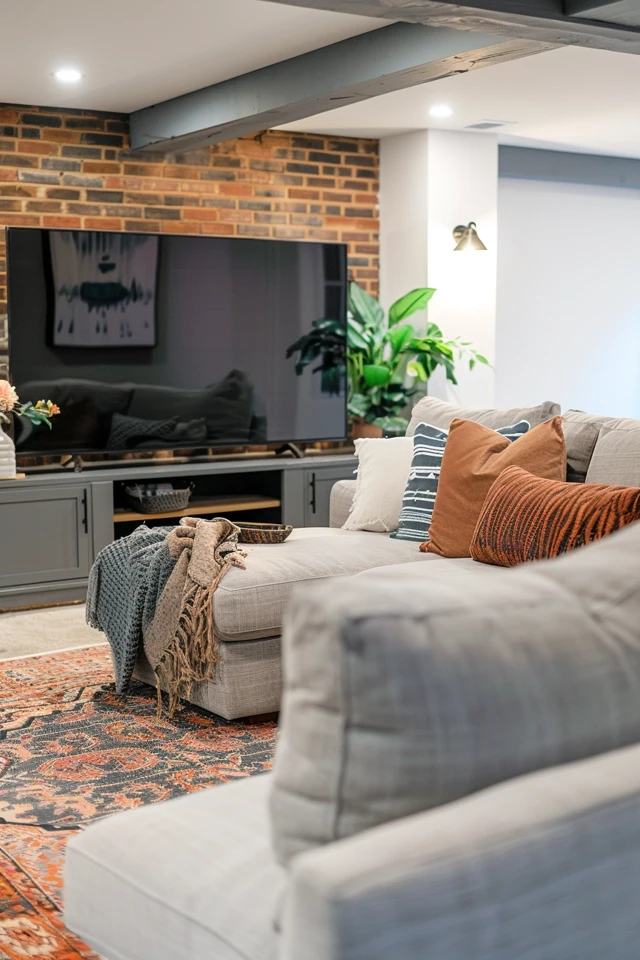
5 Tips for Cozy Basement TV Rooms
Basements often get a bad reputation as cold storage units, damp dungeons, or the place where old furniture goes to retire. However, as an interior designer, I view them as the most untapped potential in a home. Because they are separated from the main living areas, basements offer a unique opportunity to create a dedicated media escape that doesn’t need to adhere strictly to the design rules of your upstairs formal living room.
The challenge usually lies in overcoming the “cave” effect—low ceilings, little natural light, and concrete subfloors that radiate cold. Transforming this space requires a shift in strategy where we stop fighting the darkness and instead lean into it to create something moody, enveloped, and incredibly comfortable. If you are looking for visual inspiration, please scroll to the bottom because the full Picture Gallery is at the end of the blog post.
Whether you are dealing with a finished rental basement or planning a full renovation, the goal is always the same: warmth and immersion. By manipulating light, scale, and texture, we can turn a hollow echo chamber into the favorite room in the house. Here are five professional tips to help you design a cozy basement TV room that you will never want to leave.
1. Master the Lighting Strategy (The “No Can” Rule)
The biggest mistake homeowners make in basements is relying solely on recessed can lighting. While “pot lights” are efficient, using them exclusively creates a sterile, interrogation-room atmosphere. This is especially true in basements with ceilings lower than eight feet, where overhead lighting can cast harsh shadows on faces.
To make a basement cozy, you must layer your lighting. I generally aim for three distinct light sources in a media room layout. By diversifying where the light comes from, you add depth to the room and avoid that flat, commercial look.
The Three Layers You Need:
- Ambient: This is your base layer. Use dimmable recessed lights if necessary, but keep them on a separate switch. Ideally, use flush-mount fixtures with a diffuser to soften the glow.
- Task: This includes reading lamps or directional sconces. In a TV room, this is less about reading and more about creating a low-level glow that doesn’t glare off the screen.
- Accent: This is where the magic happens. LED strip lighting behind the TV or under floating shelves adds a modern, cinematic feel.
Designer’s Note: Watch Your Color Temperature
Nothing kills a vibe faster than “daylight” bulbs in a basement. Avoid bulbs labeled 5000K or higher; they emit a blue, clinical light that feels cold. Stick to 2700K (warm white) or 3000K (soft white). This warmer spectrum mimics incandescent light and instantly makes the space feel more inviting and less like a garage.
Common Mistakes + Fixes
- Mistake: Installing lights directly above the sofa.
- Fix: This creates “raccoon eyes” (shadows in eye sockets). Push recessed lights toward the perimeter of the room to wash the walls with light, which visually expands the space.
- Mistake: Forgetting dimmers.
- Fix: Every single light source in a media room needs a dimmer switch. It is the cheapest upgrade with the highest return on investment for ambiance.
2. Layout Logic: Floating the Furniture
Basements are often large, open rectangles, leading to the temptation to push all furniture against the walls to “maximize space.” In the design world, we call this the “dance floor effect.” You end up with a massive, useless empty space in the middle of the room and a viewing distance that is far too great for the TV size.
To create intimacy, you must float your furniture. Pull the sofa off the wall and bring it toward the center of the room. This defines the “media zone” and creates a walkway behind the sofa, which improves traffic flow so people don’t have to walk in front of the screen to get to the snack bar.
The Math of Viewing Distance:
For a truly immersive experience, the distance between your sofa and the TV matters. A good rule of thumb is to measure the diagonal screen size of your TV and multiply it by 1.5. This gives you the optimal viewing distance in inches.
- 55-inch TV: Sit roughly 7 feet away.
- 65-inch TV: Sit roughly 8 to 8.5 feet away.
- 85-inch TV: Sit roughly 10 to 11 feet away.
Dealing with Support Columns
Basements often come with structural lolly columns that can’t be moved. Instead of ignoring them, integrate them into the design. If a column falls near the seating area, wrap it in wood to make it look like a timber post, or build a bar-height counter between two columns to create a “drink rail” behind the sofa.
What I’d Do in a Real Project:
If the room is long and narrow, I would use an L-shaped sectional to divide the room in two. The long side of the sectional faces the TV, while the back of the sofa acts as a room divider. Behind the sofa, I would place a game table or a small workspace. This creates two distinct zones—Passive (TV watching) and Active (gaming/working)—without building a single wall.
3. Acoustics and Texture: The “Soft Box” Concept
The “cold” feeling in a basement isn’t just about temperature; it is also about sound. Drywall, concrete, and glass reflect sound waves, creating echoes that make a room feel hollow and unwelcoming. For a TV room, audio quality is paramount.
To fix this, you need to soften the hard surfaces. We call this “deadening” the room. By adding soft, porous materials, you absorb sound reflections and physically insulate the space against the chill of the foundation.
Rug Sizing and Placement:
Wall-to-wall carpet is the gold standard for cozy basements, but if you have luxury vinyl plank (LVP) or tile, you need a massive area rug. Do not skimp on size here.
- The Rule: The rug should be large enough that at least the front feet of all seating furniture rest on it. Ideally, all legs should be on the rug.
- The Pad: Never skip the rug pad on a basement floor. Buy a thick, felt padding (at least 1/4 inch thick). This provides thermal insulation against the cold slab and protects the rug backing from potential friction.
Window Treatments:
Even if your basement windows are small hoppers near the ceiling, treat them like real windows. Install floor-to-ceiling drapery panels. This tricks the eye into thinking the windows are larger than they are and adds a vertical wall of fabric that absorbs sound. If the window is truly tiny, use a roman shade, but mount it 4 inches above the window frame to maximize light when open.
Designer’s Note: Upholstery Choices
Basements can be humid. If you are worried about dampness, avoid natural fibers like linen or viscose for your sofa, as they can absorb moisture and develop odors. Instead, opt for performance velvets or high-quality polyester blends. They are durable, easy to clean, and resistant to mildew.
4. Embrace the Dark Paint Palette
There is a common misconception that you should paint small or dark rooms white to “brighten them up.” In a basement with little natural light, white walls often look dingy and gray because there is no sunlight to bounce off them.
Instead, lean into the moodiness. Dark colors blur the edges of the room, making it harder for the eye to perceive the corners, which paradoxically makes the space feel larger and infinite. Deep navies, charcoals, forest greens, or even warm terracottas work beautifully in media rooms.
The “Color Drenching” Technique:
For a modern, high-end look, paint the walls, trim, baseboards, and even the ceiling the same color. This is called color drenching. It simplifies the visual noise and is particularly effective in basements with unsightly bulkheads or ductwork. By painting the bulkheads the same color as the walls and ceiling, they disappear visually.
Selecting the Right Sheen:
Your choice of paint finish is critical in a basement to hide imperfections in the drywall.
- Ceiling: Always use Flat or Matte. This hides bumps and uneven spots.
- Walls: Use Matte or Eggshell. Avoid Satin or Semi-Gloss on walls, as the reflection will highlight every flaw and create glare from the TV.
- Trim/Doors: Use Satin. This provides just enough contrast in texture against the matte walls without being overly shiny.
Common Mistakes + Fixes
- Mistake: Painting the ceiling bright white when the walls are dark.
- Fix: This creates a “lid” effect that draws attention to how low the ceiling is. If you aren’t brave enough to paint the ceiling black, tint your ceiling white with 20% of your wall color to reduce the contrast.
5. Managing Tech and Clutter
A cozy room is a calm room, and nothing induces stress like a tangle of HDMI cables and power cords. In a basement media room, the technology is the focal point, but the machinery should be invisible.
The Console Strategy:
If you are mounting the TV on the wall, you still need a console underneath it to “ground” the TV visually. A floating TV looks like a postage stamp on a wall without furniture below it.
- Width: The console must be wider than the TV. Aim for it to be at least 6-8 inches wider on each side.
- Height: Low-profile consoles work best in basements to keep the vertical space open. Look for units that are 20-24 inches high.
- Storage: Choose a console with closed doors (caned or solid) rather than open shelving. You want to hide the router, gaming consoles, and messy wires. If you use infrared remotes, make sure the doors are mesh or glass, or install an IR repeater system.
Managing Wires for Renters:
If you cannot cut into the drywall to hide cables, use paintable cord covers. Run the cover vertically from the TV to the console and paint it the exact same color as the wall. It won’t be invisible, but it will be much less distracting than dangling black cords.
What I’d Do in a Real Project:
I always oversize the storage. Basements tend to accumulate “stuff”—board games, extra blankets, gaming accessories. I prefer to use a wall of modular cabinetry (like IKEA Besta) to create a built-in look for a fraction of the cost. I would run these cabinets wall-to-wall if possible, creating a long, linear line that elongates the room.
Final Checklist: The Designer’s “Cheat Sheet”
Before you purchase that sectional or open a can of paint, run through this quick checklist to ensure you are on the right track for a professional finish.
Layout & Furniture:
- Is the sofa pulled at least 3-4 inches away from the wall?
- Is the walkway path at least 30 inches wide?
- Is the coffee table 14-18 inches away from the sofa edge?
- Is the TV mounted at eye level (center of screen approx. 42-45 inches from floor)?
Lighting & Electrical:
- Do you have at least three sources of light (overhead, table/floor, accent)?
- Are the light bulbs 2700K or 3000K?
- Are all overhead lights on a dimmer switch?
Decor & Warmth:
- Does the rug extend under the front legs of the sofa?
- Is there a thick rug pad underneath?
- Have you included throw blankets with varying textures (knit, faux fur, fleece)?
- Are the curtains hung as high as possible (touching the ceiling or molding)?
FAQs
How do I make my basement ceiling feel higher?
Keep furniture low-profile. Sofas with low backs make the distance to the ceiling seem greater. Also, avoid heavy, dangling light fixtures. Stick to recessed lights or very shallow flush mounts. Painting the ceiling and walls the same color can also blur the boundary, reducing the feeling of a low lid.
What is the best flooring for a basement TV room?
Carpet is the warmest and best for sound absorption. However, if you are concerned about moisture or flooding, Luxury Vinyl Plank (LVP) is the industry standard. It is waterproof, durable, and comes in convincing wood looks. Just be sure to layer a large, thick area rug on top for comfort.
How can I soundproof the room without opening walls?
Soft materials are your best friend. Add heavy velvet curtains, a thick high-pile rug, and plenty of throw pillows. You can also purchase acoustic panels that look like canvas art prints. Hanging these on the wall opposite the speakers will absorb bouncing sound waves and improve audio clarity.
Is it okay to put a fireplace in a basement TV room?
Absolutely. An electric fireplace is a fantastic addition for both heat and ambiance. You can build it into a media wall below the TV or use a freestanding console with an integrated firebox. Just ensure you follow the manufacturer’s clearance requirements if mounting a TV above a heat source.
Conclusion
Designing a cozy basement TV room is less about spending a fortune on high-end renovation and more about understanding the unique physics of the space. By addressing the lighting temperature, softening the acoustics, and embracing a layout that encourages conversation and relaxation, you can transform the “dungeon” into a retreat.
Remember that the basement is the one place in your home where you can take design risks. Go darker with the paint, buy the deeper sofa, and prioritize comfort over formality. The result will be a space that feels intentional, protective, and perfectly suited for movie marathons.
Picture Gallery


