
5 Tips for Decorating an 8’ Basement
Introduction
Basements have a reputation for feeling like caves, and usually, the ceiling height is the primary culprit. While an eight-foot ceiling is standard for main floors in older homes, it can feel oppressive in a basement due to lack of natural light and the presence of heavy bulkheads or ductwork. I have walked into countless client basements that were actually quite spacious in square footage but felt cramped because the vertical space was mismanaged.
The goal isn’t to physically raise the roof, which is structurally impossible in most renovations, but to manipulate the eye. We want to create vertical movement and reduce the visual weight that hangs overhead. For a dose of inspiration before we dive into the technical details, you can find our curated Picture Gallery at the end of this blog post.
With the right lighting plan, furniture scale, and paint application, an eight-foot basement can feel just as airy and inviting as your living room upstairs. In this guide, I will walk you through the exact methods I use to trick the eye and maximize comfort in these lower-level spaces.
1. Master the Art of Recessed and Layered Lighting
Lighting is the single most critical element in a basement renovation. In a room with eight-foot ceilings, you do not have the luxury of hanging heavy chandeliers or pendants that visually lower the ceiling plane. You need a lighting strategy that sits flush against the ceiling or recedes into it.
The backbone of your plan should be recessed can lighting. I almost always specify 4-inch cans rather than the older, larger 6-inch styles. The smaller diameter looks more modern and less intrusive on a lower ceiling. As a general rule of thumb for spacing, take your ceiling height and divide it by two. For an 8-foot ceiling, you generally want your lights spaced about 4 feet apart for even coverage, though this can vary based on the beam spread of the bulb.
However, relying solely on overhead lights creates shadows on peoples’ faces, often referred to as the “raccoon eye” effect. You must layer your lighting. This means adding sconces, floor lamps, and table lamps at eye level. This draws attention away from the ceiling and creates a warm, habitable zone where people actually sit.
Designer’s Note: The 3000K Rule
A common tragedy in DIY basement finishes is the use of “Daylight” (5000K) bulbs. This blue-toned light makes a basement feel clinical, like a hospital or a garage. Stick to 3000K (warm white) for a welcoming, residential feel. If you have very warm paint tones, 2700K is also acceptable, but 3000K is the sweet spot for modern clarity without the blue cast.
Common Mistakes + Fixes
Mistake: Installing a ceiling fan with a light kit in the center of the room.
Fix: If you must have a fan, use a “hugger” style that mounts flush to the ceiling with no down rod. Better yet, rely on the HVAC system for air circulation and skip the fan entirely to keep the ceiling plane clean.
What I’d do in a real project:
- Install 4-inch LED wafer lights (ultra-thin) if ductwork prevents traditional cans.
- Put every single switch on a dimmer. This is non-negotiable for controlling ambiance.
- Add picture lights above artwork. This highlights the walls, not the floor or ceiling, drawing the eye outward.
2. Adopt the Low-Profile Furniture Philosophy
Scale is everything when dealing with limited vertical space. If you put a high-back sectional or a tall, imposing armoire in an eight-foot basement, the remaining gap between the furniture and the ceiling shrinks. This makes the room feel shorter than it actually is.
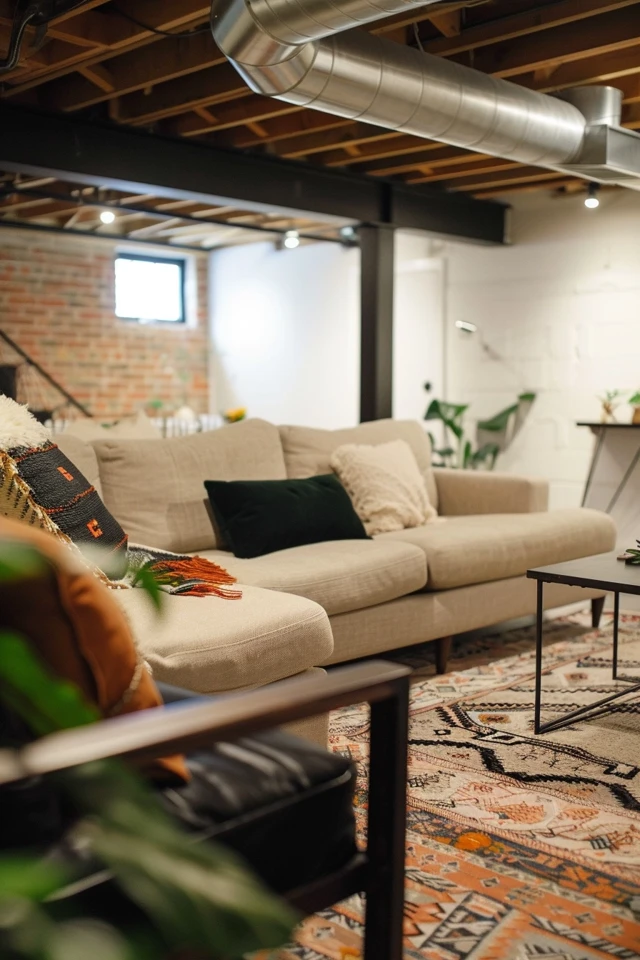
The secret is to choose furniture with a low profile. I look for sofas and sectionals where the back height is between 28 and 32 inches. By keeping the furniture low, you maximize the white space above it. This psychological trick creates an illusion of grander ceiling height because the ratio of “empty wall” to “furniture” is increased.
You also need to consider the visual weight of the pieces. A sofa with exposed legs feels lighter and airier than a skirted sofa that goes all the way to the floor. Being able to see the floor continue underneath the furniture helps the room feel less stuffed, which is vital in a basement environment.
Real-World Constraints: Getting It Down the Stairs
Before you fall in love with a 120-inch sofa, measure your stairwell. Basements usually have tight turns or low clearance on the stair landing. I often specify modular sectionals for basements because they come in smaller boxes and are assembled in the room. There is nothing worse than a delivery crew leaving a sofa on your front lawn because it physically won’t fit down the stairs.
Designer’s Note: Rug Sizing Logic
Don’t skimp on the rug. A small “postage stamp” rug makes a room feel disjointed and smaller. In a basement, you want to ground the space. Ensure at least the front two legs of all seating furniture are on the rug. Typically, an 8×10 or 9×12 rug is required for a main seating area. If you are using Luxury Vinyl Plank (LVP) flooring—which is best for basements due to moisture concerns—a thick wool or shag rug adds necessary acoustic dampening.
3. Strategize Your Ceiling Treatments and Soffits
In an ideal world, we would have a perfectly flat drywall ceiling. In reality, basements have HVAC trunks, plumbing pipes, and support beams that result in soffits (bulkheads) dropping below that eight-foot mark.
Do not try to highlight these. Some homeowners make the mistake of painting soffits a different color or adding trim to them. This creates a choppy visual line that screams, “Look at this low spot!” The best approach is camouflage. Paint the soffits, the ceiling, and any crown molding the exact same color. Flat white is the standard for reflecting light, but if you are doing a moody media room, painting the ceiling and walls the same dark color blurs the boundaries, making the ceiling height indeterminate.
If you have a drop ceiling (suspended tiles) that is dated, consider replacing the tiles with modern, architectural panels. However, if budget allows, drywalling the ceiling is the highest-return investment you can make for the finished look of the room.
Common Mistakes + Fixes
Mistake: Using heavy, wide crown molding in a room with bulkheads.
Fix: Skip the crown molding in an 8-foot basement, especially if there are soffits. It acts as a horizontal “lid” that stops the eye. A clean joint between wall and ceiling keeps the line moving upward.
What I’d do in a real project:
- If the ductwork is messy, I frame it out as cleanly as possible, keeping the soffit tight to the pipe. I don’t waste an inch.
- If the ceiling is exceptionally low (under 7 feet in spots), I sometimes recommend painting the exposed rafters and pipes a matte black or charcoal. This “industrial chic” look makes the mechanicals disappear into the void.
4. Verticality: Window Treatments and Wall Decor
Since we lack vertical height physically, we manufacture it visually using vertical lines. This is one of the oldest tricks in the designer handbook, and it works exceptionally well in basements with small, high windows (hopper windows).
Even if your basement window is small and sits high on the wall, do not just cover it with a tiny blind. Install floor-to-ceiling drapery. Mount the curtain rod as close to the ceiling (or crown molding) as possible, not right above the window frame. The fabric should hang all the way to the floor, just “kissing” the surface. This creates a long, unbroken vertical line that tricks the brain into reading the window as much larger and the wall as much taller.
Apply this same logic to wall decor. Avoid hanging art too high. In an eight-foot room, the center of your artwork should be at eye level, roughly 57 to 60 inches from the floor. However, vertical pairings work well here. Stacking two pieces of art vertically draws the eye up and down, emphasizing height rather than width.
Designer’s Note: The “Pattern Play” Rule
If you want to use wallpaper, choose a vertical stripe or a pattern with upward movement (like climbing vines). Avoid horizontal stripes, which will widen the room but make the ceiling feel lower. If using wainscoting or paneling, beadboard or vertical shiplap is superior to horizontal shiplap for this specific application.
Common Mistakes + Fixes
Mistake: “Floating” curtains that stop 6 inches above the floor.
Fix: Measure twice. If you buy standard 84-inch or 96-inch panels, you may need to hem them. They should touch the floor. A gap at the bottom cuts the visual line and looks unfinished.
5. Color Theory and Finish Selection
There are two distinct directions you can take with an eight-foot basement, and you need to commit to one. You cannot hover in the middle.
Option A: The Light Box.
If your goal is to make the basement feel like an extension of the upstairs, use light, airy colors. Off-whites, warm greys, and pale greiges are excellent. However, pay attention to Light Reflectance Value (LRV). In a low-light basement, a paint color will look two shades darker than it does on the chip. Choose a color with a high LRV (60+) to bounce around whatever artificial light you have installed.
Option B: The Moody Lounge.
If you are designing a theater room, a man cave, or a speakeasy, lean into the darkness. Painting the walls, trim, and ceiling a rich navy, charcoal, or forest green creates a cozy, enveloping effect. When the boundaries of the room disappear into shadow, you stop noticing the ceiling height entirely.
Regardless of color, I recommend using a satin or eggshell finish on the walls rather than flat. The slight sheen helps reflect light, whereas flat paint absorbs it. For the ceiling, stick to flat to hide imperfections in the drywall, unless you are color-drenching (painting walls and ceiling the same), in which case you might use the same matte finish everywhere.
What I’d do in a real project:
- Paint the baseboards the same color as the walls (but in a semi-gloss finish). This makes the wall look like one continuous surface from floor to ceiling, gaining you another 4 to 6 inches of visual height.
- Avoid accent walls in small basements. They tend to chop up the space. Continuous color flows better and feels less chaotic.
Final Checklist: The 8-Foot Basement Strategy
Before you start buying furniture or hiring contractors, run your plan through this checklist to ensure you are maximizing your vertical space.
- Lighting Check: Have you switched to 4-inch recessed cans? Are they 3000K? Do you have floor/table lamps in the plan?
- Sofa Profile: Is the sofa back height under 32 inches? Did you measure the stairwell clearance?
- Curtain Height: Are rods planned for the ceiling line, not the window line? Do panels hit the floor?
- Rug Size: Is the rug large enough to fit under the front legs of the furniture layout?
- Ceiling Paint: Is the ceiling paint flat (to hide bumps) and either bright white or color-drenched to match walls?
- Vertical Lines: Have you incorporated vertical art stacking or tall cabinetry rather than low, wide consoles?
FAQs
Is 8 feet considered a low ceiling for a basement?
In modern new construction, 9 or 10-foot basement pours are becoming common, but 8 feet is still the standard for most existing homes. While it is technically “standard,” the presence of ductwork often lowers parts of it to 7 feet or less, which is why it requires specific design attention to avoid feeling cramped.
Can I use dark paint in a basement with small windows?
Yes, absolutely. The old rule that “small rooms must be white” is a myth. However, you must pair dark walls with excellent artificial lighting. If you paint a room charcoal but only have two lamps, it will feel dungeon-like. If you paint it charcoal and wash the walls with recessed lighting and sconces, it feels sophisticated and cozy.
What is the best flooring for an 8-foot basement to help with height?
Stick to low-profile flooring. Luxury Vinyl Plank (LVP) is ideal because it is thin (usually 5-8mm) and doesn’t eat up vertical space. Adding a subfloor plus hardwood plus a thick rug can rob you of nearly 1.5 inches of headroom. Avoid high-pile wall-to-wall carpeting if height is a major concern; stick to low-pile or Berber if you must have carpet.
How do I handle a support pole in the middle of the room?
Do not try to hide it with fake ivy or carpet. Wrap it in wood (square or round) to make it look like an intentional column, or paint it the same color as your walls so it visually recedes. If it’s near the seating area, incorporate it into a drink ledge or bar table if the layout permits.
Conclusion
Decorating a basement with an eight-foot ceiling is all about optical illusions and managing scale. You have to fight the natural tendency of the space to feel compressed. By keeping your furniture profile low, your lighting bright and layered, and your window treatments high, you can transform a standard basement into the most popular room in the house.
Remember that a basement doesn’t have to be the repository for hand-me-down furniture and forgotten decor. Treat it with the same design rigor as your main floor. Invest in the lighting, choose the right paint finish, and measure everything twice. The result will be a space that feels cozy and grounded, rather than short and enclosed.
Picture Gallery


