
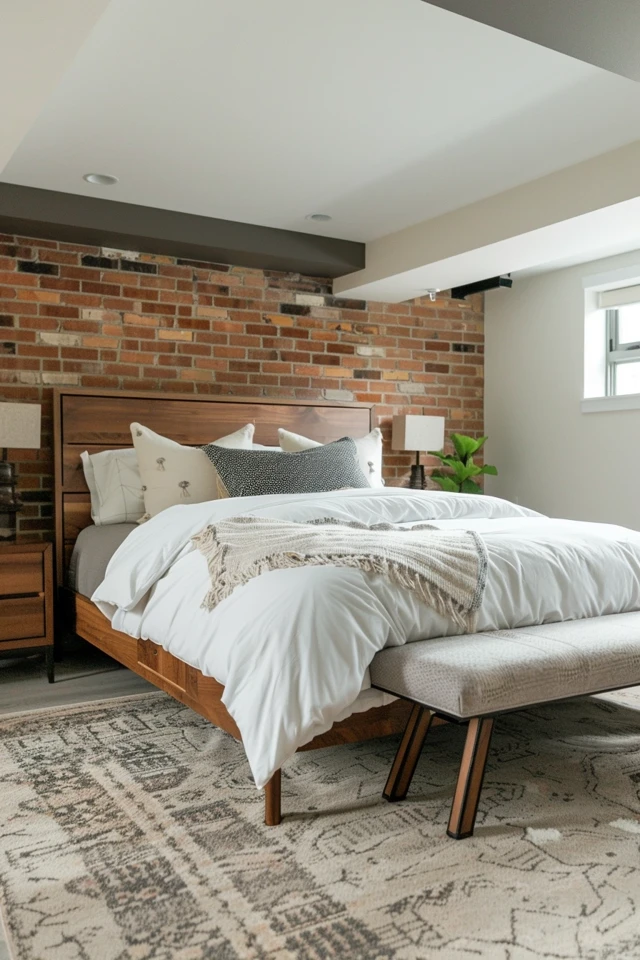
5 Tips for Designing Cozy Basement Bedroom Ideas
Basements often get a bad reputation as dark, damp storage spaces where holiday decorations go to hibernate. However, with the right approach to layout and lighting, they have the potential to be the quietest and most restful retreat in the entire house. I have put together a massive Picture Gallery at the end of this post to give you endless inspiration.
Transforming a subterranean space requires a very specific set of design rules that differ significantly from upstairs bedrooms. You are not just decorating a room; you are combating lack of natural light, low ceilings, and the inherent “chill” of concrete foundations. I have worked on countless basement renovations, and the difference between a dungeon and a sanctuary usually comes down to architectural layering and moisture management.
In this guide, I will walk you through the five most critical elements of designing a basement bedroom that actually feels cozy. We will cover technical lighting specs, flooring that survives humidity, and layout tricks to hide structural beams. Let’s turn that wasted square footage into your favorite room in the house.
1. Master the Lighting Temperature and Layering
Lighting is the single most important factor in a basement bedroom renovation. Because you likely have small, high-placed windows (or window wells), you cannot rely on the sun to do the heavy lifting. The goal is to mimic natural daylight without making the room feel like a clinical examination room.
The biggest mistake homeowners make is installing a grid of recessed “can” lights and calling it a day. This creates harsh shadows and makes the low ceiling feel even lower. Instead, you need a three-point lighting strategy: ambient, task, and accent lighting.
The 3000K Rule
For basements, I strictly specify LED bulbs with a color temperature of 3000K. Anything lower (2700K) can look too yellow or “dingy” in a space with no natural light. Anything higher (4000K+) will look blue and cold, killing the cozy vibe immediately.
Ambient Lighting: Recessed Cans
If you use recessed lighting, place them on a dimmer switch immediately. This is non-negotiable for a bedroom. Position the cans toward the perimeter of the room rather than directly over the bed. This washes the walls with light, which tricks the eye into thinking the room is wider and brighter than it is.
Secondary Sources: Sconces and Lamps
You need eye-level lighting to create warmth. I recommend wall sconces mounted about 60 to 66 inches from the floor. If hardwiring isn’t an option, use plug-in sconces with cord covers. These draw the eye up and add a design element that breaks up long expanses of drywall.
Designer’s Note: The Lumen Calculation
In a standard upstairs bedroom, you aim for about 20 lumens per square foot. In a basement, I bump this up to 30 or 40 lumens per square foot.
For a 150-square-foot bedroom, you need roughly 4,500 – 6,000 lumens total. Don’t worry about it being too bright; that is what your dimmer switches are for. It is better to have the capacity for brightness and dial it down than to be stuck in the dark.
Common Mistakes + Fixes
Mistake: Using one central flush-mount fixture (the “boob light”).
Fix: Swap it for a semi-flush mount that drops down slightly (about 4-6 inches). This allows light to bounce off the ceiling, reducing dark corners.
2. Choose Flooring That Handles Moisture and Adds Warmth
Basement subfloors are concrete, which means they are cold and prone to moisture vapor. A cozy bedroom needs to separate your feet from that cold slab. While wall-to-wall carpet seems like the “warm” choice, I actually advise against it in most basement projects.
If you have a minor pipe leak or a sump pump failure, wall-to-wall carpet is a total loss. It traps moisture in the pad, leading to mold growth that you might not smell until it is too late.
The Winner: Luxury Vinyl Plank (LVP)
I almost exclusively use LVP for basements. It is 100% waterproof, durable, and comes in convincing wood textures. Look for a product with a thick wear layer (20 mil or higher) and, crucially, an attached cork or foam underlayment. This backing provides thermal insulation and sound absorption.
Layering with Rugs
To get the coziness of carpet without the risk, use large area rugs. A large wool or high-performance polyester rug creates a soft landing zone for your feet.
Rug Sizing Rules
- King Bed: Use a 9×12 rug. This ensures you have soft texture extending 24-30 inches on either side of the bed.
- Queen Bed: An 8×10 rug is usually perfect.
- Placement: Stop the rug about 12-18 inches from the nightstands. You do not need the rug fully under the nightstands, but it should go under the lower two-thirds of the bed.
What I’d Do in a Real Project
If the budget allows, I always install a radiant heating mat system under the LVP or tile. It is an investment, but nothing makes a basement feel more premium than a warm floor. If that isn’t in the budget, I install a vapor barrier underlayment specifically designed to provide a thermal break between the concrete and the floor.
3. Cheat the Ceiling Height
Basements usually come with lower ceilings, often dropping to 7 feet or heavily impacted by ductwork soffits. If you treat this like a standard room, it will feel claustrophobic. You have to use optical illusions to lift the visual weight of the space.
Furniture Scale is Critical
You must choose “low profile” furniture. A standard bed frame with a high headboard will dominate the vertical space and make the ceiling feel like it is crushing you.
Look for platform beds where the mattress sits 10 to 12 inches off the ground. Keep headboards under 42 inches tall. By keeping the furniture low, you increase the negative space between the top of the furniture and the ceiling, making the room feel taller.
Verticality in Decor
Use vertical lines to draw the eye upward. This could be beadboard paneling, vertical shiplap, or even a vertically striped wallpaper.
Window Treatments
Even if your basement window is a small square high up on the wall, do not just cover it with a tiny blind. Install a curtain rod as close to the ceiling (or soffit) as possible.
Hang floor-length drapery panels that extend all the way to the floor. Keep the curtains open to let light in, but the fabric creates a vertical column that fools the brain into perceiving a standard window size.
Designer’s Note: The Paint Strategy
There are two schools of thought here, and both work for different vibes.
Option A (Light and Airy): Paint the walls and the ceiling the same shade of warm white (like Benjamin Moore Swiss Coffee). This blurs the line where the wall meets the ceiling, making the boundaries disappear.
Option B (The Cozy Cave): Lean into the darkness. Paint the walls and ceiling a moody charcoal or navy. This works exceptionally well for media rooms or guest suites where sleeping is the priority. It makes the low ceiling recede because you can’t clearly define the corners.
4. Navigate Structural Obstacles and Egress
In a basement, you are often fighting around support columns, water heaters, and low-hanging HVAC ducts. You cannot just ignore them. You have to integrate them.
Safety First: The Egress Window
Before you buy a single throw pillow, you must verify your egress window meets local code. In most US municipalities, a bedroom must have a window with a net clear opening of at least 5.7 square feet for fire escape.
Design-wise, keep the path to this window clear. Do not place a heavy dresser or the bed in front of it. I like to place a low bench or a reading nook under the egress window to maximize the natural light without blocking the exit path.
Handling Support Columns
If a steel lally column lands in the middle of your bedroom layout, boxing it in with drywall is the standard fix, but it can look bulky.
Instead, try these integration tricks:
- Bookshelf Anchor: Build a custom bookshelf that connects the column to the wall. The column becomes the corner post of the shelving unit.
- Bed Flanking: If you are lucky and have two columns, center the bed between them. Wrap them in wood to look like timber posts.
- The “Bar” Ledge: Wrap the column and install a floating circular table around it at bar height. This is great for a teen bedroom or a studio apartment setup.
Common Mistakes + Fixes
Mistake: Leaving soffits (boxed-in ducts) white while painting walls a color.
Fix: Paint the soffits the same color as the walls, not the ceiling. If you paint them ceiling-white, they visually drop down and encroach on the room. Painting them the wall color pushes them back.
5. Use Texture to Soften the Acoustics
Basements are echo chambers. You have concrete floors, concrete walls (behind the drywall), and usually a large open plan nearby. A bedroom that sounds hollow feels cold and unwelcoming.
You need to add “soft goods” aggressively. This is not just for aesthetics; it is for acoustic dampening.
Wall Treatments
Drywall is flat and hard. Consider adding an upholstered headboard that spans the entire width of the wall. Alternatively, use acoustic wall panels (there are very stylish felt options now) or hang a large tapestry.
Bedding Layers
Since basements run cool, bedding should look and feel heavy. Start with flannel or jersey sheets. Add a down or down-alternative duvet with a high fill power for fluffiness.
Top this with a heavy knit throw blanket. The visual weight of chunky knits contrasts beautifully with the sleek, hard surfaces often found in basements.
Material Mix
Avoid glass and chrome furniture, which feels cold. Lean toward natural wood tones, leather, and woven materials like rattan or seagrass. Wood elements are essential for bringing an organic touch to a subterranean space.
Designer’s Note: The Humidity Factor
When selecting textiles, remember that basements can be humid in the summer. Avoid natural fibers that are prone to rot if the humidity isn’t controlled (like untreated jute). Synthetic blends or treated wools often hold up better if you don’t have a top-tier dehumidifier running.
Final Checklist: The “Cozy Basement” Audit
Before you finalize your design, run through this checklist to ensure you have hit all the functional and stylistic requirements.
Lighting Audit
- Are all bulbs 3000K temperature?
- Do I have at least three sources of light (ceiling, bedside, floor/accent)?
- Is the overhead light on a dimmer switch?
Layout & Flow
- Is the egress window accessible and unblocked?
- Is there a 30-36 inch walkway clearance around the bed?
- Does the rug extend at least 18 inches past the bed sides?
Comfort & Climate
- Is the flooring insulated (cork back LVP or area rugs)?
- Is there a dehumidifier running or integrated into the HVAC?
- Have I added sound-absorbing materials (curtains, upholstered headboard)?
FAQs
What is the best color for a basement bedroom with no windows?
If you have zero natural light, warm neutrals are your best friend. Look for colors with yellow or red undertones, like creamy whites, beige, or warm greys (greige). Avoid cool greys or crisp whites, which will turn gray and shadowy without sunlight.
How do I stop my basement bedroom from smelling musty?
The “basement smell” is mold and mildew caused by humidity. Run a dehumidifier to keep relative humidity below 50%. Ensure you have proper air circulation; if the room doesn’t have a return air vent, undercut the door by an inch or install a transfer grille above the door to let air cycle back to the HVAC unit.
Can I use wallpaper in a basement bedroom?
Yes, but be careful with the material. Avoid grasscloth or natural fibers, as they can absorb moisture and smell over time. Stick to “paste-the-wall” non-woven wallpapers or high-quality vinyl wallpapers which are resistant to humidity and easy to wipe down.
Is it worth soundproofing the ceiling?
Absolutely. If the bedroom is under a kitchen or living area, impact noise (footsteps) will be loud. Installing Rockwool Safe’n’Sound insulation between the floor joists before you drywall the ceiling is the most effective budget-friendly method. For better results, use resilient channel clips to decouple the drywall from the joists.
Conclusion
Designing a cozy basement bedroom is about balancing the practical realities of the space with the comfort you crave. It requires looking past the concrete and pipes to see the potential for a quiet, enveloped sanctuary.
By prioritizing warm lighting, managing moisture with the right flooring, and using visual tricks to heighten the ceiling, you can create a room that feels intentional rather than secondary. Remember to layer your textures and keep your furniture profiles low.
Take these tips, grab your measuring tape, and start reclaiming that square footage. The result will be a space so comfortable you might forget you are underground.
Picture Gallery


