
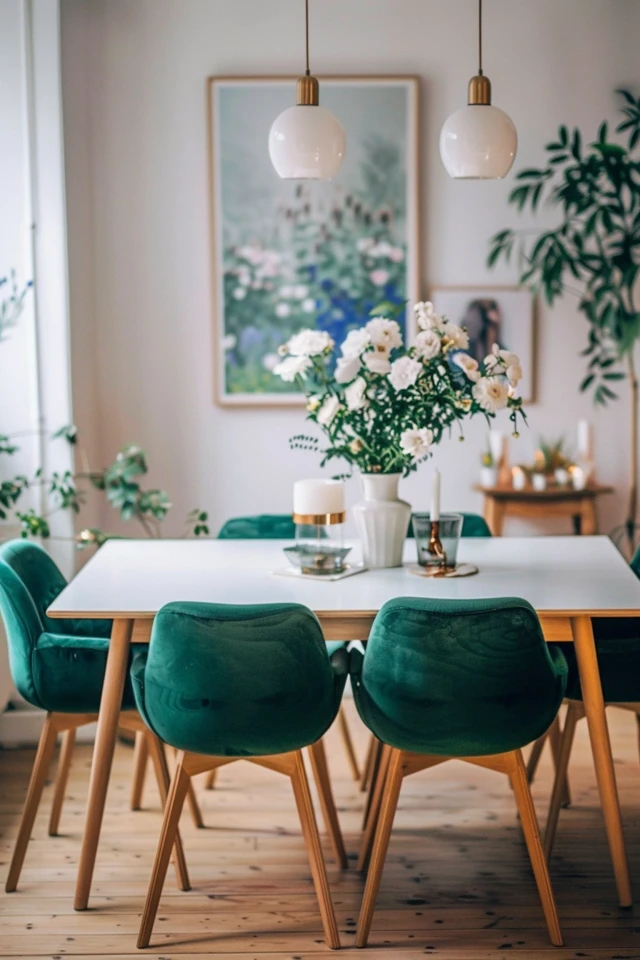
5 Tips for Dining Room Wall Decor Success
Dining rooms are notoriously difficult to finish. You get the table, the chairs, and the rug, but the walls often remain bare for months because the scale feels intimidating. For a huge dose of inspiration before you start, make sure to check out the Picture Gallery at the end of this blog post.
I recently worked with a client who had a beautiful, high-end mahogany table but felt the room was “cold.” The issue wasn’t the furniture; it was the tiny 8×10 frames floating in a sea of drywall. They lacked the weight to anchor the room.
Wall decor in a dining space isn’t just about filling a void. It is about creating an atmosphere for conversation and digestion. Whether you are hosting a Thanksgiving feast or having Tuesday night takeout, the walls set the perimeter of that experience.
1. Master the Scale and Proportions
The most common mistake I see in DIY interior design is undersized art. In a dining room, your wall decor must relate to the furniture below it, not just the wall itself. If the art is too small, your furniture will look bulky and awkward.
If you are hanging art above a buffet, console, or sideboard, the artwork should generally be two-thirds to three-quarters the width of that furniture piece. This creates a balanced visual pyramid.
For example, if you have a standard 72-inch buffet, your artwork (or collection of art) should span approximately 48 to 54 inches wide. Anything less than 40 inches will look like a postage stamp.
The “Eye Level” Rule Adjustment
You have likely heard the rule to hang art at “eye level,” which is typically 57 to 60 inches from the floor to the center of the piece. However, dining rooms require a slight modification.
In this room, you and your guests spend most of the time sitting down. If you hang art at the standard standing height, it might feel disconnected from the seated experience. I often drop the center point to 54 inches or ensure the bottom of the frame is just 6 to 10 inches above the top of the buffet or chair rail.
Designer’s Note: The Buffet Gap
One specific lesson I learned the hard way involved tall table lamps on a buffet. If you plan to use buffet lamps, you must account for their height before hammering in a nail.
Ideally, the art should hang between the lamps, and the lamps should not obscure the main subject of the painting. If you have tall lamps, you may need a vertical (portrait) piece of art rather than a horizontal (landscape) one to maintain spacing.
Common Mistakes + Fixes
- Mistake: Hanging art so high it touches the crown molding.
- Fix: Anchor the art to the furniture, not the ceiling. Keep it closer to the buffet than the ceiling.
- Mistake: Using one small canvas on a large wall.
- Fix: Reframing the piece with a massive mat and chunky frame to triple its size, or moving it to a smaller wall.
2. The Art of the Gallery Wall
If you do not have one large statement piece, a gallery wall is a fantastic solution. However, dining rooms generally call for a tighter, more formal arrangement than a living room or hallway.
I prefer “grid” layouts in dining spaces. This means matching frames, matching mats, and precise alignment. A chaotic, organic gallery wall can sometimes make a dining room feel cluttered, which isn’t conducive to a relaxing meal.
Spacing and Measurements
Precision is key here. Keep the spacing between frames tight and consistent. I recommend 2 to 3 inches between frames. Anything wider than 3 inches breaks the cohesion, and the eye reads them as separate items rather than one large installation.
For a standard 8-foot ceiling, a grid of 4 (2 over 2) or 6 (3 over 2) works beautifully. Use frames that are at least 16×20 inches. Anything smaller usually lacks impact unless grouped in a very large set (like a grid of 9).
What I’d Do in a Real Project
Here is my step-by-step process for installing a gallery wall without ruining the drywall:
- Trace the frames: I trace every single frame onto Kraft paper or old wrapping paper.
- Mark the hook: I measure the distance from the top of the frame to the hanging hardware on the back and mark that exact spot on the paper cutout.
- Tape it up: I use painter’s tape to arrange the paper templates on the wall. This allows me to step back and adjust the height and spacing without drilling a single hole.
- Level check: I place a level on top of the paper templates to ensure the rows are straight.
- Hammer time: I drive the nail right through the “X” on the paper, then rip the paper away. It works every time.
3. Texture and Dimension Beyond Canvas
Paint and framed prints are not your only options. Dining rooms are often boxy, rectangular spaces filled with hard surfaces (wood table, wood floor, glass windows). The walls are your best opportunity to introduce softness or architectural depth.
Mirrors
A large mirror is a classic dining room staple for a reason. It bounces light, effectively doubling the glow of your chandelier. However, placement is critical.
Before hanging a mirror, sit in your dining chair and look at the wall where it will go. What will it reflect? If it reflects a beautiful view or a piece of art on the opposite wall, great. If it reflects the kitchen trash can or a cluttered pantry, skip the mirror.
Architectural Molding
If you have a large blank wall and a limited budget for art, consider installing molding. Picture frame molding (box molding) adds instant elegance and reduces the need for large artwork.
You can paint the molding the same color as the wall for a subtle shadow line, or paint the wall a contrasting color. In a recent project, we installed simple chair rail and picture frame molding below it, painted the whole room a moody navy, and it completely eliminated the need for lower wall decor.
Wallpaper and Murals
Grasscloth wallpaper is one of my favorite materials for dining rooms. It adds a physical texture that absorbs sound—a huge benefit in a room with clinking silverware and porcelain plates. Even if you only wallpaper the top half of the wall above a chair rail, it warms up the acoustics significantly.
Designer’s Note: Practicality for Parents
If you have young children, be wary of wallpaper or intricate molding on the lower half of the wall (below 30 inches). Spaghetti sauce and sticky fingers are inevitable.
For families, I recommend installing wainscoting or beadboard on the lower third of the wall. Use a semi-gloss paint finish on that woodwork. It wipes down easily and protects the drywall from chair backs scraping against it.
4. Lighting as Wall Decor
We often think of lighting as purely functional, but sconces are effectively “jewelry” for your walls. In a dining room, overhead lighting can cast unflattering shadows on faces. Wall sconces introduce eye-level ambient light that makes everyone look better.
Hardwired vs. Plug-in
If you are renovating, hardwire sconces on a dimmer switch. Place them roughly 60 to 66 inches from the floor to the center of the junction box. This keeps the bulb out of your direct line of sight while eating.
If you are renting or don’t want to hire an electrician, plug-in sconces are a stylish alternative. You can hide the cord with a cord cover painted to match the wall color. There are also battery-operated “puck light” hacks, but be aware that the lumen output is usually very low and decorative only.
Picture Lights
One of the fastest ways to make an inexpensive art print look like a million bucks is to mount a picture light above it. It creates a focal point and adds drama.
For a frame that is 24 to 30 inches wide, use a picture light that is roughly half the width of the art (12 to 15 inches). If the art is very large, the light can be up to 2/3 the width. Ensure you use warm white bulbs (2700K to 3000K) to keep the art looking natural.
Common Mistakes + Fixes
- Mistake: Relying solely on the chandelier.
- Fix: Add at least two sconces or a pair of lamps on a buffet to create “layers” of light.
- Mistake: Cold, blue-light bulbs.
- Fix: Check your Kelvins. Dining rooms should never go above 3000K. 2700K is the sweet spot for a warm, appetizing glow.
5. The Focal Point Strategy
You do not need to decorate every single wall in the dining room. In fact, if you do, the room will feel closed in. I follow a hierarchy of dominance when planning wall decor.
Identify the Hero Wall
Usually, the “hero” wall is the one you see immediately upon entering the room, or the long wall that the table runs parallel to. This is where your largest investment should go—be it a large canvas, a gallery grid, or a statement mirror.
The Supporting Walls
The other walls should support the hero, not compete with it. If you have a massive, colorful painting on the hero wall, keep the adjacent walls quieter. Maybe use two simple sconces, or perhaps leave one wall entirely blank to let the eye rest.
Negative Space is Okay
In design school, we learn that “negative space” (empty space) is an active element of design. It emphasizes the objects that are there. Don’t feel pressured to fill a narrow wall between two windows just because it’s empty.
If the space is less than 24 inches wide, it is often better to leave it bare or simply let the window treatments (curtains) add the texture and color needed for that vertical space.
Real World Constraint: Drapery
Don’t forget about your curtains. If you have window treatments that stack back against the wall, they take up visual real estate. I usually account for 10 to 15 inches of “stack back” on either side of a window.
Do not hang art so close to the window that the curtain panel covers it when open. Give the curtains breathing room. A good rule of thumb is to leave at least 4 to 6 inches of clear wall between the edge of the curtain stack and the beginning of a frame.
Final Checklist
Before you start hammering nails, run through this quick checklist to ensure your plan is solid.
- Check the Math: Is the art 2/3 to 3/4 the width of the buffet or table?
- Sit Down Test: Have you checked the viewing height from a seated position?
- Reflection Check: If using a mirror, does it reflect something nice?
- Lighting clearance: Do you have room for sconces or lamps without overlapping the art?
- Safety: If you live in an earthquake zone or have kids, is the heavy art secured with proper anchors or museum wax?
- Color Balance: Does the art pull a color from your rug or chair upholstery to tie the room together?
FAQs
How high should I hang plates on a wall?
Plate walls are a charming, traditional option. Treat the collection of plates as a single unit. The center of the entire arrangement should be at eye level (approx. 57 inches). Use spring-loaded plate hangers with tip protectors to prevent scratching the china.
Can I mix metal finishes on frames and light fixtures?
Absolutely. In fact, I encourage it. If your chandelier is brass, you can use matte black picture frames. If your sconces are oil-rubbed bronze, gold frames can look stunning. Just try to limit the room to two or three distinct metal finishes to avoid a chaotic look.
What if my dining room is open concept?
In an open-concept space, the dining wall decor needs to flow with the living room but doesn’t need to match it. Use a similar color palette but perhaps a different medium. If the living room has a gallery wall, use one large piece in the dining area to differentiate the “zones.”
Is it okay to hang family photos in the dining room?
Technically, yes, it is your home. However, from a design perspective, large personal portraits can sometimes feel a bit intense for guests trying to eat. I usually steer clients toward landscapes, abstracts, or botanical prints for the dining room, saving family photos for hallways, stairwells, or family rooms.
Conclusion
Dining room walls are the backdrop to some of your most important memories. Whether you choose a moody gallery wall, a singular statement piece, or architectural molding, the goal is to create warmth.
Remember that rules like “57 inches on center” are guidelines, not laws. The architecture of your specific room, the height of your ceilings, and the scale of your furniture should always dictate the final placement. Don’t be afraid to cut out those paper templates and live with them for a few days before committing. It is the single best way to guarantee you get it right the first time.
Picture Gallery


