
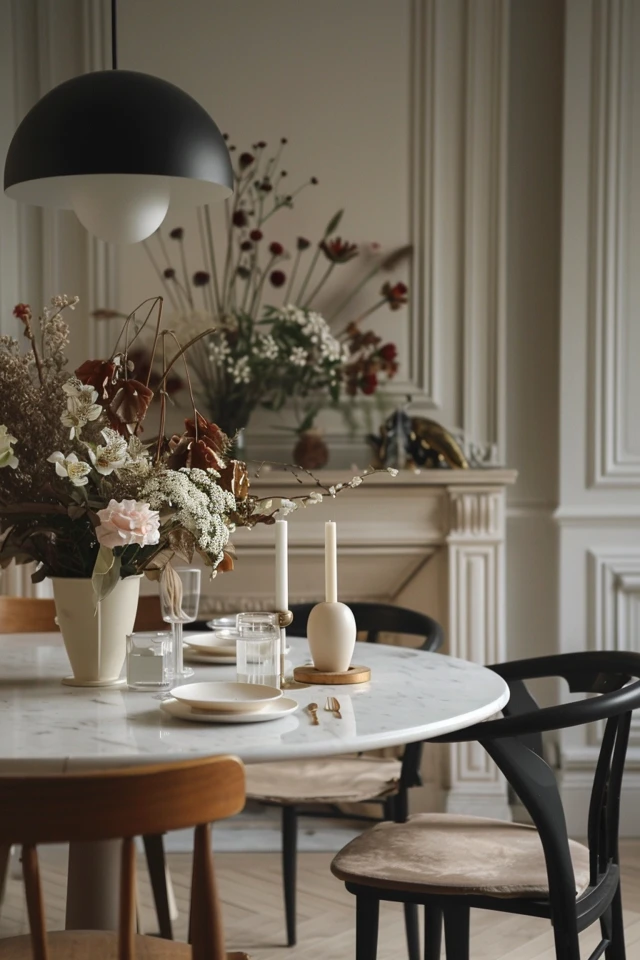
5 Tips for French Dining Room Style
There is a specific moment that happens when you walk into a dining room in Paris or Provence. It feels elegant, but never stiff; curated, yet effortlessly thrown together.
Many of my clients come to me wanting this “je ne sais quoi,” but they often mistake French style for simply buying antique furniture. True French design is about the balance between the old and the new, and the formal and the functional.
If you are looking for visual inspiration to guide your renovation, be sure to check out the Picture Gallery at the end of this blog post. In this guide, I am going to break down the architectural details, furniture layouts, and styling secrets I use to recreate that timeless French aesthetic in American homes.
1. Master the Architecture and “The Shell”
French interiors always start with a strong architectural foundation. Before you buy a single chair, look at your walls and floors. The goal is to create a sense of history, even in a new build.
In Parisian apartments, this usually means parquet floors and intricate wall molding. In the countryside (Provencal style), it leans toward stone floors, plaster walls, and exposed beams.
Wall Treatments and Molding
If you have flat drywall, you are missing the most critical element of the style. I almost always recommend adding applied molding or “picture frame” molding to the dining room walls. This adds instant depth and grandeur.
For a standard 8-foot ceiling, I typically space the boxes about 3 to 4 inches apart. If you have higher ceilings, you can extend the scale. Paint the molding the same color as the walls for a modern, cohesive look, or choose a creamy white against a soft grey wall for high contrast.
Flooring Choices
If you are renovating the floors, a herringbone or chevron wood pattern is the gold standard for a city look. White oak with a matte, natural seal works beautifully.
For a rustic farmhouse vibe, look for tumbled limestone or travertine tiles. If changing the floor isn’t in the budget, a very large vintage-style rug can cover up standard carpet or generic laminate.
Designer’s Note: The “Perfectly Imperfect” Finish
One lesson I learned early in my career is that American construction often looks “too perfect” for this style. French walls often have a plaster texture or a lime wash.
To mimic this without replastering, use a matte or flat paint finish rather than eggshell or semi-gloss. It absorbs light and makes the walls feel velvety and aged.
Common Mistakes + Fixes
- Mistake: Using bright, brilliant white paint on the molding.
- Fix: Switch to a warm white. Colors like “Swiss Coffee” or “White Dove” have enough yellow/grey undertone to look established rather than sterile.
2. Mix Your Furniture Eras and Finishes
The fastest way to kill the French vibe is to buy a matching dining set. You will never see a catalog-perfect matching table and chair set in a stylish French home.
The magic lies in the tension between periods. I love pairing a heavy, rustic wood table with refined, delicate chairs. Alternatively, a sleek marble table looks incredible surrounded by distressed wooden chairs.
The Table: The Anchor
I usually source the table first. For a French Country look, I hunt for a solid walnut or oak table with a wax finish. Avoid high-gloss lacquers.
Ideally, the wood should look like it has sustained decades of family dinners. If you have kids, this is a massive advantage because new scratches just add to the character.
The Chairs: The Contrast
If your table is heavy and square, choose chairs with curves. Louis XVI chairs with oval backs are classic. If you are worried about them feeling too stuffy, get them upholstered in plain linen rather than a pattern.
Bentwood bistro chairs are a fantastic, budget-friendly option for a more casual dining room. They are lightweight, timeless, and very durable.
Real-World Measurements
When mixing mismatched furniture, scale is the biggest risk. Here are the numbers I stick to:
- Seat Height: Ensure all chairs have a seat height between 18 and 19 inches. Vintage chairs can sometimes be lower (16-17 inches), which feels awkward at a modern table.
- Table Clearance: You need 36 inches of clearance between the table edge and the wall (or sideboard) to pull a chair out comfortably. In French dining rooms, intimacy is key, so don’t be afraid if it feels slightly tighter than a sprawling American open plan.
What I’d Do in a Real Project
If I were designing a dining room for a family with a dog and a toddler, I would skip the velvet upholstery. I would choose a reclaimed wood trestle table (indestructible) and pair it with French bistro chairs made of metal or resin-wicker. They wipe down easily but still nail the silhouette.
3. Lighting is the “Jewel” of the Room
In French design, lighting is treated as jewelry. It is often the most ornate element in the room, contrasting with simpler walls and furniture.
You essentially have two paths here: the Crystal Chandelier or the Patinated Lantern. Both work, but they tell different stories.
The Crystal Chandelier
This creates the “Parisian Chic” look. It doesn’t have to be a genuine antique antique. There are many beautiful reproductions available.
The key is to avoid anything that looks too shiny or chrome. Look for “antique brass” or “burnished gold” finishes on the metal parts. The crystal breaks up the light and adds glamour to dinner parties.
The Iron Lantern
For a more grounded, masculine, or country aesthetic, an oversized iron lantern is perfect. It balances out feminine curves in the furniture. I often use these in spaces with lower ceilings where a tiered chandelier might feel too overwhelming.
Lighting Rules of Thumb
- Size Matters: A common error is buying a fixture that is too small. The diameter of your chandelier should be roughly one-half to two-thirds the width of your dining table.
- Hanging Height: The bottom of the chandelier should sit 30 to 34 inches above the tabletop. If your ceilings are higher than 8 feet, add 3 inches of hanging height for every extra foot of ceiling.
- Dimmers are Mandatory: I never deliver a project without installing a dimmer switch in the dining room. French dining is about atmosphere. You want a low, warm glow (2700K bulbs), not a cafeteria brightness.
Designer’s Note: Sconces
Don’t rely solely on the overhead fixture. If you have the wiring capabilities, add wall sconces. They provide eye-level ambient light that is incredibly flattering for guests.
4. Layering Textiles for a “Lived-In” Look
French interiors never feel “new.” Textiles are the secret weapon to achieving that softness. This involves curtains, rugs, and upholstery.
The French approach to fabric is natural and relaxed. We are staying away from stiff synthetics or shiny polyesters. We want linen, cotton, velvet, and wool.
Window Treatments
Drapery adds height and softness to the room. I almost exclusively use linen curtains in these spaces. They have a beautiful drape and filter light softly.
The Rod Height: Hang your curtain rod as close to the ceiling molding as possible, not right above the window frame. This makes your ceilings look taller and the room more grand.
The “Puddle”: In very traditional French rooms, curtains “puddle” on the floor (have 2-4 inches of extra fabric). However, for clients with pets or robot vacuums, I recommend a “kiss” length, where the fabric just barely touches the floor.
Rug Selection
A rug frames the dining area. A vintage Oushak or Persian rug with faded colors looks stunning and hides crumbs effectively.
For a more casual look, a natural fiber rug like sisal or seagrass is very French. It adds texture and warms up the acoustics of the room.
Rug Sizing Checklist
- The 24-Inch Rule: Your rug must extend at least 24 inches past the edge of the table on all sides. This ensures that when a guest pulls their chair out, the back legs stay on the rug.
- Flat Weave is Best: Deep pile or shag rugs are a nightmare under a dining table. Stick to low-pile wool or flat weaves for ease of cleaning chairs sliding.
Common Mistakes + Fixes
- Mistake: Buying a rug that is too small (the “postage stamp” effect).
- Fix: If you love a vintage rug but it’s too small, layer it. Buy a large, inexpensive jute rug that fits the room, and place the smaller vintage rug on top of it.
5. The Art of the Sideboard and Mirrors
The final layer of the room is the sideboard (or buffet) and the mirror. This serves a functional purpose for storage and serving, but visually, it doubles the light in the room.
A large, gilded mirror—often called a Louis Philippe mirror—is a staple. The gold frame warms up the room, and the reflection bounces the light from your chandelier.
Styling the Sideboard
French styling is about “controlled clutter.” You don’t want empty surfaces, but you don’t want a mess. I follow a simple formula:
- The Anchor: Place the large mirror or a large piece of art centered above the sideboard.
- Height: Add tall buffet lamps or candlesticks on either side.
- Organic Element: Always include something living. A preserved boxwood, a vase of branches, or a bowl of lemons.
- The Collection: Display a small grouping of ceramics or white serving ware.
Mirrors and Scale
Don’t be afraid to go huge with the mirror. A mirror that is too small will look cheap. The mirror should be roughly 2/3 the width of the sideboard beneath it.
If you are renting and can’t hang a heavy mirror, the “leaner” look is very chic. Simply lean a large, tall mirror against the wall on top of the buffet. Secure it with a hidden anchor strap for safety.
What I’d Do in a Real Project
I love hunting for vintage sideboards on Facebook Marketplace or at estate sales. Look for pieces with marble tops—they are perfect for serving food and drinks because you don’t have to worry about water rings or heat damage like you do with wood.
Final Checklist: The French Dining Room
Before you finalize your design, run through this checklist to ensure you have hit all the right notes.
- Architecture: Have you added molding or texture to the walls? Is the paint finish matte or flat?
- Furniture Mix: Do you have at least one antique or vintage-style piece? Are your chairs a different finish or material than your table?
- Lighting: Is your chandelier centered? Is it on a dimmer? Is it hung at the right height (30-34 inches above table)?
- Rug Size: Can you pull a chair out without it falling off the rug edge?
- Curtains: Is the rod hung high near the ceiling? Is the fabric natural (linen/cotton)?
- Palette: Is the color scheme restrained? Think warm whites, greys, woods, and muted blues or greens.
FAQs
Can I do French style in a small dining room?
Absolutely. In fact, French style works beautifully in small spaces because it embraces intimacy. Use a round pedestal table to save space and improve flow. A round table also allows you to squeeze in an extra chair when needed. Use a large mirror to trick the eye into thinking the room is twice as deep.
Is this style expensive to achieve?
It can be, but it doesn’t have to be. The most expensive items are usually the dining chairs and the rug. Save money by buying a second-hand table (paint it if the finish is bad) and using a natural fiber rug like jute. Spend your budget on good lighting and quality linen curtains, as these set the tone for the whole room.
How do I make it kid-friendly?
French dining rooms were historically working spaces, not museums. Focus on durable materials. Choose a distressed wood table that hides scratches. Use slipcovers on chairs that can be bleached or washed. Avoid silk rugs and opt for wool or indoor/outdoor weaves that mimic the look of natural fiber. Avoid glass tabletops which show every fingerprint.
What if I have low ceilings?
Avoid heavy, tiered chandeliers that will make the room feel cramped. Opt for a semi-flush mount fixture that has an antique brass or crystal finish. Keep your furniture profiles low-slung. Use vertical striped wallpaper or floor-to-ceiling curtains to draw the eye upward.
Conclusion
Creating a French-style dining room is less about following a rigid set of rules and more about cultivating a feeling. It is the balance of the rough with the smooth, the old with the new, and the grand with the humble.
Remember that the most beautiful French rooms look like they evolved over time. Don’t rush to buy everything at once. Start with a great table and good lighting, and let the rest of the layers—the art, the ceramics, the rugs—find their way in naturally.
By focusing on scale, natural materials, and a warm, inviting atmosphere, you will create a space that feels timeless and ready for long, lingering dinners with friends and family.
Picture Gallery


