
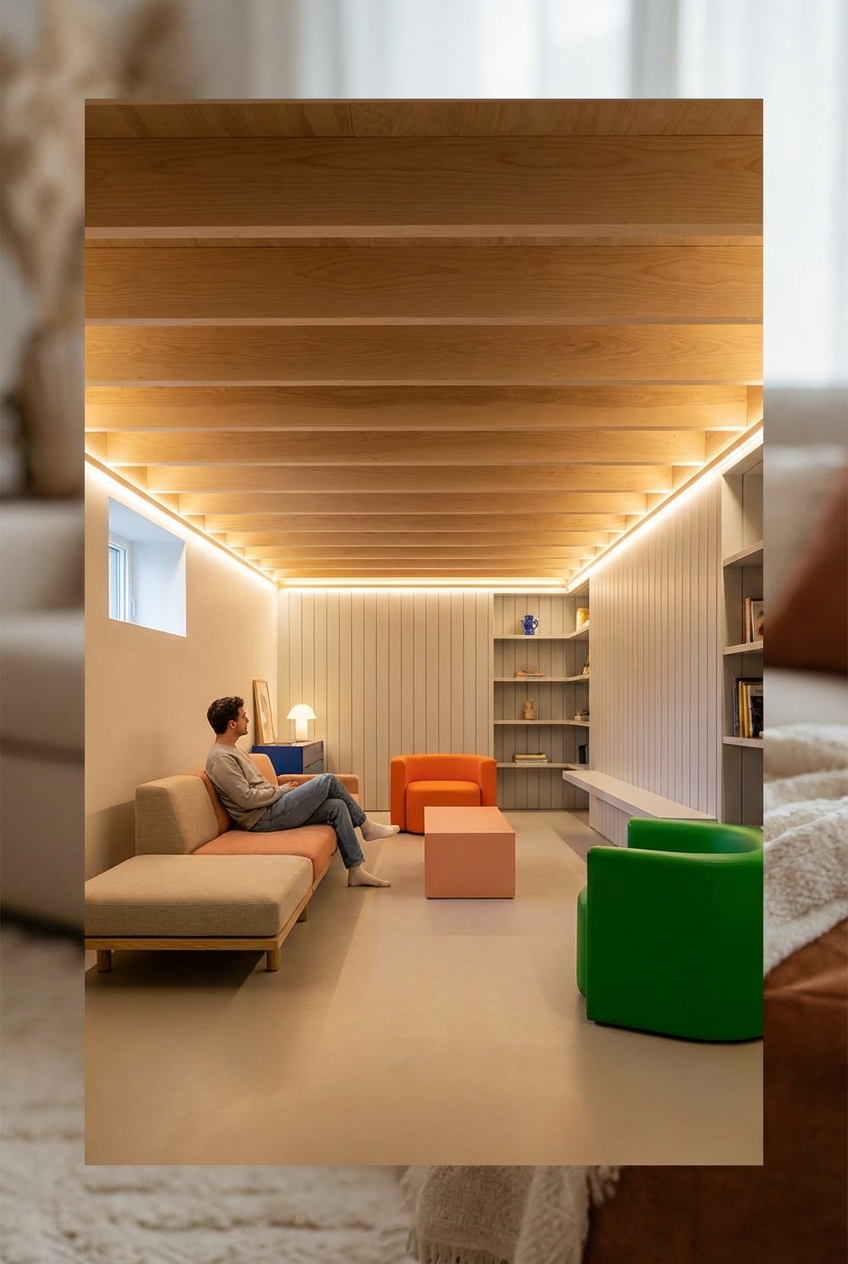
5 Tips for Making the Most of a 7’ Basement Ceiling
Walking into a basement with a 7-foot ceiling can often feel like stepping into a structural afterthought. Many homeowners feel restricted by that low clearance, worrying that the space will forever feel like a cramped, dark cave regardless of how much furniture they bring in.
The good news is that a 7-foot ceiling is actually a common standard in many older homes, and with the right design strategy, it can become a cozy, high-end retreat. By manipulating sightlines, prioritizing scale, and utilizing specific lighting techniques, you can transform a claustrophobic basement into a functional living area that feels significantly taller than it actually is.
At-a-Glance: Key Takeaways
- Embrace Low-Profile Furniture: Keeping the visual weight of your furniture close to the floor creates the illusion of more vertical space above.
- The Power of Monochromatic Palettes: Painting walls, trim, and ceilings the same color removes the visual “breaks” that emphasize a low ceiling height.
- Recessed Everything: Avoid any fixtures that hang down into the room, such as pendant lights or ceiling fans, which physically and visually shorten the space.
- Vertical Elements: Use vertical lines in wall treatments or floor-to-ceiling cabinetry to draw the eye upward and elongate the walls.
- Strategic Lighting: Incorporate “uplighting” and perimeter lighting to wash the ceiling in light, making it feel airy rather than heavy.
What This Style/Idea Means (and Who It’s For)
Designing for a 7-foot ceiling is all about “visual ergonomics.” In standard modern construction, ceilings are usually 8 or 9 feet high, giving us plenty of breathing room. When you lose that foot or two of height, every design choice becomes high-stakes because the ceiling is much closer to our line of sight.
This design approach is for homeowners who are finishing a basement in a bungalow, a mid-century ranch, or a historic home where raising the ceiling isn’t structurally or financially feasible. It is also for those who want to turn their basement into a specific functional zone—like a home office, a gym, or a media room—without it feeling like a secondary storage locker.
The goal isn’t just to make the room “look pretty.” It is to make the room feel comfortable enough that guests don’t feel the need to duck when they walk through the door. We are using psychological tricks of perspective to change how the brain perceives the boundaries of the room.
The Signature Look: Ingredients That Make It Work
To pull off a high-end look in a low-clearance basement, you need a specific set of “ingredients” that work in harmony. If you mix the wrong scales or use discordant lighting, the room will immediately feel “off.”
1. Color Drenching
This is the practice of painting the walls, the baseboards, and the ceiling in the exact same color. In a 7-foot room, a white ceiling against dark walls creates a harsh horizontal line that screams “The ceiling is right here!” By using one continuous color, the eye doesn’t find a place to stop, making the corners of the room disappear.
2. Reflective and Satin Finishes
While flat paint is traditional for ceilings, a slight sheen can work wonders in a basement. A satin or eggshell finish on the ceiling helps reflect light back into the room. This bounce-back effect makes the surface feel further away than it actually is.
3. Integrated Millwork
Built-in shelving that goes from the floor all the way to the ceiling is a classic designer trick. These vertical lines act like stripes on a shirt, making the “body” of the room look taller. Just ensure the shelves are thin and streamlined; bulky shelving will eat up the floor space and make the room feel narrow.
4. Oversized Rugs
It sounds counterintuitive, but a larger rug makes a small-ceiling room feel bigger. A small rug creates a “postage stamp” effect that draws the eye down and highlights the smallness of the floor plan. A rug that extends under all your furniture pushes the visual boundaries of the room outward.
5. Hidden Storage
Clutter is the enemy of a low ceiling. Every item sitting on a tabletop or floor takes up valuable “visual air.” In a 7-foot basement, we prioritize closed storage so the surfaces remain clean and the sightlines remain open.
Designer’s Note: I once worked on a 1940s basement where the client wanted a dark, moody man-cave. They were terrified that dark colors would make the 7-foot ceiling feel like it was crashing down. We used a deep charcoal in a flat finish for the walls and a semi-gloss for the ceiling. The result? The ceiling became so reflective it looked like water, and you actually lost track of where the wall ended. The lesson here is: don’t fear dark colors, just be smart about the finish.
Layout & Proportions (Designer Rules of Thumb)
In a low-ceiling environment, the “Golden Ratio” becomes your best friend. You have to be meticulous about the height of every piece of furniture you purchase. Here are the rules of thumb I use for 7-foot spaces:
- Sofa Seat Height: Aim for a sofa with a seat height of 14 to 16 inches. Modern, low-slung Italian-style sofas are perfect for this. Avoid “traditional” overstuffed sofas that have high backs.
- Coffee Table Clearance: Your coffee table should be 1 to 2 inches lower than your sofa seat. This keeps the center of the room “low” and open. Keep the table 18 inches away from the sofa for comfortable legroom.
- The 2/3 Rule: Any artwork or wall decor should be centered at about 57 to 60 inches from the floor (eye level), but make sure the top of the frame has at least 12 inches of “breathing room” from the ceiling. If the art is too close to the ceiling, it emphasizes the low height.
- Lighting Placement: Recessed “can” lights should be spaced approximately 3 to 4 feet apart. If you use 6-inch cans, the ceiling can look like Swiss cheese. Instead, use 3-inch or 4-inch “gimbal” lights that allow you to aim the light toward the walls.
- Rug Sizing: In a standard 12×15 basement room, don’t settle for a 5×7 rug. Go for an 8×10 or 9×12. You want at least 8 inches of flooring showing around the perimeter, but no more than 18 inches.
For seating arrangements, keep the furniture away from the walls by at least 6 inches if the space allows. Pushing everything against the walls actually makes the room feel smaller and highlights the ceiling height by showing the full span of the wall without any depth.
Step-by-Step: How to Recreate This Look
If you are staring at a bare or unfinished 7-foot basement, here is the order of operations to maximize every inch of height.
Step 1: Address the Mechanicals
Before you close up the ceiling, look at the ductwork and pipes. If possible, have a HVAC professional “tuck” the ducts between the joists. If you have to have a soffit (a drop-down box for pipes), try to run it along the perimeter of the room rather than through the center. A center-room soffit cuts the room in half and makes it feel much lower.
Step 2: Plan the “Quiet” Ceiling
Install recessed LED slim-panel lights. These are only half an inch thick and don’t require a bulky “housing” box inside the ceiling. This allows you to keep the ceiling as high as possible. Map them out so they wash the walls with light, which expands the room’s perceived width.
Step 3: Choose Your “Verticality” Element
Decide how you will draw the eye up. This could be vertical shiplap (painted a light color), floor-to-ceiling drapery (even if there are no windows, a wall of fabric can add height and soften acoustics), or a tall, narrow bookshelf. Install this element first to set the vertical scale of the room.
Step 4: The Color Drench
Select your color. If the room gets zero natural light, don’t try to force it to be “bright white”—it will just look gray and dingy. Instead, go for a mid-tone warm greige or a soft, moody blue. Paint everything: the ceiling, the walls, the vents, and the trim.
Step 5: Select “Leggy” Furniture
When buying your sofa and chairs, look for pieces with exposed legs. Being able to see the floor underneath the furniture creates a sense of “airiness.” Heavy, skirted furniture that sits flat on the floor feels like a visual anchor that pulls the room down.
Step 6: Layer the Lighting
Add floor lamps that have “uplight” capabilities and table lamps with translucent shades. By having light at three different levels (ceiling, eye level, and floor level), you distract the eye from the ceiling’s actual height.
Budget Breakdown: Low / Mid / Splurge
A 7-foot basement project can be scaled to fit almost any budget. Here is how you can allocate your funds effectively.
The Low-Budget Refresh ($500 – $1,500)
Focus entirely on paint and lighting. A DIY paint job using the “color drenching” technique will cost you about $300 in high-quality paint. Replace old, hanging light fixtures with “boob lights” or ultra-thin LED disks for $200. Spend the rest on a large, affordable jute or polypropylene rug and a couple of low-profile floor lamps.
The Mid-Range Transformation ($2,000 – $7,000)
In addition to paint, this budget allows for basic “hard” changes. Hire an electrician to install 6-8 recessed slim-panel LEDs ($1,200). Install a luxury vinyl plank (LVP) floor throughout ($2,000-$4,000). LVP is thin (usually 5mm-8mm), meaning you won’t lose height like you would with a thick carpet and pad. You can also add some IKEA “Billy” bookcases and trim them out to look like custom floor-to-ceiling built-ins.
The Designer Splurge ($10,000+)
This is where we get into structural and high-end aesthetic changes. This budget covers rerouting HVAC ducts into the joists to eliminate soffits ($3,000). You can install custom walnut or oak vertical slat walls for incredible texture and height ($5,000). Finish the space with a high-end, low-profile modular sofa and a custom-sized wool rug.
Common Mistakes (and How to Fix Them)
Even with good intentions, it’s easy to make a choice that accidentally “shrinks” your basement. Here are the most frequent errors I see in the field.
Mistake: Installing a Ceiling Fan
The Fix: Never put a ceiling fan in a 7-foot room. Even “hugger” fans hang down 8-10 inches, meaning a 6-foot person will feel like they’re about to be decapitated. Use a high-quality, oscillating floor fan or an integrated HVAC system for air movement instead.
Mistake: Using Heavy Crown Molding
The Fix: Thick crown molding creates a “frame” around the top of the room, which emphasizes exactly where the wall stops and the ceiling begins. In a low basement, skip the crown molding entirely. If you want a finished look, use a very simple, thin “stop” trim or just a clean, taped corner.
Mistake: High-Back Recliners
The Fix: Large, puffy recliners are comfortable, but they are “room killers” in low-ceiling spaces. They look like giants in a dollhouse. Swap them for “club chairs” or “swivel chairs” that have a back height no higher than 30-32 inches.
Mistake: Picking a Dark Rug with Light Walls
The Fix: This creates a “sandwich” effect where the dark floor and the ceiling feel like they are squeezing the light walls. Keep your floor color and wall color within 2 or 3 shades of each other to maintain a sense of expansion.
Room-by-Room Variations
How you handle a 7-foot ceiling depends on what you’re using the room for. Here is how to adjust the strategy based on the room’s function.
The Home Office
For a basement office, focus on your desk height. A standard desk is 29-30 inches high. To make the room feel taller while you’re working, use a “floating” desk mounted to the wall. Removing the legs of the desk opens up the floor space. Use a task lamp with a flexible neck so you can point light upward when you aren’t working on documents.
The Home Gym
Gyms are tricky because you might be jumping or lifting weights. Avoid any ceiling-mounted pull-up bars. Instead, use a floor-mounted power rack that is specifically designed for “short” basements (usually 72-80 inches tall). For flooring, use thin 1/4 inch rubber matting rather than thick 1-inch foam tiles to preserve every bit of overhead clearance.
The Media/TV Room
This is the best use for a 7-foot basement because you are mostly sitting down. Mount the TV so that the center of the screen is at eye level when you are seated. If you mount it too high, you’ll be forced to look up at the ceiling, which reminds you how close it is. Use a long, low media console (15-20 inches high) to ground the TV.
The Guest Suite
For a guest bedroom, use a “platform” bed frame that doesn’t require a box spring. A bed that sits 10 inches off the floor feels much more spacious than a traditional bed that sits 25 inches high. Use wall-mounted sconces instead of bedside table lamps to keep the nightstands clear and the horizontal lines clean.
Finish & Styling Checklist
Use this checklist as you finalize your basement design to ensure you haven’t missed any opportunities to maximize space.
- Are all light fixtures recessed or flush-mounted?
- Is the ceiling painted in a satin or eggshell finish to reflect light?
- Does the furniture have a “low-profile” silhouette (seat height under 17 inches)?
- Have you used a monochromatic color scheme for the walls and ceiling?
- Are there vertical elements (slats, shelves, or curtains) to draw the eye up?
- Is the flooring thin enough to maximize vertical clearance?
- Are “uplights” or floor lamps included to brighten the ceiling?
- Is the artwork hung at a height that leaves plenty of room above the frame?
- Have you removed all “visual clutter” and maximized closed storage?
- Do your window treatments (if any) start at the ceiling line, not the window frame?
What I’d do in a real project: If I were designing a 7-foot basement today, my first move would be to spec a 3000K LED light strip hidden behind a small “cove” molding around the perimeter of the ceiling. This creates a “halo” effect. When the ceiling edges are glowing, the center of the ceiling feels like it’s floating upward. It is the single most effective way to “lift” a low ceiling without construction.
FAQs
Can I install a tray ceiling in a 7-foot basement?
Generally, no. A tray ceiling requires you to drop the perimeter even lower (down to 6’6″ or 6’8″), which can make the room feel very heavy. In a 7-foot space, you want as much “flat” surface area as possible. If you want architectural interest, use a “coffered” look with very thin 1-inch thick faux beams instead.
What is the best flooring for a low basement?
Luxury Vinyl Plank (LVP) or Glue-down Cork are the best. They provide durability and moisture resistance without the height of a traditional subfloor and hardwood system. Avoid thick “shag” carpets, which can eat up nearly an inch of your height.
Does a white ceiling always make a room look taller?
Not necessarily. If your walls are a medium or dark color, a stark white ceiling creates a sharp “cutoff” line that highlights the low height. In many cases, painting the ceiling a shade or two lighter than the walls (rather than pure white) creates a softer transition that feels more spacious.
Can I have a 7-foot ceiling and still meet building codes?
In most US jurisdictions, the minimum height for a “habitable” space is 7 feet. However, some areas allow for 6’8″ in basements or under beams/ducts. Always check your local building department’s requirements before starting a renovation, especially if you plan to add a bedroom.
Should I use “can” lights or LED “wafers”?
Go with LED wafers. They require much less space behind the drywall, meaning you don’t have to drop the ceiling to accommodate a bulky metal housing. They also run much cooler, which is safer in tight ceiling joist spaces.
Conclusion
A 7-foot ceiling is not a design death sentence. It is simply a set of parameters that requires a more disciplined approach to scale and light. By focusing on low-profile furniture, vertical lines, and smart lighting, you can create a basement that feels intentional and sophisticated.
Remember that the goal is to create a space that feels balanced. When you keep the furniture low and the ceiling “quiet,” the lack of height becomes unnoticeable. Instead of focusing on the feet and inches, focus on the “feel” of the room. A well-designed 7-foot room will always feel more spacious than a cluttered 9-foot room.
Start with your lighting and your paint—these are your two most powerful tools. From there, layer in furniture that respects the proportions of the space, and you’ll find that your “low” basement quickly becomes the most popular floor in your home.


