
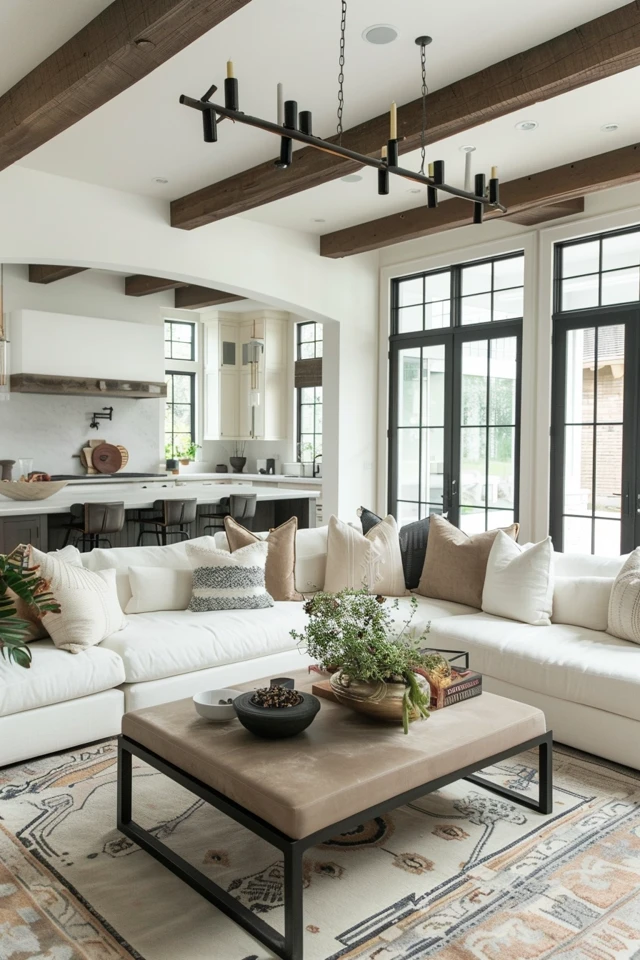
5 Tips for Planning 6 Bedroom House Plans 2 Story with Basement
Designing a home with six bedrooms spread across two stories and a basement is a significant architectural and interior design challenge. You aren’t just building a house; you are orchestrating a complex ecosystem for a large family or multi-generational living.
I have worked on several large-scale residential projects where the primary goal was maximizing occupancy without sacrificing privacy. The key is to stop thinking about the house as one giant block and start viewing it as distinct zones that must function independently yet cohesively.
If you are looking for visual inspiration to go along with these technical tips, make sure to scroll to the bottom of this page where I have curated a specific Picture Gallery just for you.
1. Strategize Vertical Privacy Zones
When you are dealing with three distinct levels—the upper story, the main floor, and the basement—bedroom placement dictates the flow of the entire home. A common error in six-bedroom plans is clustering too many sleeping quarters in one area, creating noise bottlenecks.
For a two-story home with a basement, I recommend a “3-1-2” or “4-1-1” split. This usually means three or four bedrooms on the top floor, one guest suite or office-convertible bedroom on the main floor, and one or two bedrooms in the finished basement.
The main floor bedroom is arguably the most valuable asset for long-term resale value. It serves as an accessible suite for aging parents or a private guest room away from the family chaos upstairs.
Designer’s Note: The Sound Buffer
One lesson I learned early in my career involved a client who placed the master suite directly above the basement media room. Despite insulation, the bass vibration was a nightmare.
Always plan closets and bathrooms as “sound buffers” between sleeping walls and common areas. If a bedroom shares a wall with a living space, line that wall with a solid core door and acoustic insulation batts.
Designing the Upper Level Layout
On the top floor, avoid lining up bedroom doors directly across from one another. This “dormitory” effect kills privacy and increases noise transfer.
Instead, stagger the doorways along the hallway. If space allows, create small vestibules or recessed entries for each room. This requires an extra 12 to 18 inches of hallway width but elevates the feel of the home immediately.
2. Optimize the Basement for Livability
In a six-bedroom house, the basement bedrooms often get the short end of the stick regarding light and ceiling height. If these rooms are to be truly usable, they cannot feel like subterranean storage.
You must prioritize ceiling height during the pouring of the foundation. I always specify a minimum foundation wall height of 9 to 10 feet. Once you add ductwork, plumbing drops, and a finished ceiling, you want a clear height of at least 8 feet 6 inches.
Natural light is the second non-negotiable factor. Standard window wells are insufficient for a bedroom that feels welcoming.
Egress and Light Wells
For basement bedrooms, you are legally required to have egress windows for fire safety. However, do not do the bare minimum.
I recommend “tiered” or landscaped window wells rather than the standard corrugated metal semicircles. These allow you to plant greenery visible from the bedroom window, making the space feel like a garden apartment rather than a basement.
Common Mistakes + Fixes
Mistake: Installing wall-to-wall carpet directly on the basement slab.
Fix: Moisture is inevitable in basements. Use a Luxury Vinyl Plank (LVP) with a cork underlayment or an engineered wood with a moisture barrier. This prevents that musty smell and is much easier to clean if a sump pump fails.
Mistake: Poor lighting plans.
Fix: Recessed can lights are standard, but they create shadows. Layer the lighting in basement bedrooms with sconces at 60 inches from the floor and floor lamps. Use 3000K LED bulbs to mimic natural daylight warmth.
3. Calculate the Ideal Bathroom-to-Bedroom Ratio
Nothing creates morning friction faster than a six-bedroom house with only three bathrooms. While you do not need a 1:1 ratio, you must be strategic to avoid traffic jams.
For six bedrooms, I recommend a minimum of 4.5 bathrooms. This typically breaks down to:
- Primary Ensuite (Full)
- Upper Hall or Jack-and-Jill (Full)
- Upper Guest Ensuite (Full)
- Main Floor Powder (Half)
- Basement Bath (Full)
The Jack-and-Jill Dilemma
Many clients ask for Jack-and-Jill bathrooms between kids’ rooms to save space. While they save square footage, they often cause privacy disputes and locking issues.
What I’d do in a real project is create a “compartmentalized” hall bath instead. This features a double vanity open to the hallway (or separated by a pocket door) and a separate room for the toilet and tub/shower. This allows three people to use the facilities simultaneously—one brushing teeth, one showering, and one using the restroom.
Specific Measurements to Know
If you are squeezing in extra bathrooms to accommodate the bedroom count, keep these minimums in mind for comfort:
- Toilet Clearance: You need 30 inches of clear width for the toilet, but 36 inches is much more comfortable for adults.
- Vanity spacing: For a double vanity shared by siblings, do not go smaller than 60 inches wide. 72 inches is ideal to provide drawer stacks for storage.
- Shower size: A 30×30 inch shower is code in some places, but it is unusable for most adults. Aim for a minimum of 36×48 inches.
4. Managing Traffic Flow and Gathering Spaces
A house that sleeps 8 to 12 people needs common areas that can handle that capacity. The kitchen and mudroom are the two biggest choke points in large family homes.
When planning the main floor, the “work triangle” in the kitchen is not enough. You need “zones” to keep people out of the cook’s way. I always include a dedicated beverage or snack station outside the main cooking zone so kids can grab water without crossing the path of the stove.
The Mudroom Mandatory
With six bedrooms, you likely have at least 4 to 6 people leaving the house daily. A standard closet is insufficient.
You need a dedicated mudroom, ideally connecting the garage to the kitchen. Plan for a bench that is at least 18 inches deep and allows for 24 inches of width per family member.
If you have a basement bedroom that will be used by a long-term guest or renter, consider a separate side entrance that leads directly to the basement stairwell. This bypasses the main living areas and preserves privacy for everyone.
Designer’s Note: Walkway Widths
In a standard home, 36-inch walkways are acceptable. In a 6-bedroom home, they will feel claustrophobic.
Increase your main hallways and traffic paths to 42 or 48 inches wide. This allows two people to pass each other comfortably carrying laundry baskets or groceries. It subtly makes the house feel grander and more custom.
5. Systems, Utility, and Maintenance
The unglamorous side of a massive house is the infrastructure required to run it. Heating, cooling, and cleaning for three floors requires heavy-duty planning.
HVAC Zoning
Do not attempt to heat and cool a 2-story home with a basement on a single thermostat. The top floor will be sweltering while the basement is freezing.
You must install a zoned HVAC system with separate thermostats for each level. Alternatively, use two separate units—one for the main/basement and one for the upper story. This ensures sleeping temperatures are comfortable regardless of where the bedroom is located.
The Laundry Logistics
One laundry room is rarely enough for a six-bedroom household. I strongly suggest a primary laundry room on the upper level (near the bulk of the bedrooms) and a secondary stackable unit elsewhere.
The secondary unit can go in the mudroom for sports gear and pool towels, or in the basement for guest linens and gym clothes.
Hot Water Capacity
A standard 50-gallon water heater will not suffice if three showers are running simultaneously. You have two options:
- Two 50-gallon tanks plumbed in series.
- A tankless water heater system sized for high demand (look for 10-12 gallons per minute flow rate).
Final Checklist: What I’d Do in a Real Project
If I were reviewing your blueprints today, this is the checklist I would run through to ensure the design is successful:
1. Check the sightlines.
Stand in the main living area on the plan. Can you see directly into a bathroom or a bedroom? If yes, move the door or add a privacy wall.
2. Audit the storage.
Count the closets. For 6 bedrooms, you need a minimum of one oversized linen closet on the upper floor and a general storage room in the basement (at least 100 sq ft) for seasonal items.
3. Verify furniture scale.
Draw “real” furniture sizes on the floor plan. A king bed is 76×80 inches. Ensure you have 30 inches of walking space on both sides. If a room is smaller than 12×12 feet, it will feel tight with a king bed and a dresser.
4. Review the “landing zone.”
Is there a place to drop keys and mail at the front door? Is there a place to charge 6+ phones and tablets? Plan these electrical outlets now.
5. Test the dining capacity.
Can your dining room accommodate a table for 12? You need 3 feet of clearance behind each chair for service. Ensure the room dimensions support this.
FAQs
What is the minimum square footage for a 6-bedroom house?
To comfortably fit 6 bedrooms, 4+ bathrooms, and adequate living space without feeling cramped, you generally need at least 3,500 to 4,000 square feet. This includes the finished basement. Anything smaller often results in tiny bedrooms or compromised living areas.
Is it better to have the master bedroom up or down?
For resale value and aging in place, a main-floor master is superior. However, for families with infants or young children, an upper-level master is often preferred to be closer to the kids. A popular compromise is a “junior master” on the main floor and the primary suite upstairs.
How much does it cost to finish a basement bedroom compared to an above-ground one?
Finishing a basement bedroom is typically 30-50% cheaper per square foot than building an addition above ground because the structure (foundation and floor) is already there. The main costs are framing, egress windows, plumbing, and finishes.
Do all 6 bedrooms need walk-in closets?
No, but the primary suite and any “VIP” guest suites should. For standard secondary bedrooms, a reach-in closet that is at least 6 to 8 feet wide is sufficient. Use 8-foot doors on closets to maximize access to the top shelves.
Conclusion
Planning a 6-bedroom, 2-story house with a basement is an exercise in balancing connection with separation. You need spaces large enough to gather the whole crew, but enough acoustic and physical separation to allow everyone to recharge.
By prioritizing vertical zoning, ensuring the basement is light-filled and dry, and calculating your utility needs upfront, you can build a home that functions beautifully for decades. Remember that square footage means nothing if the flow is awkward—prioritize wide hallways and smart door placements over sheer size.
Picture Gallery


