
5 Tips for Setting Up a Basement Yoga Studio
Finding a quiet corner for your yoga practice can be difficult in a busy household. The living room is often full of distractions, and the bedroom might not have enough floor space to fully extend into a Warrior II. This is why transforming a basement area into a dedicated studio is one of the most rewarding renovations you can undertake.
Basements offer natural sound insulation and a sense of separation from the daily grind upstairs. However, they also come with unique design challenges like low ceilings, limited natural light, and potential moisture issues. The goal is to turn a subterranean storage space into a sanctuary that feels warm, inviting, and intentional.
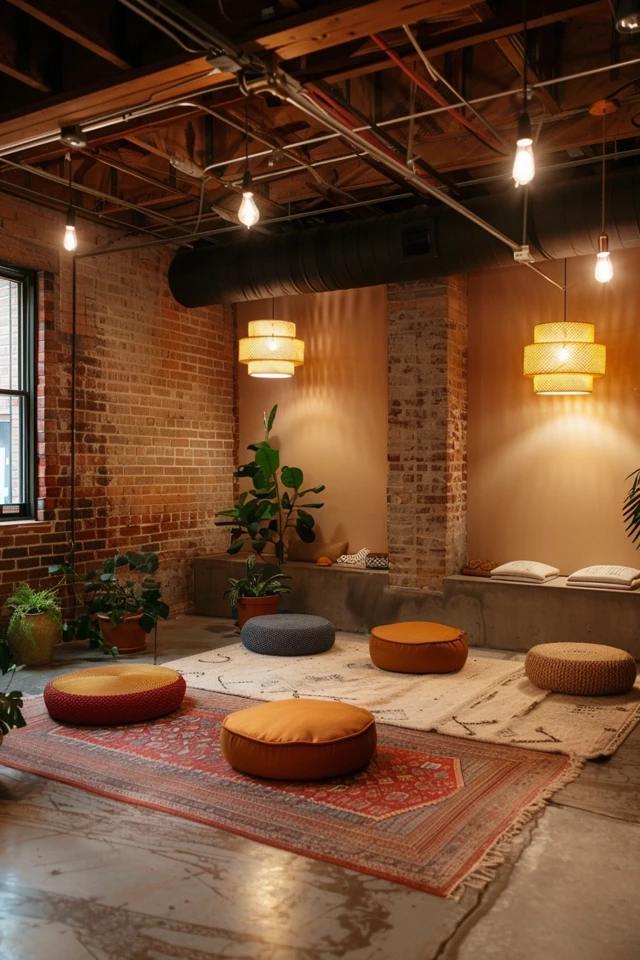
In this guide, I will walk you through the professional steps to create a functional and beautiful yoga space. For visual inspiration on lighting layouts and flooring choices, make sure to check out the Picture Gallery at the end of the blog post.
1. Choose the Right Flooring for Stability and Warmth
The foundation of any yoga studio is the floor. In a basement, you are usually starting with a concrete slab, which is too hard on the joints and too cold for relaxation poses.
You need a material that offers stability for balance poses but provides a slight “give” for comfort. Avoid plush wall-to-wall carpeting. It makes balancing difficult, holds onto sweat and odors, and breaks the visual flow of a modern studio.
My Top Recommendation: Luxury Vinyl Plank (LVP)
For basement projects, I almost exclusively specify high-quality Luxury Vinyl Plank. It is waterproof, which is essential for below-grade spaces, and it mimics the look of real wood without the risk of warping. Look for a “rigid core” product with an attached cork or foam underlayment for acoustic dampening and thermal insulation.
The Cork Alternative
If you want an eco-friendly option, engineered cork flooring is fantastic. It is naturally antimicrobial and warm to the touch. However, ensure it is sealed properly to handle humidity.
Designer’s Note: The Subfloor Layer
Never install your finish flooring directly over bare concrete. I always insist on a vapor barrier and a specific subfloor system like DMX 1-Step or a similar air-gap membrane. This prevents moisture from wicking up and keeps the floor significantly warmer in the winter.
2. Master the Lighting Design
Lighting can make or break a basement renovation. Since you likely lack expansive windows, you have to create your own “natural” light. The biggest mistake homeowners make is installing a grid of bright, clinical downlights that make the space feel like an operating room.
For a yoga studio, you need layers. You want the ability to have bright light for cleaning or high-energy flows, and soft, moody light for restorative sessions or meditation.
The Rule of Three Layers:
- Ambient: Recessed cans are fine, but place them on the perimeter of the room rather than directly over the center where you will be lying on your back. Staring into a bulb during Savasana is a design failure.
- Task/Accent: Use wall sconces to wash the walls with light. This pushes the walls out visually, making the room feel wider and less cave-like.
- Glow: Consider installing LED tape light inside a ceiling cove or behind a large mirror. This provides a diffused, indirect glow that is perfect for relaxation.
Technical Specifications to Look For:
- Color Temperature: Stick to 2700K (warm white) or 3000K (soft white). Anything above 3500K will feel too blue and cold for a basement.
- Dimmers: Every light source must be on a dimmer switch. This is non-negotiable for controlling the atmosphere.
- CRI (Color Rendering Index): Buy bulbs with a CRI of 90 or higher. This ensures your paint colors and skin tones look natural, not washed out.
3. Prioritize Climate Control and Air Quality
Basements are notorious for being damp and having poor air circulation. Deep breathing is the core of yoga, so air quality cannot be an afterthought. If the room smells musty or feels clammy, you will not want to use it.
Managing Humidity
Invest in a hygrometer to measure the relative humidity. Ideally, you want to keep the room between 30% and 50%. If you are consistently above 50%, you need a high-quality dehumidifier.
In my designs, I prefer to build the dehumidifier into a closet with a louvered door and a direct drain line so the client never has to empty a bucket. If that isn’t in the budget, buy a sleek, portable unit that blends with your decor.
Temperature Regulation
Basements are naturally cooler. While this is nice in July, it is tough in January.
- Radiant Floor Heating: If you are redoing the floors, electric radiant mats are the gold standard for yoga studios. Heat rises, and warming the body from the ground up feels luxurious.
- Supplemental Heating: An electric fireplace or a modern, wall-mounted convection heater can quickly warm a small room without the noise of a forced-air fan.
Common Mistakes + Fixes
Mistake: Relying on scented candles to mask basement odors.
Fix: Address the moisture source first. Then, use an essential oil diffuser. Open flames in a basement with lower ceilings can burn up oxygen and impact air quality faster than in open upstairs rooms.
4. Use Mirrors to Manipulate Space
Basement ceilings are often lower than standard height, usually around 7 to 8 feet. This can make the room feel compressed. Large mirrors are the interior designer’s secret weapon to double the visual volume of the room.
Placement Strategy
Place mirrors on the long wall of the room. This visually pushes the wall back and reflects whatever light sources you have, brightening the entire space.
Installation Tips
- Wall-to-Wall: For a true studio look, install sheet mirrors from baseboard to ceiling. However, leave a 4-inch gap at the bottom to avoid vacuum cleaner bumps.
- Framed Leaners: If you are renting or want a softer look, use two or three large, matching floor mirrors lined up side-by-side. Secure them to the wall for safety.
- The “Infinity” Trap: Avoid placing mirrors on opposing walls. This creates an infinite reflection tunnel that can be dizzying and distracting during balance poses.
Designer’s Note: Safety Backing
If you are buying large sheet mirrors, ensure they have “safety backing.” This is a film applied to the back that holds the glass together if it shatters, which is crucial if you are practicing with weights or props nearby.
5. Declutter with Intentional Storage
“Saucha” is the yogic principle of cleanliness and purity. Visual clutter creates mental clutter. If your basement studio doubles as a guest room or storage area, you need to hide the chaos.
In a small footprint, floor space is premium real estate. We want to get everything off the floor.
Storage Solutions
- Wall Mounts: Use heavy-duty hooks or specialized racks to hang mats vertically. This keeps them unrolled (which helps them lay flat later) and out of the way.
- Floating Shelves: Install shelves for yoga blocks, straps, and towels. Keep these organized by color for a cohesive look.
- Closed Cabinetry: If the room is multipurpose, use low-profile credenzas or built-in cabinets to hide non-yoga items.
What I’d Do in a Real Project
If I were designing a 12×12 basement studio today, here is the storage plan I would implement:
- The “Altar” Wall: A low, floating bench (18 inches high) along one wall. Underneath, I would place woven baskets for bolsters and blankets.
- Above the Bench: A single, long floating shelf for plants and candles.
- The Prop Wall: A mounted rack system behind the door for mats and straps.
Final Checklist: Ready for Practice
Before you roll out your mat, run through this quick checklist to ensure the space is fully optimized for design and function.
Spatial Planning
- Is there at least 2 feet of clearance around all sides of your mat?
- Can you extend your arms overhead without hitting a light fixture?
- Is the floor level enough for balancing poses?
Ambiance & Tech
- Are all lights on dimmers?
- Is the temperature comfortable (around 68-72 degrees F)?
- Do you have a Bluetooth speaker for music or guided classes?
- Is the Wi-Fi signal strong enough for streaming video?
Safety & Comfort
- Is the space free of tripping hazards (cords, rug edges)?
- Is there a designated spot for water and towels?
- Have you checked for drafts near windows or bulkhead doors?
FAQs
Q: My basement ceiling is only 6’8″. Can I still do yoga there?
A: Yes, but you will need to modify. You likely cannot do standing overhead reaches or jumping jacks. Focus on seated flows, floor work, and inversions where your feet don’t reach full height. Use flush-mount lighting fixtures to save every inch of headroom.
Q: What is the best paint color for a basement studio?
A: Avoid bright white, which can look gray and dingy in low light. I recommend warm off-whites (like Benjamin Moore Swiss Coffee) or soft, earthy neutrals like sage green or taupe. Dark, moody colors like navy can work, but only if you have excellent lighting design.
Q: How do I soundproof the ceiling if people are walking upstairs?
A: The best method is to install a suspended drywall ceiling with sound-dampening clips and “Rockwool” insulation between the joists. If the ceiling is already finished, adding heavy textiles like velvet curtains or acoustic wall panels can help absorb some reverberation, though they won’t stop impact noise (footsteps).
Q: Can I use area rugs over the vinyl floor?
A: Yes. A large, low-pile area rug can define the space and add warmth. Ensure it is significantly larger than your yoga mat so you don’t catch your foot on the edge during transitions. Use a rug pad to prevent slipping.
Conclusion
Creating a basement yoga studio is about more than just clearing a spot on the floor. It is about intentionally designing an environment that supports your physical and mental well-being. By addressing the specific constraints of a basement—lighting, flooring, and climate—you can turn a neglected area into the most peaceful room in your home.
Remember that the design should serve the practice. Keep it simple, keep it warm, and keep it clutter-free. With the right foundation and lighting, your basement will feel less like a dungeon and more like a private retreat.
Picture Gallery


