
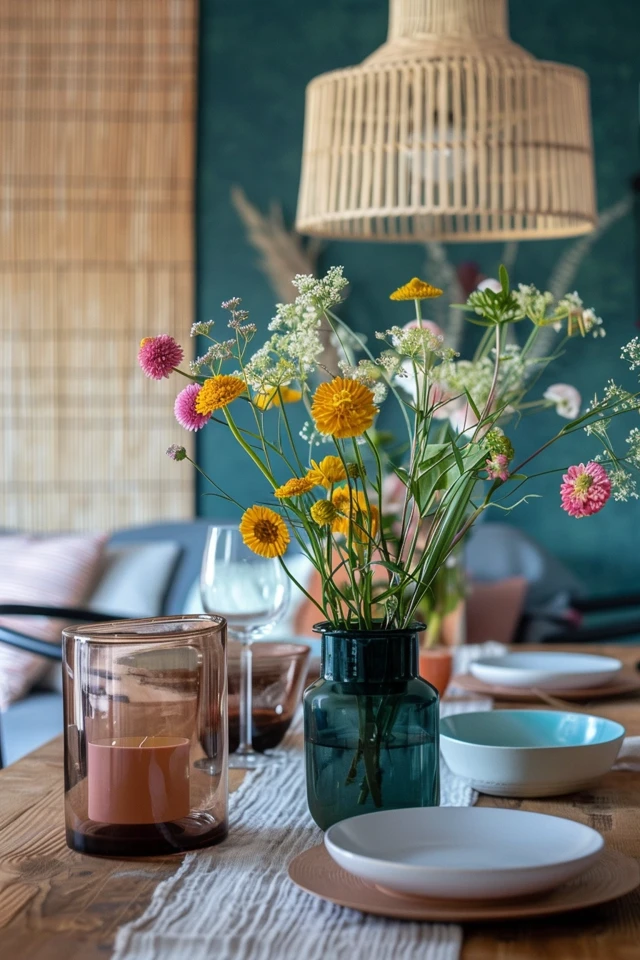
Title: 5 Tips for Using Grasscloth Wallpaper in Your Dining Room
Introduction
There is something inherently sophisticated about a dining room wrapped in grasscloth. It instantly transforms a flat, boxy drywall room into a space with depth, warmth, and acoustic softness that paint simply cannot achieve. Whenever a client tells me their dining space feels “cold” or “echoey,” natural fiber wallpaper is almost always my first suggestion.
However, moving from a standard painted wall to a textured, natural material requires a shift in mindset and expectations. If you are looking for visual inspiration before diving into the technical details, I have curated a stunning Picture Gallery at the end of this blog post to spark your creativity. Grasscloth is an investment, both in materials and labor, so getting the details right before you order is crucial.
In this guide, I am going to walk you through exactly how I specify, install, and live with grasscloth in a dining setting. We will cover everything from the “paneling effect” that shocks new buyers to the specific installation techniques that prevent expensive disasters. Let’s create a dining room that feels finished and intentional.
1. Embrace the “Paneling Effect” and Natural Shading
The most common panic call I receive from homeowners installing grasscloth for the first time usually happens on day one of installation. They see the seams between the strips of wallpaper and assume the installer made a mistake.
In almost all other types of wallpaper, the goal is to make the seams invisible. With real grasscloth, visible seams are not a bug; they are a defining feature. This is often referred to as the “paneling effect.”
Because the material is made from natural fibers like sisal, arrowroot, jute, or seagrass, the fibers will vary in thickness and color absorption. Even within the same roll, the left side of the sheet might be slightly lighter than the right side. When you place two sheets next to each other, you will see a distinct line.
Designer’s Note: Managing Client Expectations
I never install grasscloth without showing the client a photo of a finished room where the seams are clearly visible. If you are a perfectionist who needs a seamless, monolithic wall of color, natural grasscloth will drive you crazy. In that case, you should opt for a high-end faux vinyl grasscloth, which offers texture without the visible paneling.
The Rule of Symmetry
Because the seams are visible, where you start hanging the paper matters immensely. In a dining room, I always center the first panel on the most prominent wall (usually the wall the buffet or main artwork is on).
If you start in a corner and work your way across, you might end up with a tiny, awkward 2-inch sliver of paper at the far end of the wall. By centering the first panel, you ensure the seams look intentional and balanced relative to your furniture.
2. Choose the Right Fiber and Weave for Your Lifestyle
Not all grasscloth is created equal. The term “grasscloth” is a catch-all for various natural fibers glued to a rice paper backing. The specific weave you choose dictates the durability and the finished look of the dining room.
Sisal
This is the most popular option and the most refined. Sisal fibers are thin, tight, and offer a subtle, silky sheen. It looks tailored and elegant, making it perfect for formal dining rooms. However, because the weave is tight, staining is more obvious.
Jute and Seagrass
These are chunkier, more rustic options. The fibers are thicker and often have more knots and irregularities. This creates a heavier texture that looks fantastic in coastal or farmhouse-style dining rooms. The heavy texture is also more forgiving if you have slightly uneven walls, as the bumps hide the drywall imperfections.
Paper Weave
This is made from woven strips of paper rather than plant fibers. It creates a basketweave look (checkerboard pattern) that is generally flatter than sisal or jute.
Common Mistakes + Fixes
Mistake: Choosing a dark navy or black grasscloth for a sun-drenched room.
Fix: Natural fibers fade. If your dining room has south-facing windows without UV-blocking drapes, a dark grasscloth will fade unevenly, usually turning a dusty gray in the areas the sun hits. For sunny rooms, stick to lighter, oat, or wheat tones where fading is less noticeable, or install solar shades.
3. Lighting Requirements and Color Selection
Texture absorbs light. This is a fundamental rule of interior design that is often overlooked. When you paint a wall a light gray, it reflects light. When you cover that same wall in light gray grasscloth, the thousands of tiny shadows created by the fibers will make the room feel significantly darker.
You need to account for this light absorption when choosing your color. A color that looks light and airy on a small swatch can feel heavy and cave-like once it is on all four walls.
The “Vertical Test”
Never select your wallpaper by looking at the sample flat on your dining table. Light hits a flat surface differently than a vertical one. Tape the sample to the wall and observe it at three distinct times:
- Morning: To see how natural daylight plays with the texture.
- Late Afternoon: To see if shadows make the color look muddy.
- Dinner time: Turn on your chandelier and sconces. Artificial light often warms up the grasscloth, bringing out yellow or red undertones you didn’t see in the daylight.
Lighting Adjustments
Because the walls will soak up light, you may need to increase the lumen output of your light fixtures. If you currently use 40-watt equivalent bulbs, you might need to upgrade to 60-watt equivalents.
I also recommend using a slightly warmer color temperature for your bulbs, around 2700K to 3000K. This highlights the natural warmth of the fibers. Cool daylight bulbs (4000K+) can make natural grasscloth look sterile and cheap.
4. Mastering the Installation (Do Not DIY)
I am a huge proponent of DIY for many home projects. Installing grasscloth is not one of them. The material is unforgiving, expensive, and behaves differently than standard paper.
The Water Sensitivity Issue
Standard wallpaper can be wiped down if you get a little paste on the front. Grasscloth cannot. The dye in natural fibers is often not sealed. If you get a drop of water or wallpaper paste on the face of the paper, it will leave a permanent watermark or discoloration.
A professional installer uses a specific technique called “pasting the paper” carefully, or sometimes “pasting the wall” depending on the backing, keeping the front bone dry. They also change their razor blades constantly to prevent the tough fibers from fraying at the cuts.
Sizing the Walls
Before installation, the walls must be “sized” (primed with a specific wallpaper primer). For grasscloth, I recommend tinting the primer to match the paper.
Since grasscloth can shrink slightly as it dries, tiny gaps can sometimes appear at the seams. If you hang navy blue grasscloth over a stark white wall, those hair-line gaps will shine like beacons. If the wall behind is painted a dark gray, the gaps remain invisible.
What I’d Do in a Real Project
- Step 1: Order 15% to 20% more material than the calculator says. You need extra for pattern matching and mistakes.
- Step 2: Instruct the installer to “reverse hang” the strips. This means every other strip is hung upside down. This helps blend the shading variations from left to right, making the paneling look uniform rather than accidental.
- Step 3: Use a liner paper if the drywall is heavily textured. Grasscloth shows bumps from beneath.
5. Durability and The “Chair Rail” Solution
Dining rooms are generally low-traffic zones compared to kitchens, but they are not risk-free. The main enemies of grasscloth are liquid spills, grease, and cats.
Yes, cats. Cats look at grasscloth walls and see the world’s largest, most luxurious scratching post. If you have a cat that scratches furniture, do not install grasscloth floor-to-ceiling. It will be shredded within a month.
The Wainscoting Workaround
If you are worried about durability—or if you are on a tighter budget—install the grasscloth above a chair rail or wainscoting.
By installing wood paneling on the bottom 30 to 36 inches of the wall and wallpaper above, you solve three problems:
- Protection: Chair backs won’t rub against the delicate paper, and spilled wine won’t splash on it.
- Cost: You cut your material and labor costs by roughly 40%.
- Aesthetics: The contrast between smooth, painted woodwork and textured wallpaper creates a rich, historical look.
Cleaning and Maintenance
You cannot scrub grasscloth. If a guest splashes red wine on the wall, it is likely there forever. To maintain it, you simply vacuum it. Use the soft brush attachment on your vacuum cleaner once a month to pull dust out of the weave. Dust accumulation is the primary reason grasscloth starts to look dingy over time.
Final Checklist: Before You Buy
Ready to order? Run through this checklist to ensure you haven’t missed a critical detail.
- Check the width: Most grasscloth comes in 36-inch widths, which is wider than standard American wallpaper. Ensure your installer knows this for their calculations.
- Verify the “Single Roll” vs. “Double Roll” pricing: Most wallpaper is priced by the single roll but sold only in double rolls. This is confusing. Always ask for the price per bolt (double roll) to avoid budget surprises.
- Order a CFA (Cutting for Approval): Natural batches vary. Ask the vendor to mail you a small clipping from the actual batch they are about to ship you. Make sure it matches the sample you fell in love with.
- Buy clear adhesive: Ensure your installer plans to use a clear, non-staining adhesive. Clay-based adhesives can stain through the paper.
- Plan your outlet covers: You can wrap outlet covers in scraps of grasscloth, but it is thick and bulky. I prefer to paint the plastic outlet covers a coordinating matte color so they disappear visually.
FAQs
Can I use grasscloth in a dining room that opens to a kitchen?
Yes, but ventilation is key. Natural fibers are porous and will absorb cooking odors. If you fry fish every week and have poor ventilation, your dining room walls might eventually hold onto that scent. In open-concept spaces, ensure you have a strong range hood.
Is there a way to fix a snag in the fibers?
If a fiber gets pulled loose, do not pull it! Use a small pair of nail scissors to clip the fiber as close to the backing as possible. Then, use a tiny dab of clear glue to tack down the ends if necessary.
Can I paint over grasscloth later?
Technically, yes, but it is a one-way street. Once you paint it, you ruin the natural variations, and it just looks like painted texture. It is also extremely difficult to remove painted grasscloth because the paint hardens the shell, making it hard for steam to penetrate the glue for removal. Only paint it as a last resort before tearing it down.
How much does grasscloth cost?
It varies wildly. You can find budget options for around $100 per double roll, while high-end designer brands (like Schumacher or Phillip Jeffries) can range from $300 to $800+ per double roll. Installation labor is also generally 30-50% higher than standard wallpaper due to the difficulty.
Conclusion
Grasscloth wallpaper is one of the most effective tools in a designer’s arsenal for creating a dining room that feels grounded and luxurious. While it comes with specific rules regarding installation and care, the payoff is immense. The texture interacts with light in a way that paint never can, providing a backdrop that makes every dinner party feel a little more intimate.
By acknowledging the natural characteristics of the material—seams, shading, and delicacy—you can avoid the common pitfalls and enjoy the timeless beauty of natural fiber. Take your time selecting the weave, hire a pro for the installation, and enjoy the transformation.
Picture Gallery


