
Backsplash Ideas for Black Granite Countertops
I have walked into countless client kitchens where the homeowner feels “stuck” with their black granite countertops. They often feel heavy, dark, or perhaps a relic of the early 2000s. However, before we discuss ripping out thousands of dollars of perfectly durable stone, I always suggest looking at the backsplash first.
Black granite is actually a neutral powerhouse. It is the “little black dress” of kitchen design; it is versatile, forgiving of spills, and anchors a room. The problem usually isn’t the stone itself, but rather what is happening on the vertical surfaces next to it. The right backsplash can modernize the stone, bounce light around the room, and completely change the kitchen’s personality without a full demolition.
In this guide, I will walk you through the design logic I use when pairing tile with dark stone, from safe classics to moody modern statements. For plenty of visual inspiration, be sure to check out the Picture Gallery at the end of the blog post.
1. Analyzing Your Specific Granite Variety
Before you buy a single sample tile, you need to be a detective about your specific slab of granite. “Black granite” is a catch-all term, but in the industry, we know there are massive differences between “Absolute Black” and “Ubatuba” or “Black Galaxy.”
If your granite is “Absolute Black” or “Premium Black,” it likely has very little movement and reads as a solid color. This gives you the most freedom. You can get away with patterned tiles, heavy veining in a marble backsplash, or complex shapes because the counter acts as a solid anchor.
However, if you have “Black Pearl,” “Ubatuba,” or “Sapphire Brown,” your stone has speckles, flecks of mica, or swirls of green and brown. This is where homeowners make the most mistakes. If your counter has high activity (lots of speckles), your backsplash must be quiet. If you pair a busy granite with a busy mosaic tile, the kitchen will feel chaotic and visually smaller.
Designer’s Note: The “squint test”
When viewing your kitchen from the living room, squint your eyes. Does the granite look solid black, or does it read as a dark grey or green? If it reads as grey or green, do not use a stark, bright white tile. It will make the counters look dingy. Instead, opt for a creamy off-white or a soft greige to bridge the gap.
2. The High-Contrast Approach: White and Cream
Creating a “tuxedo kitchen” by pairing black counters with white cabinets or white backsplash is a timeless strategy. It works because it maximizes the Light Reflectance Value (LRV) in the room. Since black granite absorbs light, you need the vertical surface to bounce light back onto your workspace.
However, standard white subway tile can feel a bit sterile or “builder-grade” if not executed with intention. To elevate this look, pay attention to the finish and the dimensions. Instead of the standard 3×6 inch glossy subway tile, look for an elongated 2.5×8 inch tile or a handmade look with undulated edges.
The grout color you choose here changes everything. If you use white grout, the backsplash becomes a seamless textual sheet. If you use a soft grey grout (like Mapei’s “Warm Gray”), you highlight the geometric pattern of the bricks.
Common Mistakes + Fixes:
- The Mistake: Using “bright white” tile against “warm black” granite. Some black granites have brown or gold flecks. A blue-based bright white tile will clash.
- The Fix: Bring the tile sample home. Hold it vertically (not flat) on the counter. If the granite has gold flecks, choose a tile in “Ivory,” “Bone,” or “Whipped Cream.”
3. Going Moody: Tone-on-Tone Dark Backsplashes
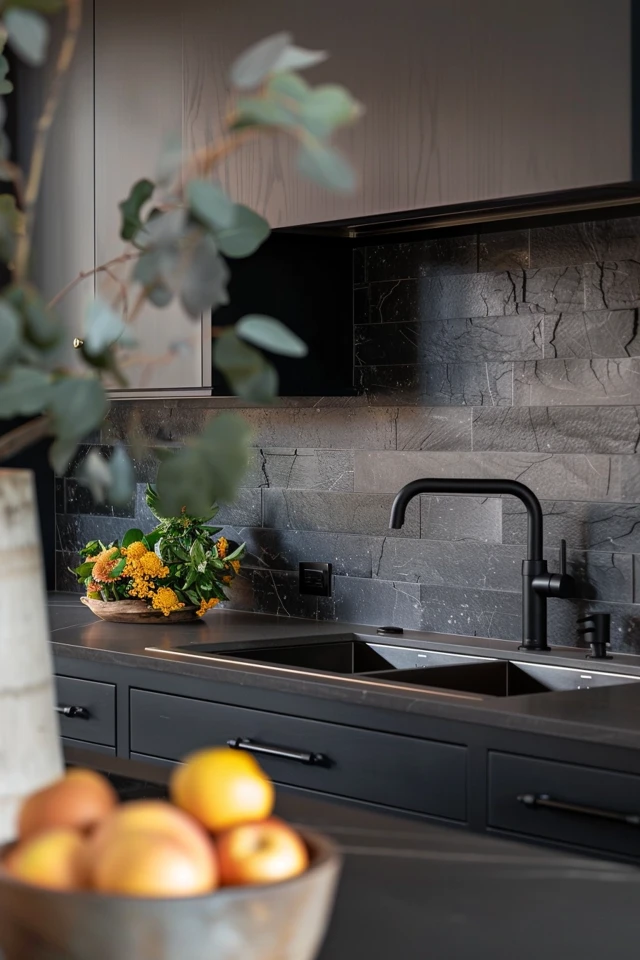
There is a misconception that dark counters require light backsplashes. This is false. One of the most sophisticated, high-end looks right now is the monochromatic palette. Pairing black granite with a charcoal, slate, or black backsplash creates a seamless, infinite look that makes the walls recede.
The secret to pulling this off without creating a “black hole” is texture variation. If your granite is polished (shiny), your backsplash should be matte or honed. If your granite is honed (matte), you can use a glossy glass or glazed ceramic tile. The contrast comes from the sheen, not the color.
I frequently use Slate or Basalt tiles in these applications. A natural cleft slate tile in a dark charcoal grey bridges the gap between the black counter and stainless steel appliances perfectly. It feels organic and grounded.
Lighting Requirement:
If you choose a dark backsplash, you must have under-cabinet lighting. Without it, you will lose the definition of the corner where the counter meets the wall. I recommend LED tape lights with a color temperature of 3000K (neutral white) to ensure the textures pop.
4. Natural Stone: Marble and Travertine
Mixing natural stone with natural stone is tricky, but when it works, it is breathtaking. Carrara marble (white with grey veining) is the most frequent partner for black granite. The grey veins in the marble tie into the black counters, creating a cohesive relationship.
When using marble tiles, scale is critical. I prefer a 3×6 or 4×12 honed marble subway tile over a small mosaic. Small mosaic patterns (like hexagon or basketweave) often have too many grout lines, which can fight with the visual texture of the granite.
Travertine is another option, though it leans more traditional or “Old World.” If your black granite has warm, brown undertones (like Tan Brown granite), a creamy tumbled travertine can look lovely. However, avoid the “patterned sets” with decorative inserts that were popular in 2005. Keep the field tile simple and consistent.
Maintenance Reality Check:
Remember that a natural stone backsplash is porous. If you cook with a lot of oil or tomato sauce, the area behind the range will need to be sealed annually. Unlike glazed ceramic, stone will absorb grease splatter.
5. Glass and Reflective Surfaces
For smaller kitchens or spaces with limited window light, glass tile is a functional problem-solver. Because glass has depth and translucency, it reflects light in a way that ceramic does not.
However, move away from the skinny, multi-colored linear glass strips that were trendy a decade ago. These date a kitchen instantly. Instead, look for large-format glass subway tiles in solid colors—a soft smoke grey, a pale blue-green (like sea glass), or a clear white.
Metallic tiles or tiles with a metallic glaze also work beautifully with black granite, particularly “Black Galaxy” granite which has copper specks. A backsplash with a subtle bronze or antique brass finish can pull those metallic flecks out of the stone, making the countertop look intentional rather than accidental.
What I’d do in a real project:
- Step 1: Assess the cabinets. If they are wood tone, I lean toward a cool glass to balance the warmth. If they are painted, I look for texture.
- Step 2: Check the lighting. If the kitchen is dark, I specify a glossy glass tile to act as a mirror.
- Step 3: Select the size. I prefer 4×12 glass tiles stacked in a 1/3 offset pattern. It looks more modern than the standard brick lay.
6. Zellige and “Perfectly Imperfect” Textures
Zellige tiles are handmade clay tiles from Morocco that have taken the design world by storm. They are characterized by variations in tone, shine, and surface flatness. No two tiles are exactly alike.
This material is my current favorite pairing for black granite. Because black granite is so hard, uniform, and industrial, the organic, wobbly nature of Zellige tile softens the entire room. It adds soul to the stone.
A “Weathered White” or “Natural White” Zellige tile provides the brightness of a white kitchen but adds a layer of complexity that standard subway tile lacks. The light hits the uneven surface and dances, adding visual interest without adding color clutter.
Installation Warning:
Zellige tiles are notoriously difficult to install. They do not use standard spacers; they are meant to be butt-jointed (jammed close together) with a wedge shim only where needed. You need a patient, skilled tiler for this. Do not attempt this as your first DIY project.
Final Checklist: Before You Order
Designing is 10% inspiration and 90% logistics. Before you place that final order, run through this checklist to ensure you haven’t missed a critical functional detail.
1. The Water Test
Take your tile sample and splash water on it. If it is natural stone or unglazed terracotta, does it darken significantly? If so, are you okay with that happening every time you do dishes? If not, you need to buy a high-quality sealer or switch to porcelain.
2. The Outlet Situation
Black granite backsplashes often look best with unbroken lines. White electrical outlets on a dark grey or black backsplash will stick out like a sore thumb. Budget for swapping your outlets and cover plates to black or dark grey (Lutron makes great colors) to blend in.
3. Height Logistics
Standard spacing between the counter and upper cabinet is 18 inches. However, if you have a slide-in range, the space might be 30 inches or more behind the stove. Calculate your square footage carefully and always order 15% extra for cuts and breakage.
4. The Edge Profile
How will the tile end on the wall if it doesn’t hit a cabinet? You cannot just leave a raw tile edge. You need a plan.
- Bullnose: Matching tile with a rounded edge (traditional).
- Schluter Strip: A thin metal edging strip (modern). Choose a metal finish that matches your faucet.
- Pencil Liner: A thin rounded molding (transitional).
Frequently Asked Questions
Is black granite outdated?
Granite itself is a natural material, so it is timeless. However, specific styles of granite fabrication can look dated. A “waterfall” edge or a thick bullnose edge on the granite can date the kitchen. Updating the backsplash is the single most effective way to make the granite look intentional and modern again.
Can I use peel-and-stick tile over an existing backsplash?
You can, but I generally advise against it for long-term solutions, especially near heat sources like the stove. The adhesive often fails over time due to the heat from cooking. If you are a renter, it is a great temporary fix. If you own the home, save up for real tile.
What is the best grout color for black granite?
If you are using white tile, a soft grey grout is usually best. It defines the tile without being too harsh. Avoid black grout with white tile unless you want a very aggressive, industrial look. If you are using dark tile, match the grout to the tile to create a seamless wall of color.
Should the backsplash match the floor?
They do not need to match, but they must coordinate. If you have a busy, patterned floor, keep the backsplash simple. If you have a plain hardwood floor, you can have more fun with the backsplash pattern. They should share the same color temperature (warm vs. cool).
Conclusion
Black granite countertops are incredibly durable and, with the right context, incredibly chic. The key is to stop viewing them as a limitation and start viewing them as a strong foundation. Whether you choose to brighten the space with a textured white ceramic, add drama with a matte charcoal stone, or soften the room with organic Zellige, the backsplash is the bridge that connects your cabinets to your counters.
Remember to test your samples in your specific lighting—morning, noon, and night—before committing. The way light hits the vertical surface will determine how the entire room feels.
Picture Gallery


