Backyard Turf Ideas: Transform Your Outdoor Space
Discover innovative backyard turf ideas to effortlessly elevate your outdoor space with stylish, low-maintenance solutions. Transform your lawn today!
I recall a specific project in Southern California where the client was desperate for a lush lawn but had three large dogs and a heavily shaded yard. Every spring, they spent a fortune on sod, only to be left with a mud pit by October. We decided to pivot to high-quality artificial turf, but we treated it like a high-end wool rug rather than just fake grass. The result was not just functional; it completely changed the architecture of the yard by allowing us to mix hardscape and green space in ways natural grass never permitted.
Modern synthetic turf has graduated from the stiff, neon-green plastic of the past into a legitimate design material that rivals natural stone or decking in importance. It offers texture, sound dampening, and color blocking without the irrigation headaches. Whether you are dealing with a sprawling estate or a tight urban balcony, turf provides a foundation that looks manicured twenty-four hours a day.
For a visual breakdown of these concepts, be sure to check out the Picture Gallery at the end of the blog post for real-world inspiration.
1. The Paver Grid System: Creating Geometric Rhythm
One of the most requested looks in contemporary landscape design right now is the “paver ribbon” or grid system. This involves laying large format pavers—usually rectangular or square—and filling the negative space between them with artificial turf. This breaks up the visual monotony of a large concrete slab and assists with drainage.
From a design perspective, this layout works best when you scale the pavers correctly to the space. For a standard patio, I usually specify 24-inch by 24-inch pavers with a 4-inch gap for the turf ribbons. If the space is larger, like a driveway, you should bump up to 3-foot by 3-foot slabs to maintain the right proportion.
The contrast between the cool gray of concrete or porcelain and the deep green of the turf creates an immediate modern aesthetic. It also softens the walking experience, making a pathway feel more like a garden journey than a sidewalk.
In my projects, I always instruct the installer to set the turf backing so the grass blades extend about 1/4 inch to 1/2 inch above the stone, but the root zone is lower. This creates a lush look without catching your toe. Conversely, if the turf is too low, the pavers look like floating islands, which ruins the illusion.
Common Mistakes + Fixes
- Mistake: Using the wrong sub-base between pavers.
- Fix: Do not just lay turf over dirt between stones. You still need a compacted crushed granite base, or the turf will sink and wrinkle over time.
- Mistake: Inconsistent spacing.
- Fix: Use wood spacer blocks during the paver installation to ensure every turf ribbon is exactly the same width. The human eye picks up on even a half-inch difference.
2. The Pet-Friendly Play Zone
Designing for dogs and children requires a shift in priorities from pure aesthetics to rigorous durability and sanitation. When selecting turf for a high-traffic family zone, the “face weight” (the amount of material per square yard) and the drainage efficiency are your two most critical metrics.
For a family backyard, I generally recommend a pile height between 1.5 and 1.75 inches. Anything taller than that tends to mat down quickly under the weight of running feet and paws. Anything shorter can feel abrasive like a putting green, which isn’t comfortable for lounging.
You must also consider heat retention. Synthetic grass can get hot in direct summer sun. For play areas, look for turf products specifically engineered with “cool yarn” technology, which reflects UV rays and keeps the surface temperature significantly lower than standard options.
Sanitation and Infill
The sand or rubber granules used to weigh down the turf (called infill) are where odors get trapped. For pet owners, standard silica sand is a disaster because it absorbs ammonia from urine.
What I’d do in a real project:
- Select the Turf: Choose a polyethylene blade (softer) rather than nylon (stiff and porous).
- The Infill: Exclusively use an antimicrobial acrylic coated sand or a zeolite infill. Zeolite is a natural volcanic mineral that traps gases and prevents the smell of ammonia from releasing.
- The Base: Ensure the sub-base is 3 to 4 inches of crushed rock, not dirt, to allow liquids to flush through instantly.
3. The Rooftop and Balcony Oasis
For urban dwellers or renters, installing turf on a balcony or rooftop deck is the fastest way to warm up a cold, industrial space. However, you face a unique constraint here: you generally cannot drill into the ground or bring in tons of crushed rock base.
In these scenarios, drainage is the primary concern. If you lay a roll of turf directly onto a concrete balcony, rainwater and pet urine will get trapped underneath. This creates a breeding ground for mold and mildew that will eventually ruin the surface beneath.
The solution is to use a raised drainage tile system. These are plastic grids that snap together and lift the turf about half an inch off the concrete. This allows air to circulate and water to flow freely to the floor drain or scupper.
Styling Small Spaces
When working with a small square footage, you want to create the illusion of depth.
I often treat the turf as a wall-to-wall carpet in these spaces. By pushing the green all the way to the perimeter, you visually expand the floor plan. If you place a small patch of turf in the middle of a concrete balcony, it looks like a rug and makes the space feel chopped up.
Secure Without Drilling
Since you cannot stake the edges down on a balcony, you need heavy-duty double-sided turf tape or a perimeter of heavy pots.
Designer’s Note:
Place heavy, rectangular planters along the windiest edges of the turf. This serves two purposes: it anchors the turf physically without glue, and it adds vertical live greenery, which helps blend the fake grass with real nature. This mix of real plants and synthetic floor is the key to making the space feel authentic.
4. The Putting Green: Luxury and Leisure
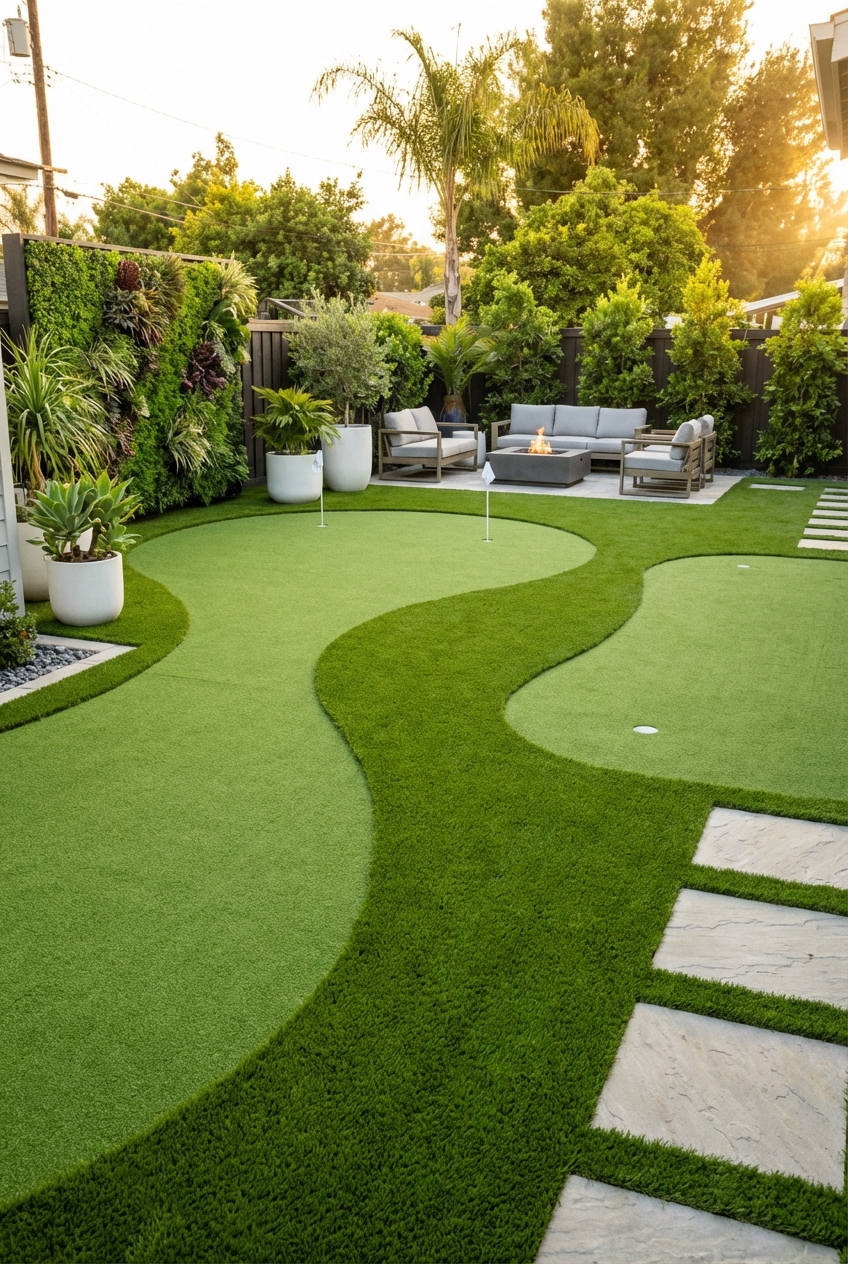
A backyard putting green is a massive trend, but from a design standpoint, it can look tacky if not integrated correctly. The goal is to avoid the “mini-golf” look and aim for “country club estate.”
The key to a high-end look is using two different types of turf. You need the putting surface (short, dense, non-directional blades) and the “fringe” (longer, taller fescue-style grass). The fringe serves a functional purpose by stopping the ball from rolling away, but visually, it blends the manicured green into the rest of the landscape.
When planning the layout, avoid perfect circles or ovals. Organic, kidney-bean shapes or undulating curves look much more natural.
Technical Considerations for Golf
For the putting surface itself, you are looking for a “slit-film” or specialized nylon turf. The speed of the green is determined by the amount of sand infill used.
Measurements to Know:
- Stimp Reading: This measures how fast the ball rolls. A typical backyard green aims for a stimp of 9 to 10.
- Cups: Place cups at least 3 feet away from the edge of the fringe. If they are too close to the edge, you can’t stand comfortably to putt.
- Slope: A perfectly flat green is boring. We usually grade the base to have slight undulations, but keep the slope under 2% to ensure the ball doesn’t roll off on its own.
5. Mixing Materials: Turf, Stone, and Wood
The most successful landscape designs rely on contrast. A sea of green turf can be just as boring as a slab of concrete. To elevate the design, you must break up the materials.
I love using turf adjacent to warm wood decking. The contrast between the warm timber tones (like Ipe or Cedar) and the cool green turf creates a rich, sophisticated palette.
Another strong combination is using “river rock” or Mexican beach pebbles as a border. Instead of running the turf all the way to a fence or a wall, stop it 12 to 18 inches short. Fill that gap with black or grey smooth stones.
The Edge Detail
The difference between a DIY job and a pro install is almost always the edging.
You need a physical barrier between the turf and your flower beds or rock borders. We use “bender board” (a flexible composite edging) or steel edging. This barrier prevents the turf base from washing away and keeps mulch or rocks from migrating onto the grass.
Lighting Integration
Lighting changes the texture of the turf at night.
I recommend uplighting trees that are situated within or near the turf areas. The ambient glow reflects off the grass blades, creating a soft, moonlit effect. Do not aim spotlights directly at the turf, as this can highlight the synthetic sheen of the plastic.
Final Checklist: What I’d Do in a Real Project
If I were consulting on your backyard renovation tomorrow, this is the mental checklist I would run through to ensure longevity and style.
FAQs
- How do I clean dog urine from artificial turf?
- Rinsing with a hose is usually enough for daily maintenance. However, for smell prevention, use an enzyme-based cleaner once a month. Connect it to your hose and spray the area. The enzymes eat the bacteria causing the odor rather than just masking it.
- Does artificial turf fade in the sun?
- High-quality US-manufactured turf is UV stabilized and rigorously tested. It should not fade noticeably for 10 to 15 years. Be wary of cheap, imported options which often lack proper UV inhibitors and can turn blue or grey after a few seasons.
- Can I put furniture on artificial turf?
- Yes, but heavy furniture will leave divots. I recommend moving the furniture slightly every few weeks and using a stiff broom to brush the fibers back up. For permanent heavy items like a swing set, place stone pads under the legs.
- How long does the installation actually last?
- A professional installation with a proper crushed rock base should last 15 to 20 years. The turf itself will eventually show wear in high-traffic paths, but the infrastructure (the base and drainage) lasts much longer.
Conclusion
Integrating artificial turf into your backyard is no longer about compromising on a natural look; it is about embracing a versatile material that solves functional problems while elevating the design. Whether you are creating a geometric grid with pavers, a soft landing zone for kids, or a maintenance-free balcony retreat, the success lies in the details.
Focus on the preparation of the base, the quality of the edging, and the specific needs of your household. By treating turf as a high-end finish rather than a shortcut, you create an outdoor room that remains pristine through seasons, droughts, and playdates.
Picture Gallery
Five photographs · drag or swipe