
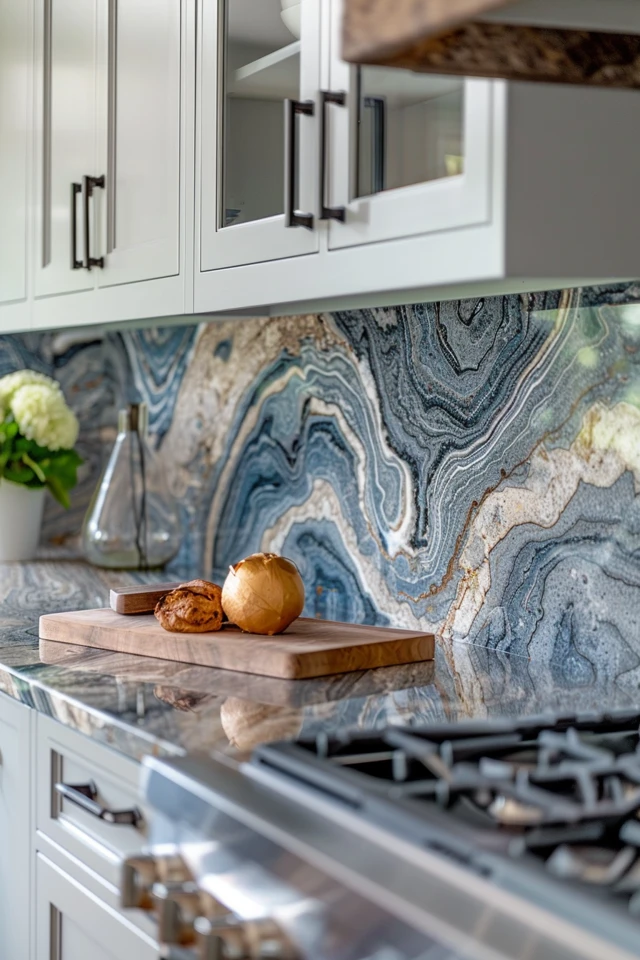
Blue Dunes Granite Backsplash Ideas Unveiled
Blue Dunes granite is one of those rare natural stones that manages to bridge the gap between traditional warmth and modern cool tones. It is characterized by its varying hues of cream, grey, and brown, with distinct ripples of blue that give it its name. Unlike the speckled granites of the early 2000s, Blue Dunes offers movement similar to marble but with the bulletproof durability of granite.
However, selecting the right backsplash for this stone is notoriously difficult because the granite itself is the “hero” of the kitchen. If you choose a backsplash that is too busy, you risk creating a chaotic visual environment. For those who want to jump straight to the visuals, please note that a comprehensive Picture Gallery is available at the end of this blog post.
In my design practice, I view Blue Dunes as a “statement stone.” This means the backsplash needs to act as a supporting character, providing texture and color harmony without fighting for attention. Whether you are doing a full renovation or a simple kitchen refresh, the following guide will help you navigate the complexities of pairing tile with this dynamic surface.
Understanding the Blue Dunes Palette
Before we look at specific tiles, we have to dissect the slab itself. Blue Dunes is an earth-tone powerhouse. It usually features a creamy or off-white background with heavy veining in grey, taupe, and subtle blue-green.
The first step in my design process is identifying the dominant undertone of your specific slab. Natural stone varies wildly from block to block. Some Blue Dunes slabs read very warm and beige, while others lean heavily into cool steel greys and icy blues.
If your slab is warmer, you need to lean toward backsplashes in soft whites, biscuits, or warm taupes. If your slab is cooler, crisp whites, greys, and even navy blues become viable options. Ignoring the specific temperature of your slab is the number one reason homeowners end up with a kitchen that feels “off.”
Option 1: The Full-Height Granite Splash
If budget allows, running the Blue Dunes granite up the wall as a full-height backsplash is the most luxurious and seamless option. This creates a cohesive, high-end look that is increasingly popular in modern transitional kitchens.
Why It Works
A full slab backsplash eliminates grout lines entirely. This is a massive functional benefit for heavy-cooking households, as there is no grout to absorb grease or tomato sauce splatter. Visually, it extends the drama of the stone vertically, making the room feel taller.
The Execution
When doing this, you must ensure you have enough material from the same lot. The movement in the veins needs to transition smoothly from the counter to the wall.
I recommend “vein-matching” where possible, though with granite, a standard transition is often acceptable due to the random nature of the pattern. Ensure your fabricator measures the distance between the counter and the upper cabinets precisely—standard spacing is 18 inches, but this can vary.
Option 2: The Soft White Ceramic Solution
For 80% of my clients using Blue Dunes, a soft white ceramic tile is the correct answer. However, “white” is a deceptive term in interior design. You cannot simply grab a box of bright white subway tile and hope for the best.
Matching the Cream
Blue Dunes rarely pairs well with a stark, hospital-white bright tile. The granite usually has a muddy, organic base. A bright white tile will make the granite look dirty or yellowed by comparison.
Instead, look for “creamy white,” “ivory,” or “biscuit” tones. Bring the tile sample to the slab yard. You want a white that melts into the lightest color found within the granite.
Texture Over Pattern
Since the color is simple, you can play with texture. I love using Hand-molded or Zellige-style tiles here. These tiles have an undulating surface that catches the light differently across the wall.
This adds depth and interest without introducing a geometric pattern that competes with the granite’s movement. It feels organic, just like the stone.
Option 3: Pulling Out the “Blue” with Navy or Slate
If you want drama and moodiness, look at the blue veins in the stone. While the stone is named “Blue Dunes,” the blue is often a subtle steel blue or slate grey.
The Dark Contrast
Using a backsplash in a deep navy, charcoal, or slate blue creates a stunning anchor for the kitchen. This works particularly well if you have white or light wood cabinetry, as it creates a high-contrast sandwich.
Material Choices
For dark colors, I prefer matte finishes over glossy ones. A matte navy tile absorbs light and feels velvety, which contrasts beautifully with the polished, reflective surface of the granite.
If you choose a glass tile in a dark color, be aware that it will reflect everything on your counter. I usually steer clients toward matte ceramic or porcelain for dark backsplashes to reduce glare.
Layout Logic and Grout Selection
The shape of the tile and the color of the grout are just as important as the tile color itself. With a busy stone like Blue Dunes, the layout should generally be quiet.
Tile Patterns
- Standard Brick (Subway): The safest and most timeless choice. It provides structure without chaos.
- Stacked Bond: Stacking rectangular tiles directly on top of each other gives a modern, mid-century feel. This is great for contemporary homes.
- Herringbone: Proceed with caution. Herringbone creates a lot of “visual noise” because of the zig-zag pattern. If you love herringbone, use a grout color that matches the tile exactly to minimize the pattern’s impact.
The Grout Rule
This is a non-negotiable rule in my designs: When pairing a backsplash with busy granite, the grout must match the tile.
If you use white tile with dark grey grout, you create a grid pattern on the wall. That grid will fight with the flowing veins of the Blue Dunes. By matching the grout to the tile (e.g., ivory tile with ivory grout), the backsplash reads as a texture rather than a pattern.
Designer’s Note: The Lighting Lesson
I recently worked on a kitchen renovation in Seattle where the client fell in love with a grey glass backsplash to go with their Blue Dunes. In the showroom, it looked perfect.
Once installed in their home, the “warm dim” LED under-cabinet lighting turned the grey glass a sickly green color. It completely clashed with the warm ripples in the granite.
The Lesson: Glass tile interacts with light differently than ceramic. It has a transparent quality that can be altered by the wall color behind it and the color temperature of your bulbs.
Always test your tile samples vertically (propped up on the counter) with the exact lighting you will have in your finished kitchen. If you are using 3000K LEDs (my preferred standard for kitchens), view the sample under that specific light.
Common Mistakes + Fixes
I see the same errors repeated frequently when homeowners DIY their backsplash selection for granite. Avoiding these will save you time and money.
Mistake 1: Using Small Mosaic Tiles
Many people gravitate toward those 1×1 inch glass and stone mosaic sheets.
The Fix: Avoid mosaics. They create thousands of grout lines and small squares. When placed next to a busy granite, the kitchen looks cluttered and frantic. Stick to tiles that are at least 3×6 inches or larger.
Mistake 2: Leaving the 4-Inch Granite Splash
Builders often install a short 4-inch strip of granite on the wall and then ask you to tile above it.
The Fix: Remove the 4-inch strip before tiling. A tiled backsplash should start directly at the countertop deck. Keeping the 4-inch strip and tiling above it breaks the wall horizontally and makes the ceiling feel lower.
Mistake 3: Ignoring the Cabinet Color
Focusing only on the counter and ignoring the upper cabinets.
The Fix: Your backsplash must harmonize with both. If you have warm white cabinets and a cool grey tile, the cabinets will look yellow. The tile must bridge the gap between the cabinet finish and the countertop stone.
What I’d Do in a Real Project
If I were designing a kitchen with Blue Dunes granite today, here is the exact checklist I would follow to ensure success.
- Step 1: Secure the slab first. I would take a photo of the specific slab and bring a physical piece (if possible) to the site.
- Step 2: Set the lighting. I would ensure all recessed cans and under-cabinet lights are 3000K. 2700K is too yellow; 4000K is too blue.
- Step 3: Select a “Handmade Look” Subway Tile. I would choose a 2.5″ x 8″ ceramic tile in a “Cloe” or “Zellige” style.
- Step 4: Color Match. I would hold the tile against the lightest creamy vein in the granite. It must be a near-perfect match.
- Step 5: Layout. I would install it in a standard brick pattern with a tight 1/16-inch grout line.
- Step 6: Grout. I would select a grout color that matches the tile face exactly (no contrast).
Final Checklist
Before you order materials, run through this final summary to ensure you haven’t missed any critical details.
- Undertones: Have you identified if your Blue Dunes slab is warm (beige) or cool (grey)?
- Scale: Is the tile large enough to not look busy? (Avoid small mosaics).
- Lighting: Have you viewed the sample in your kitchen at night with the lights on?
- Finish: If the granite is polished, have you considered a matte tile to create contrast?
- Quantity: Did you order 15% extra tile for cuts and breakage?
- Height: Did you measure the distance from counter to cabinet? (Standard is 18 inches).
FAQs
Q: Is Blue Dunes granite outdated?
A: No. While “speckled” granite is considered dated, Blue Dunes has organic veining that mimics high-end quartzite or marble. It fits perfectly into the current trend of warm, earthy, organic kitchens.
Q: Can I use a patterned cement tile with Blue Dunes?
A: I generally advise against it. Cement tiles usually have strong geometric patterns. Blue Dunes has a strong fluid pattern. Mixing geometry with fluid veins usually results in a clash. If you must, keep the colors very muted.
Q: What is the best backsplash for resale value?
A: A cream or off-white ceramic subway tile. It offends no one, makes the kitchen look bright and clean, and allows the new owner to appreciate the granite without distraction.
Q: How do I clean the grout behind the stove?
A: If you use a light grout, apply a high-quality penetrating sealer immediately after installation. Re-seal it once a year. For heavy cookers, a full-height granite splash behind the range only (with tile everywhere else) is a great practical compromise.
Conclusion
Blue Dunes granite is a spectacular material that brings nature’s artistry into your home. It creates a warm, inviting atmosphere that sterile white quartz simply cannot replicate. The key to a successful design is letting the stone shine.
By choosing a backsplash that offers quiet support—through color harmony, appropriate scale, and subtle texture—you create a kitchen that feels curated and professional. Remember to trust your eye, test your samples under your own lighting, and when in doubt, simplify. The stone has enough personality for the whole room; your backsplash just needs to hold its hand.
Picture Gallery


