
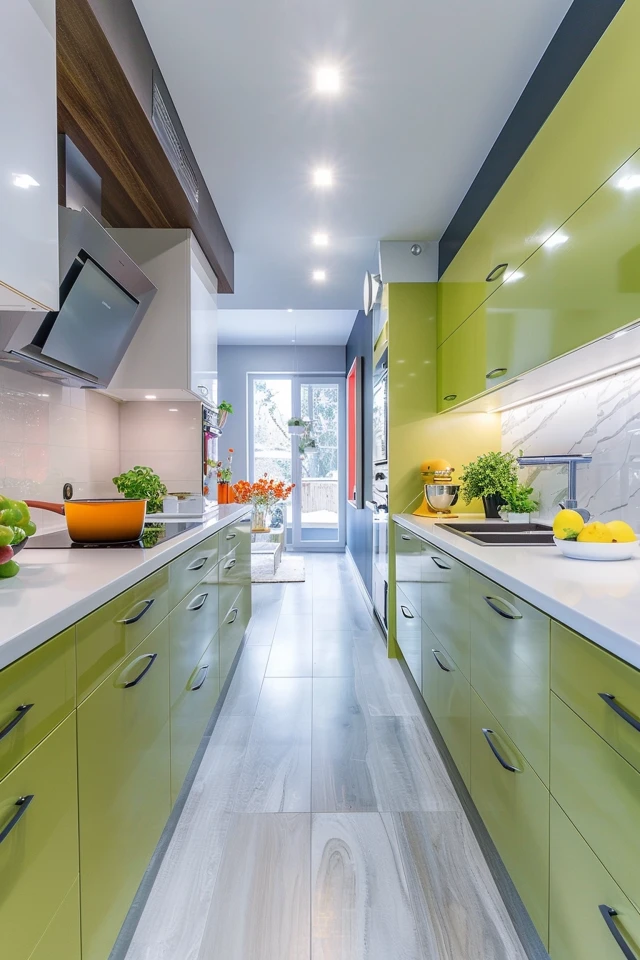
Brighten Up Your Space: Galley Kitchen Lighting Ideas
Designing for a galley kitchen is a distinct challenge that I encounter frequently in my practice. These narrow, corridor-style layouts are incredibly efficient for cooking, but they often suffer from the “tunnel effect.” Without the right lighting strategy, the space can feel cramped, dark, and uninviting.
Many homeowners assume that one central ceiling fixture is enough to illuminate a small footprint. In reality, a single light source in a galley kitchen is the quickest way to create harsh shadows right where you are trying to chop vegetables. You block the light with your own body when standing at the counter, making prep work frustrating and dangerous.
I have spent years transforming dark, narrow kitchens into bright, functional workspaces. If you are looking for visual inspiration, you can jump right to the Picture Gallery at the end of this blog post. However, if you are ready to learn the technical rules of layering light in a tight space, keep reading for my full guide.
1. The Foundation: Layering Light in a Corridor Layout
The biggest mistake I see in DIY kitchen renovations is relying on a single layer of light. In a galley kitchen, you do not have the luxury of borrowed light from adjacent open-concept spaces. You have to manufacture depth and dimension yourself.
To make a narrow kitchen feel wider and taller, you need three distinct layers: ambient, task, and accent lighting. Ambient lighting is your base layer, usually provided by recessed cans or flush mounts. It allows you to navigate the room safely.
Task lighting is the workhorse of the kitchen. This is specific, directional light that illuminates your countertops, stove, and sink. In a galley layout, this is usually achieved through under-cabinet lighting. Without it, your upper cabinets cast a shadow over your workspace.
Accent lighting is the final layer that adds personality. This might be a picture light over a piece of art on the blank wall, or toe-kick lighting at the base of the cabinets. It provides a soft glow at night and makes the room feel finished.
Designer’s Note:
When planning your layers, always put each layer on a separate switch. You do not want your bright task lights on when you are grabbing a glass of water at midnight. I always insist on dimmer switches for the ambient and accent layers to control the mood.
2. Overhead Lighting: Recessed Cans and Flush Mounts
In a galley kitchen, floor space is premium real estate. You rarely have room for floor lamps, and even pendant lights can feel cluttering if the ceiling is low. This is why recessed lighting (can lights) or low-profile flush mounts are often the best choice for your ambient layer.
The placement of recessed lighting is critical. A common amateur error is placing the lights directly down the center of the walkway. This creates the “cave effect” I mentioned earlier. The light hits the floor beautifully, but your counters remain dark.
The Placement Rule:
For optimal illumination, place your recessed lights approximately 24 to 30 inches away from the wall. This positions the beam directly over the edge of your countertops. When the light hits the counter, it reflects back into the room, making the space feel brighter. It also ensures the light is in front of you, not behind you, while you work.
If you cannot install recessed lighting due to budget or structural constraints, track lighting is a fantastic alternative for galleys. It allows you to use a single junction box to power multiple heads. You can aim some heads at your cabinets and others at the walls.
Illuminating the vertical surfaces (cabinet fronts and walls) pushes the visual boundaries of the room outward. This optical illusion makes the narrow corridor feel significantly wider.
3. Task Lighting: Eliminating Shadows
If you only implement one upgrade from this guide, make it under-cabinet lighting. In a galley kitchen, where wall space is dominated by cabinetry, the area underneath the uppers is naturally the darkest part of the room.
There are two main types of under-cabinet lighting: puck lights and linear strip lights. I almost always specify linear LED strip lights for my clients. Puck lights create pools of light with dark spots in between, known as “scalloping.” This can look dated and doesn’t provide even illumination for slicing and dicing.
Linear strips provide a continuous wash of light. When installing these, mount them as close to the front of the upper cabinet as possible, just behind the face frame or light rail. If you mount them against the back wall, they will highlight the backsplash texture but fail to light the center of your cutting board.
Color Temperature Matters:
For kitchen task lighting, accuracy is key. You want to see the true color of your food. I recommend a Kelvin rating between 3000K and 3500K. This is a crisp, white light. Anything lower (2700K) will look too yellow and sleepy for a workspace. Anything higher (4000K+) can feel sterile and clinical, like a hospital.
For Renters:
If you are renting and cannot hardwire lights, look for rechargeable, motion-sensor LED bars. They attach with magnetic strips and can make a massive difference in functionality without risking your security deposit.
4. Decorative Fixtures: Adding Style Without Clutter
Just because a space is functional doesn’t mean it has to be boring. However, in a narrow galley, you must be careful with scale. A giant chandelier will visually shrink the room and obstruct sightlines.
If you have a window at the end of your galley (a common layout), installing a statement pendant or a sconce above the sink is a perfect way to draw the eye through the room. This creates a focal point at the end of the “tunnel,” which lengthens the space visually.
If your ceilings are higher than eight feet, you might consider two or three small pendants down the center of the walkway. However, this only works if the walkway is at least 48 inches wide. If your kitchen is tighter than that, pendants can make the room feel claustrophobic.
Semi-Flush Mounts:
A great compromise between a flat recessed light and a dangling pendant is a semi-flush mount. These fixtures hang down just a few inches (usually 4 to 8 inches) from the ceiling. They allow light to bounce off the ceiling as well as cast downward, providing a softer, more diffused glow than a recessed can.
Material Selection:
In a small space, materials affect light perception. Clear glass shades are excellent because they take up very little visual weight. Metallic finishes like polished nickel or brass can act as mini-mirrors, bouncing light around the room. Avoid heavy, opaque shades in black or dark bronze unless you have abundant natural light.
5. Expanding the Space: Optical Illusions with Light
Lighting is not just about visibility; it is about architecture. In a galley kitchen, your primary goal is to mitigate the narrow feeling. We can use light to “cheat” the dimensions of the room.
One of my favorite tricks is washing the walls with light. If you have a blank wall opposite your cabinets, do not leave it dark. Install shallow wall sconces or use adjustable track heads to bathe that wall in light. When walls are bright, they appear to recede, making the room feel wider.
Another technique is toe-kick lighting. This involves installing LED tape light at the very bottom of your base cabinets, in the recessed toe-kick area. When this area is illuminated, it creates a “floating” effect for the cabinets. It separates the floor from the cabinetry, which increases the perceived floor area.
Mirrors and Reflection:
While not a light fixture, introducing reflective surfaces amplifies your lighting plan. Consider a glossy tile backsplash rather than a matte one. The gloss will catch the under-cabinet light and reflect it into the room. If you have a windowless galley, placing a mirror on a stretch of wall can mimic a window, bouncing light around and breaking up the solid surfaces.
Designer’s Note: Common Mistakes + Fixes
Throughout my career, I have seen the same lighting errors repeated in galley kitchens. Here is a quick guide to identifying and fixing them.
Mistake 1: The “Runway” Effect
The Issue: Lining up recessed lights in a perfectly straight line down the exact center of the ceiling.
The Fix: If your walkway is wide enough, stagger the lights slightly or push them toward the counters. If you must center them, ensure they have a wide beam angle (spread) to reach the cabinets.
Mistake 2: Ignoring the Corners
The Issue: The ends of the galley kitchen are often left in shadow, making the room feel shorter than it is.
The Fix: Ensure your lighting plan extends all the way to the end walls. A recessed light should be placed roughly 24 inches from the end wall to wash it with light.
Mistake 3: Mixing Color Temperatures
The Issue: Having cool white daylight bulbs (5000K) in the ceiling and warm yellow bulbs (2700K) under the cabinets. This creates a jarring, unpolished look.
The Fix: Standardize your bulbs. I stick to 3000K for everything in the kitchen. It blends well with halogen and other incandescent sources in adjacent living rooms.
What I’d Do: The Real Project Checklist
If I were designing a galley kitchen for a client tomorrow, this is the exact checklist I would follow to ensure success.
- Assess Natural Light: Note where the window is. Is it north-facing (cool light) or south-facing (warm light)? This helps decide if I need more fixtures.
- Establish the Grid: Map out recessed lights to align with the edge of the countertops, not the center of the floor.
- Select High CRI Bulbs: I only buy bulbs with a CRI (Color Rendering Index) of 90 or higher. This ensures wood tones, food, and paint colors look accurate.
- Hardwire Under-Cabinet Lights: I plan for the transformer location early in the renovation so hidden wires are possible.
- Choose a Focal Point: Select one decorative fixture (sink pendant or semi-flush) to anchor the design so it doesn’t feel purely utilitarian.
- Install Dimmers: Every switch gets a dimmer. Cooking requires 100% brightness; hosting a party requires 50% brightness.
FAQs
How many lumens do I need for a small galley kitchen?
For a kitchen, you generally need about 30 to 40 foot-candles of light for general areas and 70 to 80 foot-candles for task areas. In plain English, for a standard 40-square-foot galley walkway, aim for at least 2,000 to 3,000 lumens total from your ambient lighting.
Can I use a chandelier in a galley kitchen?
You can, but be mindful of width. A round chandelier can make a narrow room feel tighter. A linear fixture (lantern style or island light) that runs parallel to the cabinets often looks better. Ensure the bottom of the fixture is at least 7 feet off the floor so it doesn’t obstruct movement.
What is the best way to light a rental galley kitchen?
Plug-in wall sconces are a great option if you have open wall space. They add style and light without wiring. Also, use high-quality battery-operated LED bars under cabinets. Swap out any existing ceiling bulbs for high-lumen, high-CRI bulbs to instantly upgrade the light quality.
Do dark cabinets require more light?
Yes, absolutely. White cabinets reflect light; dark navy, black, or wood cabinets absorb it. If you choose dark cabinetry, you should increase your lumen output by roughly 20% to 30% to compensate for the absorption.
Conclusion
Lighting a galley kitchen is about more than just buying a bright bulb. It requires a strategic approach that addresses the unique geometry of the space. By layering your light sources, prioritizing task lighting, and using placement to visually expand the walls, you can turn a dark corridor into a bright, welcoming culinary space.
Remember that flexibility is key. Your kitchen needs to function as a laboratory for cooking but also as a warm part of your home for entertaining. Dimmers and separate zones give you that control.
Whether you are tearing down drywall for a full renovation or just looking for a weekend upgrade with plug-in fixtures, improving your lighting is the highest-ROI change you can make in a galley kitchen. It changes how the paint looks, how the space feels, and how easily you can work.
Picture Gallery


