
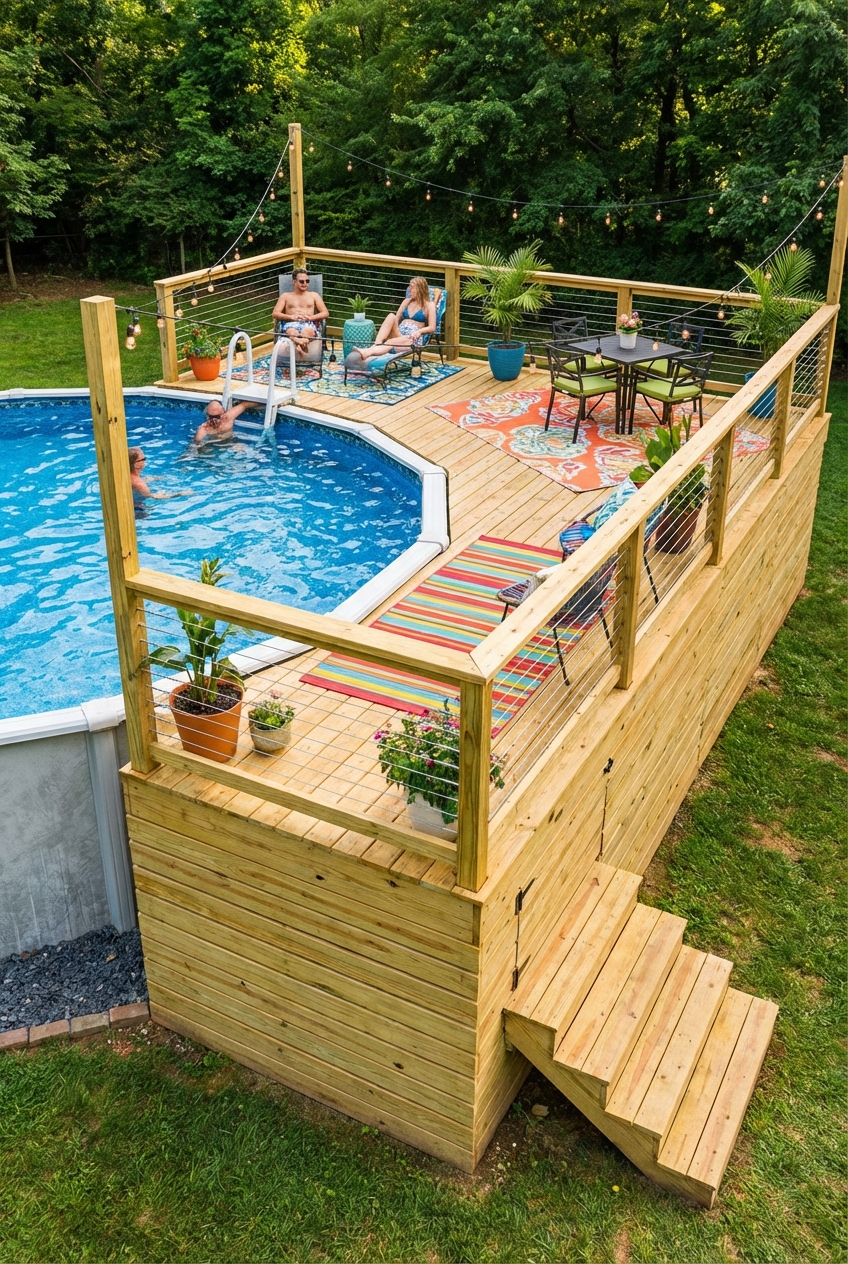
Budget-Friendly Above Ground Pool Deck Ideas
One of the most frequent challenges I encounter with clients is integrating an above-ground pool into the landscape without it looking like a temporary afterthought. We all know the “blue blob” effect where the pool dominates the backyard visually. The solution is almost always a deck, but full-wrap custom decks can easily cost more than the pool itself.
However, you do not need an unlimited budget to create a resort-style feel. By being strategic about the deck’s footprint, materials, and flow, we can create a functional and beautiful space that respects your wallet. I have designed plenty of backyards where a simple 10×10 platform completely transformed the swimming experience.
For plenty of visual inspiration to spark your creativity, be sure to check out the Picture Gallery at the end of this blog post.
1. Strategic Layouts: The “Splash Pad” Approach
The biggest misconception about pool decks is that they must wrap around the entire circumference of the pool. This is the quickest way to blow your budget on lumber and labor. Instead, I always recommend what I call the “Splash Pad” or a side-deck approach.
This layout creates a dedicated entry point and a lounging zone on just one side of the pool. By focusing your budget on a smaller square footage, you can afford better finishes and furniture. A 12×12 foot freestanding deck adjacent to the pool provides ample space for two lounge chairs and a small bistro table.
This approach also simplifies the structural engineering. A freestanding rectangular deck is much easier to build than a curved structure that follows the pool’s wall. You eliminate the complex cuts and waste associated with circular designs.
Designer’s Note: The Transition Zone
One failure point I often see in DIY projects is a lack of connection between the ground and the deck. If your deck is just a floating platform, it feels disconnected.
To fix this, I always design wide “stadium stairs” leading up to the deck. Instead of a standard 3-foot wide staircase, extend the steps to 5 or 6 feet wide. This creates a visual anchor and provides extra seating for guests who want to chat but don’t want to swim.
2. Material Selection: Where to Save and Splurge
When working with a tight budget, pressure-treated (PT) pine is your best friend. It is significantly cheaper than cedar, redwood, or composite materials. Many homeowners fear PT wood because they think it looks cheap, but the secret lies in the stain and maintenance.
I recommend letting the pressure-treated wood cure for a few months until it is dry to the touch, and then applying a semi-solid stain. A dark charcoal or a deep walnut stain can make inexpensive pine look like high-end hardwood. It creates a modern, sophisticated contrast against the blue water.
If you have a little wiggle room in the budget, try the “cocktail rail” trick. Build the frame and floor out of pressure-treated lumber, but use composite decking for the top cap of your handrails. This is where people lean and rest their hands, so having a splinter-free, smooth surface adds a tactile sense of luxury without the cost of a full composite deck.
Common Mistakes + Fixes
Mistake: Using standard nails for decking boards.
Fix: Always use polymer-coated deck screws. Nails will eventually pop up as the wood expands and contracts, creating a safety hazard for bare feet. Screws hold tight and allow you to easily replace a board if it warps.
Mistake: Installing boards tight against each other.
Fix: Use a 16-penny nail as a spacer between boards during installation (roughly 1/8 to 1/4 inch). This gap is crucial for drainage and airflow. Without it, water pools on top, accelerating rot and mold growth.
3. Scale and Flow: Managing Traffic
Even a small budget deck needs to handle traffic flow properly. In interior design, we follow strict rules about clearances, and outdoor spaces are no different. You need to account for the “wet zone” (the path from the stairs to the pool ladder) and the “dry zone” (where furniture sits).
Never block the path to the pool with furniture. A good rule of thumb is to keep a clear 36-inch pathway from the deck stairs to the pool entry. This prevents swimmers from dripping water over people who are sunbathing and reduces slip hazards.
For the furniture area, ensure you have room to move. If you place a sun lounger on the deck, you need at least 24 inches of clearance on one side for easy access. If you are tight on space, avoid bulky deep-seating sets. Opt for Adirondack chairs or sleek metal loungers that take up less visual and physical weight.
What I’d Do in a Real Project
If I were consulting on a budget deck today, here is the checklist I would use to maximize space perception:
- Build the railing at 36 inches high: Unless local code requires 42 inches, a slightly lower rail keeps the view open, making the deck feel larger.
- Run decking boards diagonally: Installing floorboards at a 45-degree angle increases rigidity and makes the space feel wider, though it does require slightly more cutting.
- Cantilever the edge: Allow the deck boards to overhang the rim joist by 1 to 1.5 inches. This creates a finished shadow line that looks professional.
4. Safety and Privacy Integration
Safety is non-negotiable, especially with elevated decks. The most budget-friendly way to secure the area is often a gate at the bottom of the stairs rather than at the top. This keeps the deck itself as a secure zone. Ensure the gate is self-closing and self-latching, with the latch at least 54 inches high to be out of reach of small children.
For privacy, you don’t need to build a fortress. A full privacy fence around a raised deck can make you feel like you are in a cage. Instead, use strategic screening.
Identify the neighbor’s sightline and place a 6-foot wide trellis or privacy screen just in that section. You can build a simple frame with 2x4s and horizontal 1×2 slats spaced 1 inch apart. This looks modern and allows airflow while blocking the view.
Landscape Integration
The area underneath an above-ground pool deck is often an eyesore. It usually becomes a collection of weeds and pool equipment. To hide this without buying expensive lattice, use landscaping.
Plant tall ornamental grasses like Feather Reed Grass or Miscanthus around the perimeter of the deck. They grow fast, they are inexpensive, and they soften the hard edges of the wood structure. Within two seasons, they will hide the structural posts and the underside of the deck completely.
5. Lighting and Styling on a Dime
Lighting transforms a utilitarian platform into an evening entertainment space. You do not need to hire an electrician to run hardwired post caps. Solar post caps have improved significantly in recent years. Look for caps with a “warm white” (2700K-3000K) rating rather than the harsh “cool white” that looks like a parking lot.
Bistro lights are another high-impact, low-cost solution. However, avoid draping them haphazardly. Install 8-foot poles at the corners of your deck (secure them to the railing posts) and string the lights in a perimeter or an X-pattern. This creates a “ceiling” that makes the deck feel like an outdoor room.
When it comes to textiles, an outdoor rug is essential for defining the lounging zone. It also protects bare feet from hot wood and potential splinters. Choose a rug made of polypropylene, which resists mold and fading. Size the rug so that the front legs of your chairs sit on it—usually, a 5×8 or 8×10 is appropriate for standard pool decks.
Designer’s Note: The “Rule of Three” for Decor
When styling your deck, avoid clutter. I use the rule of three for accessories. For example, group a lantern, a small potted succulent, and a citronella candle on a side table.
For planters, use the same rule. Group three pots of varying heights in a corner. This creates a focal point without taking up valuable floor space. Ensure your pots are heavy enough (ceramic or stone) so they don’t blow over in the wind, but be mindful of total weight on the deck structure.
Final Checklist: Budget Deck Success
Before you buy your first lumber delivery, run through this final check to ensure your project stays on track and looks professional.
- Check Local Codes: Verify setback requirements from property lines and specific pool safety codes regarding gate latches and railing heights.
- Confirm Equipment Access: Ensure your deck design does not block access to the pool skimmer, pump, or filter. You will need to get to these daily.
- Slip Resistance: If using paint or solid stain, mix in a non-slip additive. Wet decks are incredibly slippery.
- Joist Tape: Spend the extra $50 for butyl joist tape. Apply it to the top of your joists before laying decking. It seals the nail holes and prevents rot, doubling the life of your frame.
- Hardware Quality: verify all hangers, brackets, and screws are rated for pressure-treated lumber (usually hot-dipped galvanized or stainless steel).
- Gate Swing: Ensure your safety gate swings away from the pool, so if the latch fails, a child pushing on it won’t fall toward the water.
FAQs
Do I need a permit for an above-ground pool deck?
Yes, in almost all municipalities, a deck requires a building permit. This is especially true for pool decks due to safety regulations regarding barriers and latching mechanisms. Skipping this step can lead to fines or being forced to tear it down when you sell the house.
Can I attach the deck directly to the pool?
No, you should never attach the deck structure to the pool wall. Above-ground pools are designed to hold water pressure, not the lateral load of a deck. The deck should be a freestanding structure that sits close to the pool (within 1/2 inch) without touching it.
What is the best foundation for a budget deck?
For low-level decks, pre-cast concrete deck blocks are often allowed and are much easier and cheaper than pouring concrete footings. However, if the deck is higher than 30 inches or in a freeze-thaw zone, you may be required to dig proper footings below the frost line.
How do I calculate how much lumber I need?
Calculate the square footage of your deck and add 15% for waste and cuts. For railing, measure the linear footage of the perimeter. Always buy slightly more than you think you need; returning a few boards is easier than halting construction to run to the store.
Conclusion
Building a deck for your above-ground pool doesn’t have to drain your savings account. By prioritizing a smart layout over massive square footage, choosing cost-effective materials like pressure-treated pine, and using landscaping to soften the edges, you can achieve a high-end look.
Remember that the goal is to create a safe, comfortable zone that encourages you to use your pool more often. It is about functionality and flow, not just size. Start with a solid plan, pay attention to the safety details, and style it with intention. With these steps, you will be enjoying your new poolside retreat long before the summer ends.
Picture Gallery


One thought on “Budget-Friendly Above Ground Pool Deck Ideas”