
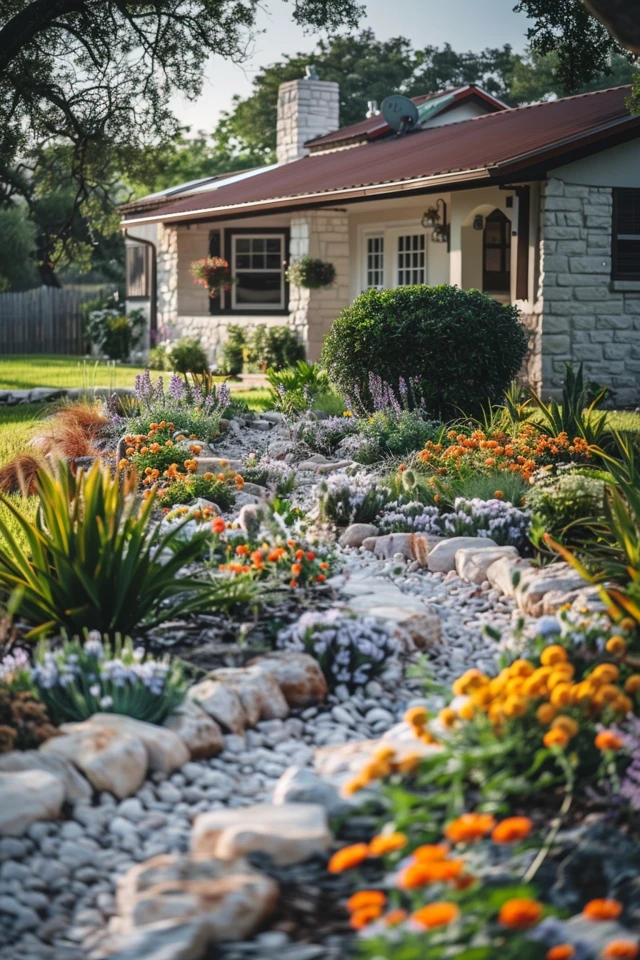
Charming Landscape Ideas for Ranch Style House
Ranch-style homes are experiencing a massive resurgence in popularity, and for good reason. Their single-story layouts offer an ease of living that is hard to beat, but their long, low architectural profiles present a unique set of challenges when it comes to curb appeal. I often see homeowners struggling with how to landscape these properties because standard design rules don’t always apply to such horizontal facades.
When I work on a ranch renovation, my primary goal is to soften the boxy geometry without fighting the home’s inherent mid-century character. You want to create depth and interest without hiding the house behind a wall of overgrown shrubbery. If you are looking for specific visual examples of these transformations, be sure to check out the Picture Gallery at the end of this blog post.
The secret lies in balancing the strong horizontal lines of the roof with vertical planting elements and curving hardscapes. In this guide, I will walk you through the exact strategies I use to turn flat ranch exteriors into charming, dimensional landscapes. We will cover everything from bed depths and plant layering to lighting and hardscaping materials.
1. Softening the Rectangular Geometry
The defining feature of almost every ranch house is the rectangle. You have a rectangular footprint, rectangular windows, and a long, horizontal roofline. If you mirror this with straight flower beds and a straight concrete path, the house can feel severe and uninviting.
To counter this, I almost always introduce organic curves into the landscape beds. This doesn’t mean you need a kidney-bean-shaped pool in the front yard, but the transition from lawn to garden bed should have a gentle, sweeping flow. This disrupts the rigid grid of the architecture and draws the eye across the property rather than just straight at the front door.
The Rule of Bed Depth
One of the most common mistakes I see is flower beds that are too shallow. A standard 3-foot deep bed pushed up against the foundation does nothing for a ranch house. It looks like a green mustache applied to the facade.
In my projects, I insist on landscape beds that are at least 6 to 8 feet deep. This depth is crucial because it allows us to layer plants (which we will discuss in the next section) rather than planting them in a single soldier row. A deep bed creates a sense of luxury and permanence that shallow beds simply cannot achieve.
Designer’s Note: The “Landing Strip” Walkway
Avoid a straight, narrow concrete path from the street to the front door. This emphasizes the boxiness of the home. Instead, curve the walkway. If space allows, flare the walkway where it meets the driveway and where it meets the porch. I recommend a minimum width of 48 inches for the main entry path so two people can walk side-by-side comfortably.
2. Layering Plants for Vertical Interest
Because ranch homes are low-slung, usually capping out at 12 to 15 feet high, you have to be very careful with vertical scale. If you plant a tree that will grow to 60 feet right in front of the house, you will dwarf the structure and make it look like a shed.
However, if you only plant low ground cover, the house feels exposed. The solution is creating layers of height that bridge the gap between the ground and the roofline. I use a “stair-step” approach to planting that builds volume gradually.
The Three-Layer System
- The Back Layer (Foundation): These should be your evergreens that provide year-round structure. I look for shrubs that max out at roughly two-thirds the height of the windows. You never want to block natural light. Boxwoods or Yews are classic choices here, kept neatly trimmed.
- The Middle Layer (Texture): This is where you add loose, flowing shapes to contrast the rigid house. Hydrangeas, ornamental grasses, or flowering perennials work beautifully here. I aim for plants that sit about 18 to 24 inches lower than the back layer.
- The Front Layer (Border): This creates the crisp edge between the lawn and the bed. Low-growing perennials like Liriope, Coral Bells, or creeping phlox work well. This layer softens the hard edge of the soil.
Common Mistakes + Fixes
Mistake: Planting a massive shade tree (like an Oak or Maple) within 10 feet of the front door to create shade.
Fix: Move large canopy trees at least 20 to 30 feet out from the foundation. For areas closer to the house, use ornamental understory trees like Dogwoods, Japanese Maples, or Redbuds. These typically top out at 15–25 feet, which is in perfect proportion to a single-story ranch.
3. Hardscaping and The Entry Experience
Ranch homes often have modest entryways. Unlike colonials with grand porticos, the ranch front door can sometimes get lost in the long facade. Hardscaping is your best tool for correcting this visual imbalance and signaling to guests exactly where to go.
I like to create a “front courtyard” feel if the setback allows. By extending a paved area or a small patio off the front porch, you extend the living space outdoors—a core tenet of the original mid-century ranch philosophy.
Material Selection
The materials you choose should complement the era of the home. If you have a brick ranch, avoid using red brick pavers for the walkway; it’s too much red. Instead, opt for a contrasting material:
- Slate or Flagstone: The irregular shapes add organic texture.
- Exposed Aggregate Concrete: This has a retro feel that fits perfectly with mid-century modern aesthetics.
- Large Format Pavers: Modern 24×24 inch concrete pavers with grass or gravel joints look fantastic and modernize a dated exterior.
What I’d Do in a Real Project
If I were renovating a standard 1960s ranch today, I would build a low sitting wall (about 18–20 inches high) perpendicular to the house, creating a semi-private entry courtyard. This wall adds a horizontal line that mimics the architecture but brings it forward into the landscape, creating depth. I would face it with natural stone veneer to add texture.
4. Embracing the Indoor-Outdoor Connection
One of the best features of ranch architecture is the connection to the backyard, usually via sliding glass doors. In landscape design, we need to treat the rear patio not as a separate entity, but as a room without a roof. The flow from the living room to the patio should be seamless.
When designing the rear landscape, I focus heavily on “zoning.” Since the house is long, the backyard often mirrors that width. Breaking the backyard into distinct functional zones prevents it from looking like a football field.
Creating Zones
I typically establish three distinct zones in a ranch backyard:
- Dining Zone: Ideally located closest to the kitchen or sliding doors. This needs hard paving (concrete or pavers) for stability.
- Lounging Zone: This can be slightly offset or stepped down. I often use softer materials here, like an outdoor rug over decking, or even a gravel fire pit area.
- Active Zone: This is the open lawn for pets or kids. Keeping this visually separate from the dining area makes the yard feel larger and more organized.
Privacy Considerations
Because ranch homes are single-story, you don’t need massive trees for privacy from neighbors unless they have two-story homes. A strategic row of Emerald Green Arborvitae or a modern horizontal slat fence is usually sufficient to screen the patio area without making the yard feel enclosed.
5. Lighting the Long Facade
Lighting is the most underutilized tool in landscaping, especially for ranch homes. Because the facade is so wide, dark spots are very noticeable at night. Proper lighting creates rhythm and highlights the horizontal expanse of the home in a positive way.
You want to avoid the “airport runway” look, where path lights are placed every 2 feet along the walkway. That looks cluttered and amateur. Instead, use light to paint a picture of the house after dark.
Strategic Placement
- Wash the Walls: Use soft wash lights placed in the landscape beds to shine back onto the house foundation. This highlights the texture of brick or stone and grounds the house.
- Uplight the Corners: Place uplights at the far left and right corners of the house. This defines the boundaries of the structure and prevents it from disappearing into the darkness.
- Silhouette Trees: If you have those ornamental trees we discussed earlier (Japanese Maples, etc.), place a light fixture at the base aiming up into the canopy. This creates a dramatic focal point that draws the eye away from the flat roofline.
Kelvin Temperature Matters
For residential landscapes, always stick to 2700K or 3000K LED bulbs. 2700K is a warm, inviting white (like an incandescent bulb). 3000K is slightly crispier but still neutral. Anything higher (4000K-5000K) will look blue and clinical, like a gas station.
Final Checklist: The Ranch Refresh
If you are about to break ground or head to the nursery, use this checklist to ensure you are staying true to the design principles we discussed. This is the mental list I run through on every consultation.
Planning & Layout
- Bed Depth: Are the front beds at least 6 feet deep? If not, widen them before planting.
- Walkway Width: Is the main path at least 4 feet wide?
- Curve Check: Have I introduced curved lines to offset the rectangular house?
Plant Selection
- Height Limit: Do I have plants that will block windows? (Check mature sizes on tags, not current sizes).
- Tree Scale: Are large trees pushed back at least 20 feet from the foundation?
- Winter Interest: Do I have roughly 30-40% evergreen plants so the yard isn’t bare in winter?
Finishing Touches
- Mulch Color: Am I using a natural brown or dark mulch? (Avoid dyed red mulch; it distracts from the house).
- Lighting: Do I have lights highlighting the house corners and key trees?
- House Numbers: Are the house numbers large, modern, and well-lit? (A crucial detail for curb appeal).
Frequently Asked Questions
What is the best low-maintenance shrub for the front of a ranch house?
For a foolproof, low-maintenance option, I love the ‘Green Velvet’ Boxwood or dense spreading Yew. They grow slowly, keep their shape with minimal pruning, and stay green all year. If you want flowers, the ‘Bobo’ Hydrangea is excellent because it stays small (around 3 feet) and won’t block your windows.
How do I landscape a ranch house on a tight budget?
Focus on the beds first. Expanding the shape of your landscape beds costs nothing but sweat equity. Remove the sod to create deep, curved beds. Then, use gravel or crushed stone for walkways instead of pavers or concrete—it’s significantly cheaper and looks very chic and modern. Finally, buy smaller plants. A 1-gallon shrub will catch up to a 3-gallon shrub in about two years.
Can I use a fence in the front yard of a ranch style home?
Yes, but keep it low and transparent. A solid 6-foot fence kills the curb appeal of a ranch. A horizontal slat fence that is 36 to 42 inches high adds architectural interest and defines a courtyard without hiding the home. It pairs beautifully with the mid-century aesthetic.
My ranch is plain vinyl siding. How do I add character with landscaping?
If the house lacks texture, the landscaping must provide it. Use plants with varied textures—combine the broad leaves of Hostas with the feathery fronds of ferns and the spikes of ornamental grasses. Also, adding a large boulder or two into the garden beds adds a heavy, permanent natural element that contrasts well with vinyl siding.
Conclusion
Landscaping a ranch-style house is all about respecting its horizontal nature while introducing the softness and depth it often lacks. By widening your beds, layering your plants, and treating your outdoor spaces as extensions of your indoor rooms, you can elevate a simple structure into a stunning home.
Remember that landscaping is a process. You don’t have to do it all at once. Start by reshaping the beds and establishing your “back layer” of evergreens. Once that structure is in place, you can have fun filling in the textures and colors over time. The goal is a home that feels grounded, welcoming, and intentionally designed.
Picture Gallery


