
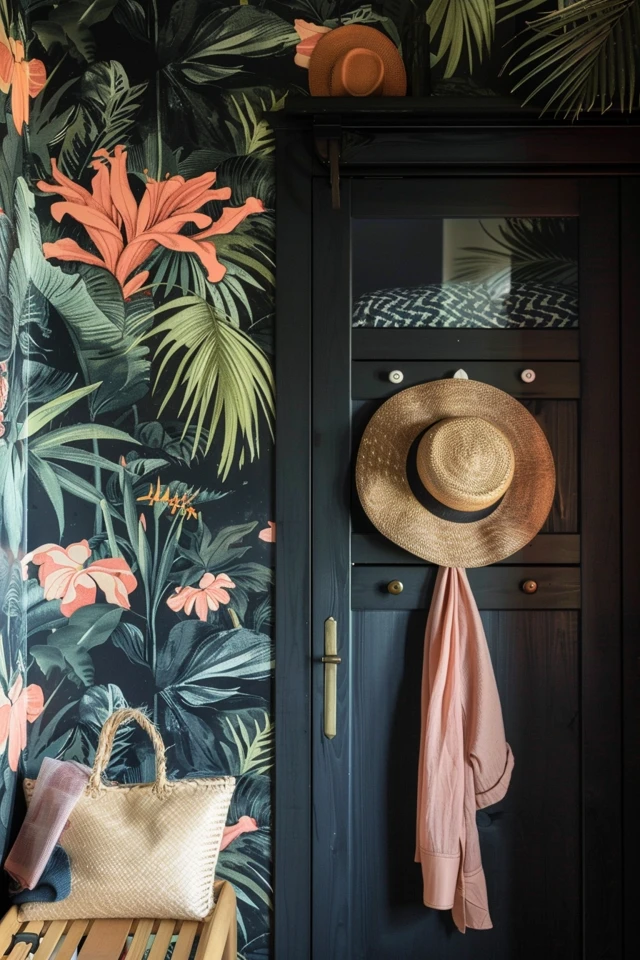
Chic Closet Wallpaper Ideas for a Stylish Space
There is nothing quite like opening a closet door and being greeted by a burst of pattern and color, transforming a mundane daily routine into a boutique experience. Closets are often the most overlooked spaces in a home, yet they are the first places we visit in the morning and the last we see at night. We have compiled a comprehensive Picture Gallery at the end of this blog post to help you visualize these concepts in real homes.
In my years as an interior designer, I have found that small, enclosed spaces like closets or powder rooms are actually the best candidates for bold design risks. Because the door is usually closed, you do not have to worry about the wallpaper clashing with the adjacent bedroom or hallway. It is a “jewel box” moment designed entirely for your enjoyment.
Whether you have a sprawling walk-in with a center island or a standard reach-in rental closet, adding wallpaper is the single most effective way to elevate the space. It creates a backdrop that makes your clothing look more expensive and your morning routine feel more organized. Below, we will explore the rules of scale, material selection, and lighting to ensure your project is a success.
1. The “Jewel Box” Effect: Why Boldness Wins in Small Spaces
The biggest misconception homeowners have is that small spaces require small, subtle prints. In reality, tiny patterns often read as “visual noise” or clutter when viewed from a distance. In a closet, which is already filled with the visual texture of clothing, shoes, and hangers, you need a design that holds its own.
I always encourage clients to go big with scale in a closet. A large-scale floral, a wide geometric, or a mural-style print creates a sense of expansiveness. The walls seem to push outward rather than closing in on you.
If you are nervous about committing to a permanent pattern, peel-and-stick wallpaper has come a long way in terms of quality and finish. High-quality removable paper has a matte finish that mimics traditional paper, making it perfect for renters or those who like to change their style frequently.
Designer’s Note: The “Background Check”
One lesson I learned early in my career involved a client with a very colorful wardrobe. We chose a busy, multi-colored geometric wallpaper. Once the clothes were hung, the space looked chaotic.
If you own a lot of neutral clothing (blacks, whites, denims), a colorful wallpaper acts as stunning art. If your wardrobe is a rainbow of prints and colors, stick to a two-tone wallpaper or a monochromatic texture to provide a calming backdrop.
2. Selecting the Right Material for Durability and Function
Not all wallpapers are created equal, and closets present unique challenges regarding wear and tear. You must consider friction, as clothes on hangers will brush against the walls, and shoes might scuff the lower portions.
Vinyl and Washable Papers
For high-traffic family closets or coat closets, solid vinyl or vinyl-coated paper is the gold standard. These materials are incredibly durable and can be wiped down with a damp sponge. If you store heavy coats or muddy boots, this is your best option to prevent permanent scuffs.
Traditional Non-Woven Paper
This is the most common type of boutique wallpaper. It allows the walls to breathe, which is important in closets that might not have HVAC vents. However, it is more delicate than vinyl. If you use this, I recommend installing a bumper rail or ensuring your closet rods are positioned at least 12 inches from the back wall to minimize contact.
Grasscloth and Naturals
I love the look of grasscloth for a masculine or organic aesthetic, but it comes with a major warning. Real grasscloth is textured and rough.
Warning: Do not use rough natural fibers if you hang silk blouses, fine knits, or delicate suits directly against the wall. The texture will snag the fabric. If you love the look, use it on the ceiling or behind open shelving that holds boxed items, not hanging garments.
3. Placement Strategies: Beyond the Four Walls
Wallpapering a closet does not always mean wrapping the entire room from floor to ceiling. Strategic placement can save you money on materials while still providing that “wow” factor.
The “Fifth Wall” (The Ceiling)
In walk-in closets where the walls are covered by tall cabinetry or shelving units, you might not have much wall space left. Wallpapering the ceiling is a sophisticated move that draws the eye upward.
This makes the ceiling feel higher and adds a surprise element. I recommend a non-directional pattern (like a cloud print or abstract texture) so you do not have to worry about the pattern looking upside down from certain angles.
Backing the Shelves
If you have open shelving or glass-front cabinets, applying wallpaper to the back panel is a classic design trick. This creates a beautiful silhouette for your handbags or folded sweaters.
This is also a great place to use up leftover scraps from a bedroom project. Since you see less of the pattern, you can get away with busier prints here.
The Accent Wall
In a standard reach-in closet, wallpapering just the back wall (behind the clothes) creates depth. However, be aware that once the closet is full, you might only see the top 12 inches of the paper. In this scenario, I often suggest wallpapering the side walls and the inside of the door instead for better visibility.
4. Lighting and Color Temperature
You cannot discuss wallpaper without discussing lighting, especially in a windowless closet. The color of your light bulbs will drastically alter how your wallpaper looks.
Most residential bulbs fall into the “warm white” category (2700K). This casts a yellow glow that can make crisp white wallpaper look dingy or turn blue wallpaper green. It also makes it difficult to distinguish navy blue from black when getting dressed.
The 3000K to 3500K Rule
For closets, I strictly specify LED lighting in the 3000K to 3500K range. This is a cleaner, whiter light that renders colors accurately without feeling sterile or clinical (like a hospital, which is 4000K+).
If you choose a dark, moody wallpaper (like charcoal or hunter green), you must increase the lumen output (brightness) of your fixture. Dark walls absorb light, so a single flush mount fixture will leave you dressing in the dark. Add battery-operated LED strips above the hanging rod to wash light down the front of the wallpaper.
5. Measuring and Logistics: Avoiding the Nightmare
One of the most frustrating aspects of wallpapering a small space is the waste. You might think a small closet requires very little paper, but the pattern repeat dictates the usage.
Calculating Usage
To get it right, measure your total square footage (Width x Height of each wall). Then, look at the “repeat” dimension on your chosen paper.
If a pattern repeats every 24 inches, you will waste significant paper matching the design at the seams. For a standard closet, I always recommend ordering 20% overage rather than the standard 15%. It is better to have an extra roll for future repairs than to run short and find the dye lot is discontinued.
Handling Obstructions
Closets are full of obstacles: shelf brackets, rod supports, and light switches. Professional installers will often remove all shelving before pasting.
If you are DIY-ing, do not try to cut around brackets. Take the time to unscrew the hardware, patch the holes if you plan to move them, or simply paper over the holes and poke them through later to reinstall the hardware in the exact same spot.
Common Mistakes + Fixes
Mistake: Ignoring the “Return” Walls
Many people wallpaper the back wall of a reach-in closet but leave the side walls (the returns) white.
Fix: Wrap the wallpaper onto the side walls and even the inside face of the door frame. This creates a cohesive, finished look rather than a flat “sticker” effect.
Mistake: Choosing Vertical Stripes in Older Homes
Closets in older homes are rarely perfectly square. Vertical stripes will highlight bowed walls or uneven ceilings.
Fix: Opt for organic patterns like florals, foliage, or abstract prints. These designs hide uneven corners and distract the eye from architectural imperfections.
Mistake: Not Priming the Walls
Closets often have flat, builder-grade paint. If you apply wallpaper paste directly to this, the drywall will suck up the moisture, making the paper bubble or peel later.
Fix: Always apply a wallpaper primer (often called “size”) before hanging. This creates a sealed surface that allows you to slide the paper into position and ensures better adhesion.
What I’d Do in a Real Project: A Mini-Checklist
If I were designing a client’s walk-in closet today, here is the exact workflow I would follow to ensure a high-end result:
1. Audit the Wardrobe: I would look at the client’s clothes first. If they own mostly neutrals, I would pull samples of bold, emerald green or navy chinoiserie paper. If they love colorful prints, I would choose a textured grasscloth-look vinyl in a warm grey or cream.
2. Prep the Canvas: I would have the contractor remove every shelf, rod, and baseboard. It is impossible to get clean seams around fixed shelving.
3. Lighting Upgrade: Before papering, I would swap the ceiling fixture for a semi-flush mount with clear glass to maximize light spread, using 3000K bulbs.
4. Paint the Trim: I would paint the ceiling and the remaining wood trim in a color pulled from the wallpaper, rather than standard white. This “color drenching” technique makes the closet feel custom-built.
5. Install and Re-assemble: After the paper is dry (24 hours), I would reinstall the shelving, ensuring we use felt pads behind any brackets that press tightly against the new paper.
Final Checklist for Your Project
Before you buy your first roll, ensure you have ticked these boxes:
Durability Check: Is the paper washable? If not, is it in a low-contact area?
Pattern Scale: Have you taped a sample to the wall and stepped back to view it with the door open?
Lighting: Have you tested the sample under your specific closet lighting (not just natural daylight)?
Hardware: Do your closet rods and knobs clash with the paper’s metallic accents? (e.g., Mixing chrome rods with gold-flecked paper usually looks disjointed).
Overage: Did you calculate for pattern matching and add 20% for waste?
Texture: Is the surface smooth enough to avoid snagging delicate clothing?
FAQs
Can I wallpaper a closet with wire shelving?
Yes, but it is difficult. Wire shelving is often anchored into the wall in many spots. I highly recommend removing the shelving, patching the holes, wallpapering, and then reinstalling. Trying to cut paper around twenty different anchor points will result in a messy look.
How do I clean wallpaper in a closet?
For vinyl or non-woven papers, use a clean, microfiber cloth dampened with warm water. Do not use chemical cleaners or bleach. For grasscloth or flocked papers, use the soft brush attachment on your vacuum cleaner to remove dust.
Does wallpaper helps with closet odors?
Wallpaper itself does not help, and standard paper can actually absorb odors over time. If you have a shoe closet prone to smells, look for “odor-neutralizing” wallpaper liners (charcoal-infused) or stick to vinyl which does not absorb scents like paper does.
Is peel-and-stick wallpaper safe for rental closets?
Generally, yes. However, if the closet paint is old, peeling, or completely matte (chalky), the adhesive might pull the paint off upon removal. Test a small patch in an inconspicuous bottom corner for 48 hours before doing the whole room.
Conclusion
Transforming your closet with wallpaper is one of the most satisfying home improvement projects you can undertake. It changes the tone of your entire day, turning the act of getting dressed into a moment of joy. By paying attention to scale, choosing the right material for your specific wardrobe, and upgrading your lighting, you can create a space that feels like a luxury boutique.
Remember that a closet is a private space, making it the safest place in your home to experiment with your personal style. Whether you choose a moody, dark floral or a bright, geometric print, the result will be a home that feels finished and intentionally designed.
Picture Gallery


