
Cozy Cottage Couches for Charming Home Decor
There is something inherently welcoming about a cottage-style living room that makes your shoulders drop the moment you walk through the door. It is unpretentious, layered, and built for actual living rather than just looking pretty. The anchor of this aesthetic is always the couch, serving as the primary gathering spot for family, pets, and quiet Sunday afternoons.
In my years designing homes, I have found that clients often struggle to balance the romantic idea of a cottage sofa with the practical realities of daily life. They want that soft, cloud-like look but worry about stains, sagging cushions, or the piece looking too “shabby” rather than chic. Finding that sweet spot requires looking at specific silhouettes and understanding fabric durability.
For immediate inspiration, feel free to skip ahead to the Picture Gallery at the end of the blog post. Otherwise, let’s dive into the technical details of selecting the perfect sofa. We will cover everything from selecting the right arm height to measuring your space so you don’t end up with a piece that overwhelms the room.
1. Defining the Cottage Silhouette: Shapes and Styles
When we talk about cottage style, we are usually referencing a relaxed, traditional aesthetic that prioritizes comfort over sharp lines. You generally want to avoid the stark, boxy shapes found in mid-century modern or industrial design. The goal is softness.
The “English Roll Arm” is perhaps the most iconic choice for this look. It features a low, rounded arm set back from the front edge of the seat, often revealing a turned wooden leg with a castor wheel. This shape is timeless and works exceptionally well in smaller rooms because the low arms improve visual flow.
Another strong contender is the slipcovered track arm or the skirted sofa. A skirted bottom hides the legs entirely, creating a solid block of fabric that feels grounded and cozy. This is excellent for hiding dust bunnies or dog toys that inevitably roll underneath furniture, but it can look heavy in a room with low ceilings.
Designer’s Note: The “Sink-In” Factor
One thing I always tell clients is that a cottage couch should look like it wants to be sat on. However, there is a fine line between “cozy” and “messy.”
In a real project, I usually spec a “bench seat” (one long cushion) instead of two or three individual seat cushions for a cottage look. Why? Because individual cushions tend to separate and create gaps that swallow remotes and phones. A single bench seat stays neater and allows three people to sit comfortably without anyone falling into the crack.
2. Fabric Selection: Durability Meets Aesthetics
The quintessential cottage couch is often white, cream, or oatmeal. This terrifies many homeowners, especially those with muddy paws or sticky toddler fingers entering the mix. The secret isn’t avoiding light colors; it is choosing the right material composition.
Cotton Duck and Twill: These are heavy, tightly woven cotton fabrics often used for slipcovers. They are incredibly durable and can usually be bleached. If you choose a slipcovered sofa in white denim or heavy cotton, you are essentially buying a couch you can throw in the washing machine.
Performance Linen: True linen is beautiful but wrinkles instantly and stains easily. For high-traffic rooms, I specify performance linen blends. These synthetic mixes mimic the slubby texture of natural flax but repel liquids and resist pilling.
Velvet: For a moodier, English cottage vibe, a distressed velvet in moss green, navy, or cognac is stunning. Velvet is surprisingly durable because it doesn’t have loose weaves that cat claws can snag.
Understanding “Double Rubs”
When shopping, ask for the fabric’s “double rub” count. This is a standard industry test for durability.
- 10,000 – 15,000: Delicate/decorative use only. Avoid for a main sofa.
- 15,000 – 30,000: Good for everyday use.
- 30,000+: Heavy-duty/commercial grade. This is what you want for a family room.
3. Scale, Layout, and Measurements
A beautiful couch will look terrible if the scale is wrong for the room. In cottage design, rooms are often smaller or quirkier, with architectural features like bay windows or fireplaces that dictate layout.
The biggest mistake I see is buying a sofa that is too deep for a small room. Standard sofa depth is around 38 to 40 inches. If you are tall or love to nap, a 42-inch depth is luxurious, but it will eat up your floor space.
If you have a narrow living room (common in older cottage-style homes), look for “apartment” or “condo” sizing. These sofas are typically 70 to 80 inches long, whereas a standard sofa is 84 to 96 inches. Saving those few inches can be the difference between a functional walkway and a cramped obstacle course.
Clearance Rules of Thumb
Keep these numbers in your phone when you go shopping:
- Coffee Table Distance: Leave 14 to 18 inches between the edge of the sofa and the coffee table. This is close enough to set down a drink but far enough to walk through.
- Walkways: You need at least 30 to 36 inches of clear walking path behind or around the sofa.
- Rug Sizing: The front legs of the sofa should always sit on the rug. Ideally, the rug extends 6 to 10 inches past the sides of the sofa to ground the space.
4. Cushion Fill and Comfort Mechanics
The interior construction of the sofa determines how long it will last and how much maintenance it requires. Cottage sofas often feature loose back cushions, which look relaxed but require regular fluffing.
100% Down: This is the most expensive and softest option, but I rarely recommend it for families. It offers zero support and requires fluffing every single time you stand up. It effectively turns into a pancake within months if not maintained aggressively.
High-Density Foam: This is the firmest option. It holds its shape perfectly but lacks that cozy cottage “squish.” It can feel a bit formal and stiff for a lounge area.
The Sweet Spot: Down-Wrapped Foam: This is what I use in 90% of my projects. It features a solid foam core for support and structure, wrapped in a layer of down and feathers (or a down alternative) for surface softness. You get the look of a relaxed cushion without the constant maintenance.
Common Mistakes + Fixes
Mistake: Buying a tight-back sofa for a cottage room.
Correction: A tight-back (where the backrest is upholstered directly to the frame) is great for mid-century looks, but it lacks the casual vibe needed here. Stick to loose cushions.
Mistake: Ignoring the frame construction.
Correction: Ensure the frame is “kiln-dried hardwood.” This prevents the wood from warping over time due to humidity changes—a common issue in drafty cottages.
5. Styling Your Cottage Couch
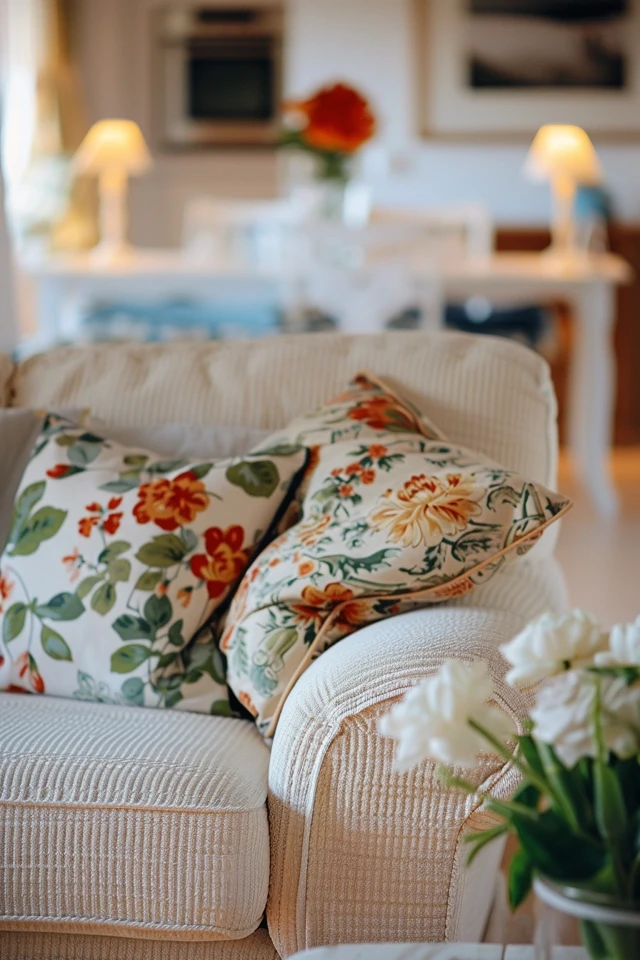
Once the sofa is in place, styling brings the look home. Cottage style relies heavily on texture and pattern mixing. You want the sofa to look collected, not catalog-perfect.
Start with your throw pillows. Avoid the two matching pillows that come with the couch; they usually look stiff and cheap. Instead, use a mix of sizes and inserts. I recommend using inserts that are 2 inches larger than the cover (e.g., a 22-inch insert in a 20-inch cover) for a plump, luxurious look.
Mix your patterns using the rule of three: one large-scale pattern (like a floral), one small-scale pattern (like a ticking stripe or gingham), and one solid or textured fabric (like a chunky knit or boucle). This creates visual interest without chaos.
Throw blankets are mandatory for the cottage aesthetic. Drape a wool or cashmere throw over the arm or back of the sofa. This adds a layer of color and texture while serving a practical purpose on chilly evenings.
Lighting Coordination
Your lighting plan must interact with the sofa layout. Floor lamps are excellent for cottage spaces as they add height.
- Place a floor lamp slightly behind and to the side of the sofa.
- The bottom of the lampshade should be roughly at eye level when you are seated.
- This prevents glare while providing adequate reading light.
Final Checklist: What I’d Do in a Real Project
If I were sourcing a sofa for a client’s cottage renovation today, this is the exact workflow I would follow. Use this mini-checklist to keep your shopping focused.
1. Measure the Entry points
Before measuring the room, measure the front door, hallways, and stairwells. A 96-inch sofa won’t help you if it gets stuck in the hallway. I have seen this happen, and it is a heartbreaking (and expensive) return process.
2. Choose the Silhouette
I would hunt for an English Roll Arm sofa or a skirted track-arm sofa. I would verify that the legs are removable, which can gain you 3-5 inches of clearance during delivery.
3. Select the Fabric
I would pull samples for a Performance Crypton fabric in a creamy oatmeal color or a heavy-weight slipcover in white cotton. I would take these samples home and rub dirt on them, then try to clean them. If the stain sticks, the fabric is out.
4. Check the “Sit”
I would sit on the sofa for at least 15 minutes in the showroom. I would remove my jacket and shift positions. Does the front rail dig into my legs? Is the back high enough to support my neck?
5. Finalize the Details
I would order a single bench seat cushion for a cleaner look and specify a down-wrapped foam fill. I would then pair it with a vintage washed-out Persian rug or a natural jute rug to anchor the cottage vibe.
FAQs
Is a white slipcover actually practical for pets?
Yes, but only if it is 100% cotton or a high-quality blend that is machine washable. The beauty of white is that you can bleach it. A beige sofa that cannot be bleached is actually harder to keep clean than a white one that can be.
Can I mix a cottage sofa with modern decor?
Absolutely. This is often called “Modern Cottage” or “Warm Minimalist.” The key is to keep the color palette neutral. A soft, rolled-arm sofa looks beautiful next to a sleek, modern glass coffee table if the colors are harmonious.
What if my living room is very dark?
A light-colored sofa is your best friend in a dark cottage. It acts as a reflector, bouncing available light back into the room. Avoid dark velvets or heavy leathers in poorly lit spaces, as they absorb light and make the room feel smaller.
How do I stop my cushions from sliding forward?
This is a common annoyance. You can buy non-slip rug pads (the grippy mesh kind) and cut a strip to place between the cushion and the frame. It works perfectly and is invisible.
Conclusion
Choosing the right couch for a cottage-style home is about balancing the romance of the aesthetic with the reality of your lifestyle. It is the largest investment piece in the room, so it deserves thoughtful consideration regarding scale, fabric, and construction.
Don’t be afraid to prioritize comfort. The most beautiful cottage homes are the ones that feel lived-in and loved, where a few wrinkles in the linen or a well-worn velvet arm only add to the charm. Take your time, measure twice, and choose a piece that invites you to stay awhile.
Picture Gallery


