
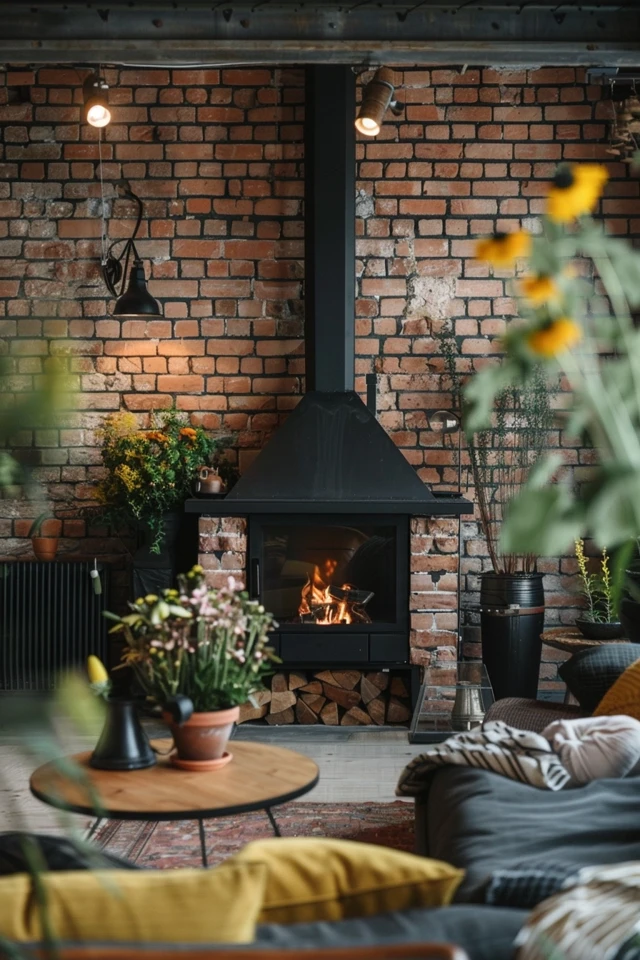
Creating Charm with Off Center Fireplace Ideas
Few architectural features cause as much initial panic for homeowners as an off-center fireplace. We are biologically wired to love symmetry because it feels balanced and safe, so when a focal point sits awkwardly to the left or right of a wall, it can feel like a design mistake. However, in my years of drafting floor plans and styling living rooms, I have come to prefer these asymmetrical layouts because they offer distinct functional zones that perfectly centered fireplaces often prohibit.
Rather than viewing the placement as a flaw to be fixed, you need to view it as an opportunity to create a dynamic, multi-purpose room. The key is to stop trying to force symmetry where it does not exist and instead focus on balance through visual weight. For plenty of visual inspiration on how to style these tricky layouts, be sure to scroll down to the Picture Gallery at the end of this blog post.
By manipulating furniture arrangements, lighting, and millwork, we can turn that awkward corner hearth into the most charming feature of your home. Let’s dive into the mechanics of balancing your space.
The Theory of Visual Weight and Balance
The biggest mistake I see clients make is leaving the “empty” side of the wall blank, hoping the fireplace will somehow command the room on its own. This just makes the room feel like it is listing to one side. To fix an off-center fireplace, you must treat the wall like a seesaw.
If you have a heavy stone fireplace on the left, you need something of equal “visual weight” on the right to level the seesaw. This does not mean you need another fireplace; it means you need an object that commands attention. Large-scale cabinetry, dark-colored shelving, or a significant piece of art can provide this counterweight.
When designing custom joinery for these walls, I often prescribe a built-in unit for the larger side of the wall. If the fireplace is 5 feet wide and sits on the far left of a 15-foot wall, I will design a 10-foot shelving unit for the right side. By painting the shelving and the fireplace mantel the same color, they read as one cohesive architectural element rather than two disjointed pieces.
Designer’s Note: The “Floating” Mistake
I once worked on a renovation where the client tried to balance an off-center hearth by placing a tiny, delicate console table on the adjacent empty wall. It looked like a postage stamp on a billboard.
The Fix: We replaced the small console with a chunky, dark wood sideboard that was nearly as wide as the empty wall space. We hung a large mirror above it to reflect the room’s light. Suddenly, the heavy fireplace on the left didn’t feel so heavy because the right side was fighting back with equal mass.
Furniture Layouts That Actually Work
Furniture placement is where the rubber meets the road. If you point your sofa directly at an off-center fireplace, your entire room will feel skewed. You need to detach the furniture layout from the architecture of the fireplace wall.
The Floating Zone Technique
In rooms larger than 12×14 feet, I almost always float the furniture. This means pulling the sofa off the wall and creating a conversation circle that sits in the center of the room, regardless of where the fireplace is.
- The Rug Rule: Use a large rug to define this floating zone. The rug acts as an island. As long as the furniture is symmetrical on the rug, the room will feel balanced, even if the fireplace is off to the side.
- Sizing: Ensure the front legs of all seating furniture sit on the rug. Ideally, allow 12 to 18 inches of floor space between the rug edge and the walls.
The L-Shape Solution
Sectionals or L-shaped layouts are the best friends of asymmetrical rooms. Place the main section of the sofa facing the intended focal point (often a TV or a view), and use the perpendicular arm of the sectional to bridge the gap toward the fireplace.
This creates a cozy “nook” feeling. If the fireplace is in the corner, angle a comfortable reading chair toward it. This acknowledges the fireplace as a secondary focal point without forcing the whole room to bow to it.
Solving the Television Dilemma
The question I get asked most frequently is, “Where do I put the TV?” With a centered fireplace, you are often forced to mount the TV above the mantel, which is usually too high for comfortable viewing. An off-center fireplace actually solves this ergonomic nightmare.
Side-by-Side Placement
If your fireplace is on the left, place your TV on a low media console on the right. This keeps the center of the screen at eye level—ideally 42 to 48 inches from the floor for a standard sofa. This arrangement is far superior for your neck and allows the fireplace and the TV to share the spotlight without competing.
The “Dark Wall” Trick
If you hate the look of a black TV screen next to a fireplace, paint that entire wall a dark, moody color like charcoal, navy, or forest green. The black rectangle of the TV will blend into the wall color, allowing the fire and the mantel to remain the true stars of the show.
What to Avoid
Do not mount the TV above an off-center fireplace unless you absolutely have no other wall space. If you do this, you leave the large empty side of the wall with nothing to do, which visually tips the room over. If you must mount it there, fill the adjacent empty wall with floor-to-ceiling bookshelves to create a library feel.
Materials and Finishes to Unify the Space
When a layout is tricky, materials can smooth over the awkward transitions. The goal is to reduce visual clutter so the asymmetry feels intentional rather than accidental.
Monochromatic Drenching
One of my favorite contemporary techniques is “color drenching.” This involves painting the walls, the trim, the mantel, and even the built-in shelving the exact same color.
When you use high-contrast colors (like a white mantel against a blue wall), you highlight the outline of every object. This draws attention to the lack of symmetry. By painting everything a soothing taupe or warm gray, the lines blur. The fireplace becomes texture rather than a stark geometric shape.
Using Vertical Texture
To balance a squat, off-center firebox, add verticality to the adjacent space. Vertical shiplap, wood slats, or fluted paneling can draw the eye up.
If you have a low fireplace on one side, install floor-to-ceiling vertical wood slats on the adjacent empty wall. This vertical repetition tricks the brain into seeing height and structure, distracting from the horizontal imbalance.
Common Mistakes + Fixes
Even with the best intentions, homeowners often fall into specific traps with these layouts. Here is how to identify and correct them.
Mistake: The “Lone Soldier” Art Piece
Hanging one small picture in the center of the large empty wall space next to the fireplace.
The Fix: Use a gallery wall. A collection of art allows you to spread visual interest across the entire width of the wall. It feels organic and flexible, whereas a single centered canvas emphasizes that the wall creates an awkward centerline.
Mistake: Ignoring the “Dead Corner”
Leaving the corner next to the fireplace empty because nothing fits.
The Fix: Use this spot for a firewood storage niche, a tall indoor tree (like a Ficus Audrey), or a substantial floor vase. A plant adds life and softens the hard corner where the fireplace masonry meets the drywall.
Mistake: Rugs Too Small
Using a 5×7 rug that floats in the middle of the room, unconnected to the fireplace or the furniture.
The Fix: Size up. In an average living room, an 8×10 or 9×12 rug is standard. The rug should be large enough to visually anchor the fireplace hearth if possible, or at least run parallel to it to establish a straight line.
What I’d Do in a Real Project: A Mini Checklist
If I walked into your home today to fix an off-center fireplace layout, this is the exact mental checklist I would run through. You can use this to audit your own space.
- Check Traffic Flow: Ensure there is at least 30 to 36 inches of walking path between furniture pieces. Does the fireplace hearth intrude on this path? If so, choose rounded furniture (like a circular coffee table) to prevent shin bruises.
- Measure the “Negative” Space: Measure the width of the wall next to the fireplace. I immediately look for a piece of furniture or millwork that fills at least 75% of that width.
- Lighting Audit: Asymmetrical rooms often have dark corners. I would plan for a floor lamp on the side opposite the fireplace to balance the glow of the fire.
- Anchor the Mantel: I would style the mantel with objects of varying heights. I typically place a taller item (vase or candlestick) on the side furthest from the center of the wall to draw the eye outward.
Renter-Friendly Solutions
Not everyone can install built-in cabinetry or re-tile a fireplace surround. If you are renting or on a strict budget, you can still achieve balance.
The Power of Mirrors
A large, leaning floor mirror is a renter’s secret weapon. Place a tall, wide mirror on the wall adjacent to the off-center fireplace. It mimics the scale of a doorway or a window, adding architectural interest without construction.
Plug-In Sconces
Hardwired lighting requires an electrician, but plug-in wall sconces do not. Install a swing-arm sconce on the empty wall space. This adds a “permanent” fixture look that helps define that zone as a reading nook or media area.
The Bench Trick
If the fireplace has a raised hearth that cuts off abruptly, place a bench of the same height right next to it. Top the bench with a cushion or books. Visually, this extends the horizontal line of the hearth across the room, making the fireplace look wider and more centered than it actually is.
Final Checklist for Your Space
Before you start buying furniture or knocking down walls, run through this summary to ensure you have a cohesive plan.
- Balance, Don’t Center: Have you placed a heavy item on the opposite side of the room to counter the fireplace’s weight?
- Zone Your Furniture: Is your seating arrangement independent of the walls? Create a floating island.
- Check Your Levels: Are your TV and art hung at the correct eye-level heights relative to the seating?
- Lighting Layers: Do you have ambient light (overhead), task light (reading lamps), and accent light (on shelving) distributed evenly?
- Rug Size: Is your rug big enough to hold the furniture together?
FAQs
Can I just drywall over the fireplace if I hate the placement?
Technically yes, but I rarely advise it. Removing a fireplace reduces home value. It is almost always better to camouflage it with paint or drywall over just the firebox (leaving the chimney intact) if you truly never use it. However, styling it is usually the more cost-effective and value-retaining route.
How far should the sofa be from the fireplace?
Ideally, you want about 5 to 7 feet between the fireplace and the edge of the sofa or coffee table. This allows for safe passage and keeps the heat from damaging leather or wood finishes.
What if my fireplace is in the corner at a 45-degree angle?
Corner fireplaces are tricky. The best approach is to ignore the angle. Orient your rug and sofa parallel to the room’s main walls, not the fireplace. Let the fireplace be an accent in the corner rather than forcing the whole room to tilt 45 degrees.
Should I paint the brick white?
If the brick is a high-contrast red or orange that clashes with your decor, painting it white or a neutral color can help it recede. However, if the brick is a neutral earth tone, try cleaning it first. Once you paint brick, it is very difficult to go back.
Conclusion
An off-center fireplace is not a design flaw; it is an invitation to break the rules of rigid symmetry. By understanding visual weight, utilizing smart furniture layouts, and employing corrective styling tricks, you can transform an awkward wall into a sophisticated, multi-functional living space.
Remember that the most interesting homes are those that navigate constraints with creativity. A perfectly symmetrical room often feels like a showroom, but a balanced, asymmetrical room feels like a home. Trust your eye, measure your zones, and embrace the quirkiness of your space.
Picture Gallery


