
Creative Diaper Storage Ideas for Easy Organization
Introduction
Designing a nursery is often one of the most exciting parts of expecting a new addition, but the reality of daily life with a newborn quickly shifts the focus from aesthetics to survival. When you are holding a squirming baby at 3:00 AM, the placement of your diapers, wipes, and creams matters more than the shade of paint on the walls. Efficient storage is not just about keeping the room tidy; it is about creating a workflow that keeps your baby safe and keeps you calm.
As an interior designer, I always tell my clients that the best nursery designs are the ones that anticipate the mess before it happens. You need systems that allow for one-handed grabbing, easy refilling, and visual calmness when the work is done. For a dose of visual inspiration, don’t forget to check out our curated Picture Gallery at the end of this post.
We are going to look at storage solutions that blend high-end design principles with absolute practicality. Whether you are working with a sprawling master suite or a cozy apartment nook, these strategies will help you maintain a stylish home while tackling the most functional aspect of parenting.
1. The Changing Table: Maximizing the Prime Real Estate
The changing table is your command center, and the way you organize it dictates the flow of your entire day. In design terms, we look at the “reach radius.” This is the semi-circle of space you can comfortably access without moving your feet or taking a hand off the baby.
Everything inside this radius must be essential. Do not clutter the top surface with decorative items that can be knocked over. Instead, prioritize a changing pad that fits securely, leaving at least 8 to 10 inches of clear surface area on the side for immediate needs like a fresh diaper and the wipe dispenser.
If you are using a dresser as a changing table, the top drawer is your most valuable asset. I recommend using spring-loaded drawer dividers to create rigid compartments. Flimsy fabric bins often collapse under the weight of supplies, so structure is key here.
Designer’s Note: The “Left-to-Right” Rule
In almost every project I work on, I arrange the changing station based on the parents’ dominant hand. If you are right-handed, place the diapers and wipes to the right of the changing pad. This prevents you from reaching across the baby’s body, which is a common safety hazard and simply less ergonomic.
Internal Drawer Layout
- Lane 1 (Far Left or Right): Rows of diapers standing vertically. This allows you to grab one without disrupting the stack, unlike stacking them flat.
- Lane 2 (Center): Wipes dispenser. Ensure the container has a weighted plate so you pull one wipe at a time, not a clump of five.
- Lane 3 (Remaining Space): Creams, rash ointments, and hand sanitizer. Use small acrylic organizers here to catch leaks.
2. Vertical Storage Solutions for Small Spaces
When floor space is limited, you have to design upwards. Vertical storage is often underutilized in nurseries, yet it offers some of the most accessible options for diaper organization. This approach is particularly helpful for renters who cannot install permanent cabinetry but need to keep supplies off the floor.
Wall-mounted shelving above the changing station is a classic choice, but placement is critical. A common mistake is installing shelves too low, where a kicking baby might knock items down, or too high, rendering them useless.
The ideal height for the bottom shelf is roughly 14 to 16 inches above the changing pad surface. This keeps items out of the baby’s reach but within yours.
The Pegboard System
I frequently use pegboards in modern and industrial-style nurseries. They allow for infinite adjustability as your child grows.
- Flexibility: You can move baskets and hooks around without drilling new holes.
- Visibility: You can see exactly when you are running low on supplies.
- Styling: Paint the pegboard to match your wall color for a monochromatic, built-in look that reduces visual clutter.
Common Mistakes + Fixes
Mistake: Using open shelving for everything.
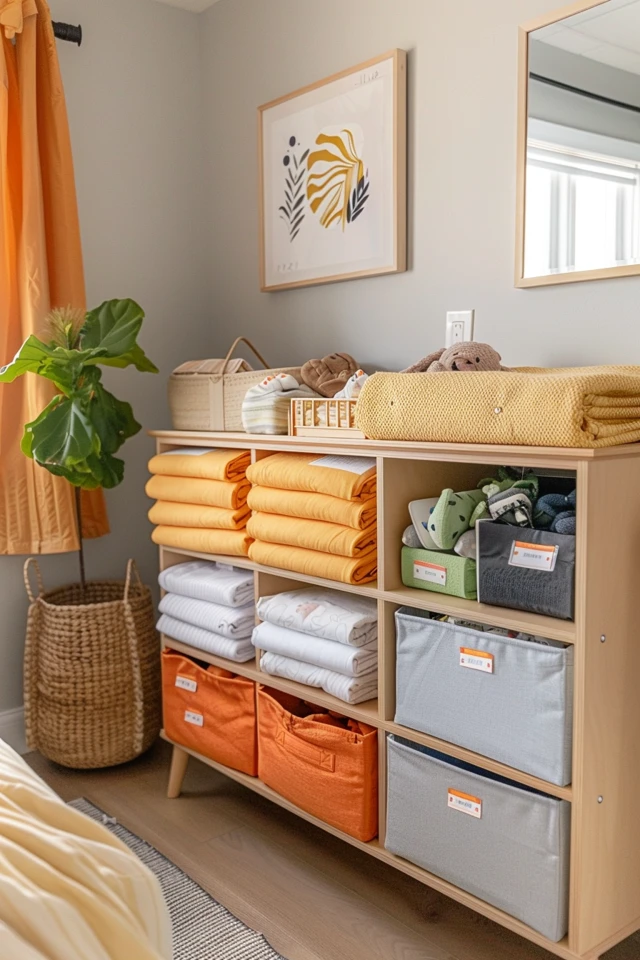
Fix: Open shelves can quickly look chaotic. Use opaque baskets (wicker, felt, or canvas) on the shelves to hide the colorful branding of diaper packages. This maintains the serene aesthetic of the room while keeping supplies handy.
3. The Mobile Diaper Station
You will not always be in the nursery when a change is needed. A rolling utility cart is one of the most versatile pieces of furniture you can buy for a new home. It acts as a satellite changing station that can move from the living room to the master bedroom.
When selecting a cart, look for one with three tiers and a lip around the edge of each shelf. The lip should be at least 2 inches high to prevent items from sliding off during transport.
Styling a Utility Cart
To keep a metal cart from looking like it belongs in a hospital, focus on the accessories.
- Top Tier: The essentials. A portable changing pad, a stash of 5-10 diapers, and a travel wipe container.
- Middle Tier: A change of clothes (onesies and socks) and burp cloths.
- Bottom Tier: Backstock items and perhaps a small toy or rattle to distract the baby during changes.
Material Coordination
If your living room features brass accents or warm woods, choose a cart in a matte white, black, or gold finish. Avoid bright primary colors unless that fits your specific decor scheme. By treating the cart as a piece of furniture rather than just a plastic bin, it integrates seamlessly into your main living areas.
4. Hidden Storage and Built-Ins
For those who prefer a minimalist look, hiding the diapers completely is the goal. This requires a strategy I call “decanting.” Diaper boxes are bulky and visually loud. The moment you bring a bulk box home, open it and transfer the contents into designated hidden zones.
If you have a closet near the changing station, an over-the-door organizer is a fantastic, low-cost solution. However, avoid the clear plastic shoe organizers if you want a high-end look. Opt for structured fabric pockets with stiffeners that hold their shape.
Under-Crib Storage
The space beneath the crib is often forgotten. The standard clearance under a crib is usually between 6 and 10 inches.
- Rolling Bins: Use low-profile wooden drawers on casters or fabric bins with lids.
- Usage: This is the perfect spot for “size up” diapers. If your baby is currently in size 1, store the boxes of size 2 under the crib so they do not take up prime drawer space.
Designer’s Note: Camouflaging the Ugly
If you must store diapers on an open bookshelf, use the “basket-in-basket” method. Place a smaller, washable plastic bin inside a beautiful woven basket. You toss the diapers in the plastic bin. This protects your expensive wicker or rattan from creams and spills while maintaining the texture and warmth of the room design.
5. Material Selection: Baskets, Bins, and Durability
The material of your storage containers matters for both safety and longevity. In a nursery, we deal with lotions, oils, and the occasional mess. Your storage needs to be wipeable or washable.
Wicker and Rattan
These add beautiful texture and warmth, which is vital in a room that can sometimes feel sterile.
The Risk: Natural fibers can dry out and become brittle, creating sharp points that can scratch little hands.
The Solution: Always choose baskets lined with fabric (cotton or linen). This protects the baby’s skin and keeps the diapers from snagging on the material.
Acrylic and Plastic
Clear acrylic is trendy and incredibly practical because you can see inventory levels instantly.
The Risk: It can look cold and clinical.
The Solution: Mix acrylic organizers inside drawers, but stick to softer materials for exposed shelving. If you use clear bins on shelves, ensure the contents are neatly arranged, or it will look cluttered.
Fabric and Canvas
Soft-sided bins are excellent because they are silent. When you are digging for a diaper at night, a plastic bin scraping against a shelf can sound like a gunshot.
The Risk: They lose their shape over time.
The Solution: Buy canvas bins with reinforced wire rims or cardboard inserts. This keeps them standing upright even when they are half-empty.
6. Managing Bulk Storage and Refills
Buying in bulk saves money, but storing 200 diapers requires a plan. Do not try to fit the entire Costco box into your changing table drawers. Treat the nursery like a retail store: you have “floor inventory” (the drawer) and “backstock” (the closet or garage).
Designate a high shelf in the closet for unopened sleeves of diapers. Organize them by size. It is surprisingly easy to forget you have a box of size 3s tucked away until the baby has outgrown them.
The “Sunday Reset” Routine
I encourage clients to adopt a restocking routine. Every Sunday evening, take ten minutes to move inventory from your bulk storage to your active drawers and mobile carts.
- Unpack: Take diapers out of plastic packaging so they are ready to grab.
- Check Wipes: Ensure you have a backup pack accessible.
- Assess Sizes: If the current diapers are looking tight, check your backstock for the next size up.
Final Checklist: What I’d Do in a Real Project
If I were designing a nursery for you tomorrow, this is the exact checklist I would run through to ensure your diaper storage is foolproof.
- Check the Reach: Stand at the changing table. Can I reach a diaper, a wipe, and the trash pail without moving my feet?
- Anchor the Furniture: Is the dresser or shelving unit anchored to the wall? This is non-negotiable for safety once the baby starts pulling up.
- Lighting Assessment: Is there a dimmable light source or a nightlight near the diaper storage? You need to see the supplies without turning on the overhead lights.
- Drawer Dividers: Are the drawers compartmentalized? One large drawer becomes a junk drawer within a week.
- Odor Control: Is the diaper pail located within arm’s reach but not directly next to the clean diaper storage (to prevent scent transfer)?
- Texture Check: Are the storage baskets soft to the touch? No rough edges near the baby.
FAQs
Q: How many diapers should I keep in the changing table drawer?
A: Aim for about 2 to 3 days’ worth of supply. For a newborn, this is roughly 25 to 30 diapers. Overstuffing the drawer makes it hard to grab just one, and under-filling means you are constantly restocking.
Q: What is the best way to store open packs of wipes so they don’t dry out?
A: Use a dedicated wipe dispenser with a rubber gasket seal. If you prefer using the original packaging, store the pack upside down (opening facing the bottom) when not in use. This keeps the moisture concentrated at the top wipe.
Q: How do I organize diaper storage for two children in diapers at the same time?
A: Color coding is your best friend here. Use different colored baskets or drawer organizers for each size. Alternatively, assign the top drawer to the baby (who needs more frequent changes) and the second drawer to the toddler.
Q: Can I use open shelving above the changing table safely?
A: Yes, provided it is installed into studs and the items on it are lightweight. Avoid heavy ceramic jars or glass containers. Stick to baskets, soft toys, and paper goods.
Conclusion
Creating an organized diaper storage system is about more than just neatness; it is about creating a calm environment where you can focus on bonding with your baby rather than hunting for supplies. By combining smart measurements, the right materials, and a logical workflow, you can transform a messy necessity into a streamlined part of your daily routine.
Remember that your needs will change as your baby grows. The systems you set up for a newborn might need tweaking when you have a wiggly twelve-month-old. The best designs are flexible. Start with the essentials, prioritize safety and accessibility, and choose storage pieces that you genuinely enjoy looking at.
Picture Gallery


