
Title: Creative Driveway Edge Ideas for Curb Appeal
Introduction
As a designer, I always tell my clients that the driveway is essentially the “red carpet” of the home. It is the very first structural element guests interact with, yet it is often the last place homeowners invest their design budget. I remember a project last year where we completely renovated a stunning mid-century modern facade, but the cracked, undefined asphalt driveway dragged the whole aesthetic down.
By simply adding a crisp steel edge and a band of river rock, we transformed the entire approach from “deferred maintenance” to “high-end intentional.” For plenty of visual inspiration on how to achieve these looks, be sure to check out the curated Picture Gallery at the end of this blog post.
Designing a driveway edge isn’t just about pretty flowers; it is about defining boundaries and protecting your landscape. A proper edge stops grass from encroaching on the pavement and prevents gravel or mulch from spilling onto the drive. It marries function with aesthetics in a way that feels finished and thoughtful.
1. The Classic Apron and Soldier Course
When we talk about upgrading a driveway without repaving the whole thing, a masonry edge is usually my first suggestion. The most traditional and timeless approach is the “soldier course.” This involves laying bricks or rectangular pavers side-by-side, standing upright like soldiers, perpendicular to the driveway.
This technique works exceptionally well with asphalt driveways. The contrasting texture of red clay brick or gray tumbled granite against the smooth black asphalt creates an immediate visual frame. It makes the driveway look wider and more substantial.
For a more modern or relaxed look, you can opt for a “sailor course.” This is similar to the soldier course, but the bricks are laid wide-side down. This creates a thicker, bolder border that serves as a stronger visual weight against large two-story homes.
Technical Considerations for Masonry Edging
If you are doing this, you cannot simply lay bricks in the dirt next to the asphalt. They will heave and shift within a single season.
- The Haunch: You must install a concrete haunch (a triangular wedge of concrete) behind the pavers underground to lock them in place.
- Base Depth: I require a minimum of 6 inches of compacted crushed stone base beneath the edging pavers.
- Leveling: The pavers should sit about 1/4 inch above the surrounding grass or soil, but flush with the driveway surface to allow for snow shoveling.
Designer’s Note: Material Selection
Don’t just pick a brick that matches your walkway. Look at the architectural stone on your house or the color of your roof shingles. If your roof is slate gray, a charcoal granite cobblestone edge looks much more cohesive than a red clay brick.
2. Softening the Hardscape with Planting Borders
If your driveway feels like a giant runway of concrete, you need to soften the edges with organic textures. A planting border is the best way to break up the harsh lines of a paved surface. However, this is where I see the most mistakes regarding scale and maintenance.
The goal here is repetition. You want a row of plants that draws the eye toward the house. Using twenty different types of flowers along the driveway looks messy and chaotic. Stick to one or two species for a clean, architectural look.
The “Car Door” Rule
We have to be realistic about how driveways are used. People swing car doors open, and guests step off the pavement.
- Spacing: Plant your border at least 24 to 30 inches away from the actual edge of the asphalt.
- Buffer Zone: Fill that 24-inch gap with a low ground cover or decorative stone.
- Height Limits: Keep driveway plantings under 30 inches tall. You need clear sightlines when backing out of the garage.
Top Plant Picks for Durability
Driveway edges are harsh environments. They suffer from radiated heat in summer and salt spray in winter.
- Liriope (Monkey Grass): Virtually indestructible and keeps its leaves year-round in many climates.
- Boxwoods: Great for formal estates, but require protection from winter road salt.
- Lavender: loves the reflected heat from the driveway and smells amazing when you brush past it.
3. Metal Edging for Modern Minimalism
For contemporary homes or landscapes that rely on wild, naturalistic planting, heavy stone borders can feel too clunky. This is where steel or aluminum edging shines. It creates a razor-sharp separation between your driveway materials (like gravel or asphalt) and your lawn or garden beds.
I frequently use Corten steel for these applications. Corten is a weathering steel that develops a stable, rust-colored patina over time. It looks incredible against green grass and gray gravel. It brings a warm, industrial element that feels very current.
Installation Specifics
When specifying metal edging, the gauge (thickness) is the most critical factor.
- Gauge: Do not buy the flimsy stuff from big-box stores. Use 14-gauge steel or thicker. Thinner metal will wave and warp over time.
- Depth: The edging should be driven at least 4 to 5 inches into the ground.
- Profile: Only leave about 1/2 inch to 1 inch of metal visible above grade to avoid it becoming a tripping hazard.
A Note for Renters
If you are renting and can’t install permanent steel edging, look for “pound-in” scalloped edging or recycled rubber borders. They aren’t as sleek, but they define the space. Alternatively, line the driveway with uniform rectangular planter boxes. This creates an edge without breaking ground.
4. The “Rumble Strip” Approach: Belgium Block & Cobblestone
If you have a gravel driveway, containment is your number one issue. Gravel travels. It ends up in the lawn, which ruins mower blades, and it ends up in the street. To combat this, we use a raised edge, often referred to as a Belgian Block curb.
Belgian blocks are large, rectangular chunks of granite. Unlike flat brick edging, these are often set to protrude 3 to 4 inches above the driveway surface. This acts as a physical barrier that keeps loose stone inside the driveway area.
Common Mistakes + Fixes
Mistake: Setting blocks loosely in dirt.
Fix: Like the soldier course, these must be set in wet concrete. The spaces between the blocks should also be pointed with mortar to prevent weeds from shooting up through the cracks.
Mistake: Ignoring drainage.
Fix: If you create a raised curb on both sides of a sloping driveway, you have created a water chute. You must leave gaps or install catch basins at the bottom to allow heavy rain to escape, otherwise, your garage will flood.
What I’d Do in a Real Project
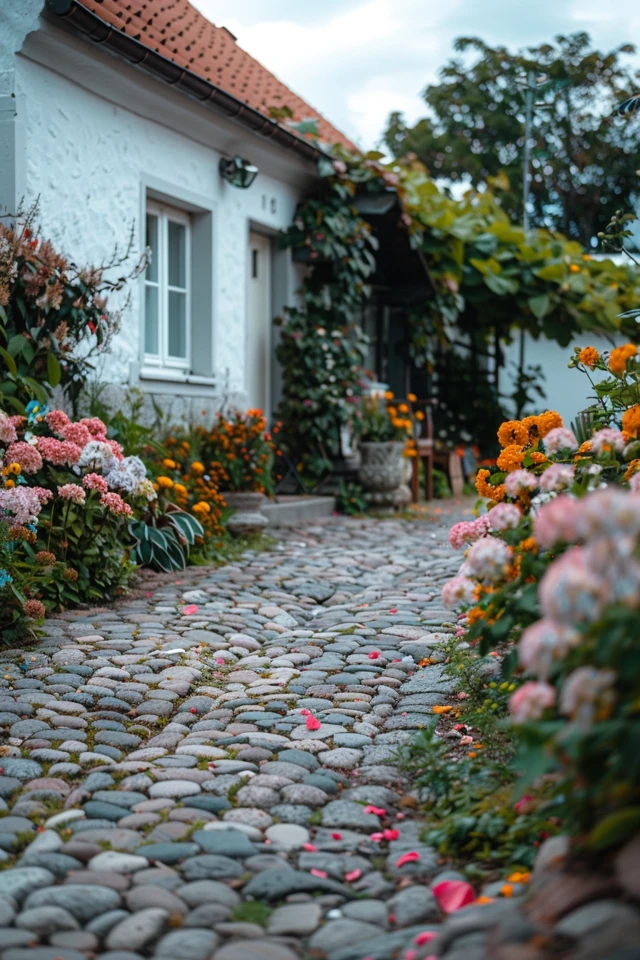
If I am designing a farmhouse or a cottage, I use reclaimed cobblestones. I specifically ask suppliers for “worn” or “rounded” edges. Sharp, new granite looks too commercial. The worn edges imply the driveway has been there for a century.
5. Lighting: Defining the Edge at Night
Curb appeal doesn’t stop when the sun goes down. In fact, a properly lit driveway edge is a safety necessity. However, you want to avoid the “airport runway” effect. Seeing two perfect parallel lines of bright lights looks tacky and commercial.
Instead of placing lights directly on the edge, push them back into the landscape border. The goal is to wash the light over the edge of the driveway, not to stare directly into a bulb.
Designer Rules for Lighting Spacing
- Staggering: Place lights on alternating sides of the driveway rather than directly across from each other.
- Distance: Space path lights 8 to 12 feet apart. Pools of light should slightly overlap or have dark gaps between them for drama.
- Kelvin Temperature: Always use 2700K or 3000K warm white LEDs. Anything higher (4000K+) looks blue and clinical, like a gas station.
Solar vs. Hardwired
As a professional, I almost always recommend hardwired low-voltage systems. They are reliable and consistent. However, if you are on a tight budget, buy high-quality solar lights with glass housings, not plastic. Plastic housings cloud over within two seasons due to UV exposure.
6. Loose Stone and French Drain Borders
Sometimes the edge of the driveway is a functional trouble spot for water. If your driveway sits lower than the surrounding lawn, water will pool at the edges. In this case, a decorative stone border can double as a French drain.
We dig a trench about 12 inches wide and 12 inches deep along the driveway edge. We line it with landscape fabric, install a perforated pipe, and backfill it with decorative river rock or crushed basalt.
Aesthetic Benefits
This creates a distinct textural contrast. The gray river rock looks beautiful against black asphalt or concrete. It acts as a negative space that frames the driveway.
Maintenance Reality
Loose stone borders will eventually accumulate leaves and debris.
- The Fix: You will need a leaf blower. Do not try to rake leaves out of gravel; it is a nightmare.
- Weed Control: Do not skip the landscape fabric underneath. If you do, the rocks will sink into the mud, and weeds will take over within weeks.
Designer’s Note: The Transition Zone
The most critical part of any driveway edge is where it meets the street and where it meets the garage or walkway. We call these “transition zones.”
At the street, I often flair the edging outward. If the driveway is 12 feet wide, the opening at the street should be 16 to 18 feet wide. This radius makes turning in easier and looks more welcoming.
At the top, near the house, the edging should seamlessly connect to the front walkway. If your walkway is brick, the driveway edge should ideally incorporate that same brick to tie the hardscape together visually.
Final Checklist: Planning Your Driveway Edge
Before you buy a single brick or plant, run through this checklist to ensure your plan is viable.
- Check Utilities: Call 811 before you dig trenches for edging or lighting. Internet and gas lines often run along driveways.
- Measure Twice: Calculate the linear footage of both sides of the driveway. Add 10% to your material order for cuts and waste.
- Consider Snow Removal: If you live in a snowy climate, raised edging (like Belgium block) can be damaged by snowplows. Flush edging is safer for plowing.
- Drainage Check: Run a hose on your driveway. Watch where the water goes. Do not block that exit path with a new border.
- Scale Test: Lay out a garden hose or rope where you want the edge to be. Stand back at the street and see if the proportions look right.
FAQs
How much does it cost to install a cobblestone driveway edge?
Material costs vary wildly, but generally, you can expect to pay between $15 and $30 per linear foot for professional installation of a concrete-set cobblestone edge. DIY costs will be roughly half that, primarily for materials and tool rental.
Can I install edging on an existing asphalt driveway?
Yes, absolutely. You do not need to repave. You will cut back the grass/sod along the existing asphalt, dig your trench, and install the edging tight against the existing pavement. If the asphalt edge is ragged, you may need to rent a masonry saw to cut a clean, straight line first.
What is the best material for a curved driveway?
Flexible steel edging or small pavers (like 4×4 granite cobbles) are best for curves. Large format rectangular stones require many angled cuts to make a turn, which often looks choppy. Steel bends seamlessly to create smooth, sweeping arcs.
How do I stop delivery trucks from ruining my grass edges?
This is a common issue. The only real solution is to widen the hardscape at the entry point or install a “rut guard” using a grid system (like geo-grid) filled with gravel and soil along the first 10 feet of the driveway. This supports the weight of a tire without looking like pavement.
Conclusion
Upgrading your driveway edge is one of the highest ROI projects you can do for your home’s exterior. It takes a functional necessity and turns it into a design feature. Whether you choose the sharp, modern lines of Corten steel or the old-world charm of a brick soldier course, the key is proper installation.
Remember to respect the “haunch” for pavers, check your drainage, and keep plantings far enough back to survive car doors. A well-defined edge not only protects your landscape but signals to everyone arriving that this home is cared for and curated.
Picture Gallery


