
Creative Small Basement Ideas for Low Ceilings
Walking into a basement with low ceilings can often feel like stepping into a cave. The space feels compressed, the light is usually scarce, and distinct mechanical features like ductwork often threaten to lower the clearance even further. However, as an interior designer, I see these spaces as some of the most rewarding challenges in home design.
With the right optical illusions and smart layout choices, you can trick the eye into perceiving height where there is none. If you are looking for visual inspiration, please note that a curated Picture Gallery is available at the end of this blog post.
The goal isn’t just to make the room fit for purpose, but to make it a favorite destination in your home. By manipulating scale, lighting, and vertical lines, we can turn a cramped storage area into a cozy lounge, office, or guest suite. Let’s look at how to maximize every inch of vertical space you have.
1. Strategic Lighting Design
In a room with standard eight or nine-foot ceilings, we often rely on pendant lights or chandeliers to create a focal point. In a low-ceiling basement, dangling fixtures are the enemy. They physically intrude on the headroom and visually lower the ceiling plane.
The absolute best investment you can make in a low basement is recessed lighting, specifically LED wafer lights. Unlike traditional “can” lights that require housing up into the joists, ultra-thin LED wafers can fit almost anywhere, even directly under ductwork or pipes. They provide a clean, smooth ceiling surface that keeps the eye moving.
Aim for a color temperature of 3000K. This is the “sweet spot” for basements. It is crisp enough to feel modern and bright, but warm enough to avoid that sterile, clinical feeling often associated with 4000K or 5000K daylight bulbs. You want the space to feel like a living room, not a dentist’s office.
Layering Light at Eye Level
Once your overheads are sorted, you must layer your lighting. This is a pro tip that changes the entire atmosphere. Use floor lamps and table lamps to bring the light source down to the human scale.
When you illuminate the corners of a room with a floor lamp, you “push” the walls out visually. It distracts the eye from the ceiling height and focuses attention on the furniture and decor.
Designer’s Note:
One lesson I learned early in my career involved a client who insisted on track lighting in a 7-foot basement. The tracks themselves dropped the clearance by another four inches, and the directional heads created harsh shadows that made the ceiling feel like it was caving in. Always choose flush or recessed fixtures.
2. Managing Ductwork and Soffits
The biggest headache in basement design is almost always the HVAC ductwork. In many older homes, the main trunk line runs right down the center of the room, dropping the clearance to six feet or less. You cannot move it without a massive budget, so you have to embrace it.
The instinct is often to box it in with drywall (create a soffit) and paint it white. However, if your walls are a color and your ceiling is white, a white soffit just highlights how low the obstruction is. It draws a sharp line exactly where you don’t want people to look.
The “Color Drenching” Technique
A highly effective modern technique is “color drenching.” This means painting the walls, the baseboards, the ceiling, and the soffits all the same color. When you remove the contrast between the wall and the ceiling, the boundaries of the room blur.
Your eye doesn’t instantly snap to the corner where the wall meets the ceiling. This creates an infinite effect that makes the room feel larger and more enveloping. If you are worried about it being too dark, choose a mid-tone neutral like a soft “greige” (gray-beige) or a muted sage green.
Common Mistakes + Fixes:
Mistake: creating a drop ceiling (grid ceiling) to hide pipes. This usually steals 3 to 5 inches of height.
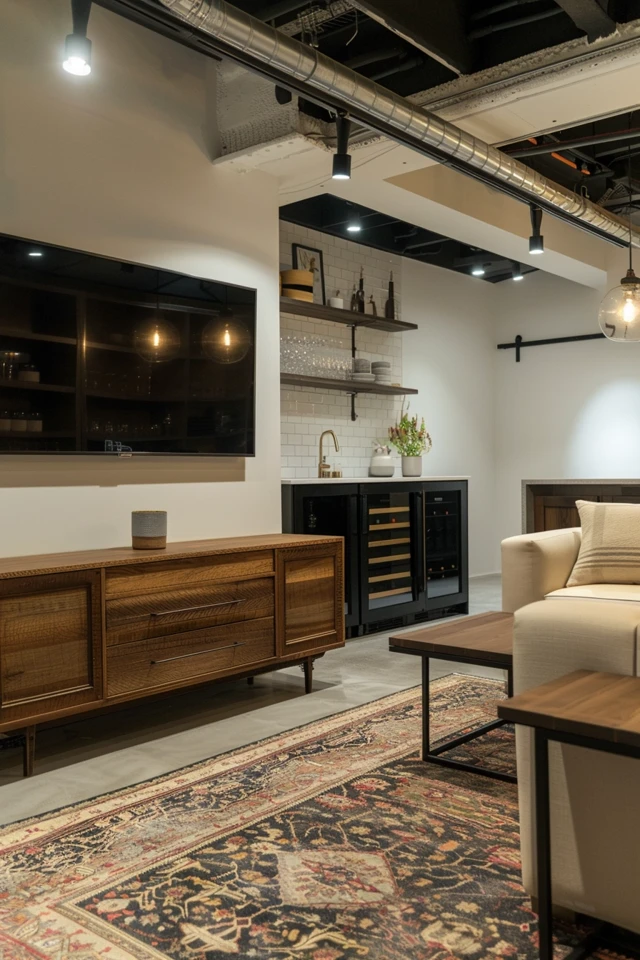
Fix: Spray paint the open ceiling joists and mechanicals a uniform matte black or charcoal. This “industrial chic” look gains you maximum height and makes the ceiling disappear into the shadows.
3. Furniture Scale and Placement
Furniture selection is where most homeowners unknowingly sabotage their small basement design. If you bring in overstuffed, high-backed furniture from a standard living room, it will look monstrous in a low-ceiling space.
You need “low profile” furniture. This refers to pieces that sit closer to the ground and have lower back heights. When the top of your sofa is lower, the distance between the furniture and the ceiling increases, creating the illusion of more vertical space.
Specific Measurements to Look For
When shopping for a basement sofa or sectional, look for a total back height of 32 inches or less. Avoid high wingback chairs. Instead, opt for barrel chairs or mid-century modern styles which naturally have lower silhouettes.
Additionally, prioritize furniture on legs rather than skirted pieces that go all the way to the floor. Seeing the floor continue underneath the sofa tricks the brain into thinking the floor area is larger. Even 4 to 6 inches of visible leg makes a massive difference in how heavy the room feels.
What I’d do in a real project:
- Sofa: A modular sectional with a low back (under 30 inches) in a performance fabric.
- Coffee Table: A glass or acrylic table. Transparency reduces visual bulk.
- TV Console: A floating media cabinet mounted to the wall. This keeps the floor clear and looks custom.
4. Vertical Architectural Elements
Since we lack physical height, we have to manufacture it. We do this by emphasizing vertical lines. Your eye naturally follows lines; if you give it vertical paths to follow, the room feels taller.
One of the easiest ways to do this is with wall paneling. Vertical shiplap or beadboard draws the eye upward. Even a subtle pinstripe wallpaper can achieve this effect.
The Curtain Trick
Basement windows are notoriously small and high up on the wall. Do not treat them like small windows. If you mount a curtain rod just two inches below the ceiling (or soffit) and let the drapery hang all the way to the floor, you create a strong vertical column.
This does two things: it softens the acoustics of the basement, and it frames the window in a way that suggests a full-sized opening lies behind it. Make sure the curtain rod extends 6 to 10 inches past the window frame on either side so the curtains don’t block the limited natural light when open.
5. Flooring Considerations
In a basement, every fraction of an inch counts. Traditional hardwood floors on sleepers or subfloors can raise the floor level by over an inch. This is height you cannot afford to lose.
Luxury Vinyl Plank (LVP) is the industry standard for basements for good reason. It is waterproof, durable, and very thin—usually around 5mm to 8mm. You can install it directly over the concrete slab (with a vapor barrier), preserving your headspace.
When laying the floor, run the planks parallel to the longest wall in the room. This stretches the perspective. If you are dealing with a square room, laying the floor on a diagonal can make the footprint feel significantly larger, though it increases material waste and installation cost.
Rug Sizing Rules
Just because the room is small or in a basement doesn’t mean you should use a postage-stamp-sized rug. A small rug creates a “floating island” look that makes the room feel disjointed.
Select a rug that allows at least the front legs of all seating furniture to sit on it. Ideally, leave about 12 to 18 inches of bare floor visible around the perimeter of the rug. This border frames the space perfectly without cramping it.
Final Checklist: The “Space-Maker” Strategy
Before you finalize your design, run through this checklist. If you can check off at least four of these items, your low-ceiling basement will feel open and inviting.
- Lighting: Are you using recessed wafers (3000K) instead of hanging fixtures?
- Paint: Have you considered painting the ceiling and walls the same color to blur the edges?
- Furniture: Is the sofa back height under 32 inches?
- Window Treatments: Are curtains mounted at the ceiling line and touching the floor?
- Decor: Is the art hung slightly lower than standard? (Hanging art lower creates the illusion of more wall space above it).
- Flooring: Are you using a thin material like LVP or polished concrete to save height?
Frequently Asked Questions
How do I handle a support column in the middle of the room?
Do not try to hide it with mirrors; that rarely works. Instead, integrate it. If it is near the seating area, wrap it in wood and build a small drink shelf around it. If it is in a play area, use rope to wrap it for a textural element. Treat it as intentional architecture rather than a mistake.
Should I paint a low basement ceiling black?
Painting a ceiling black works best if you have an open ceiling with exposed joists/pipes. The black hides the mess and creates depth. If you have a drywalled, flat ceiling that is low, painting it black can feel oppressive unless the room has a lot of natural light or you are specifically aiming for a moody “theater” vibe.
Is carpet better than hard flooring for a cozy feel?
Carpet is cozy, but in basements, it creates moisture risks. If you have a low ceiling, a thick carpet and pad also steal vertical space. I prefer LVP for durability and height preservation, adding softness with a high-quality area rug that can be removed and cleaned if necessary.
What is the minimum ceiling height for a habitable room?
Codes vary by municipality, but generally, the International Residential Code requires 7 feet (84 inches) for habitable spaces. However, there are often exceptions for beams and ductwork, which can dip lower (often down to 6 feet 4 inches) over a percentage of the floor area. Always check your local building codes before permitting a renovation.
Conclusion
A basement with low ceilings does not have to be a dark storage unit for holiday decorations. It holds the potential to be the coziest room in your house. The secret lies in embracing the cozy factor rather than fighting for grandeur.
By keeping your furniture low, your lighting recessed, and your vertical lines strong, you change the perception of the space. It stops being a “basement” and starts being a “lounge.” Don’t let the tape measure discourage you; some of the most stylish interiors are born from the tightest constraints.
Picture Gallery


