
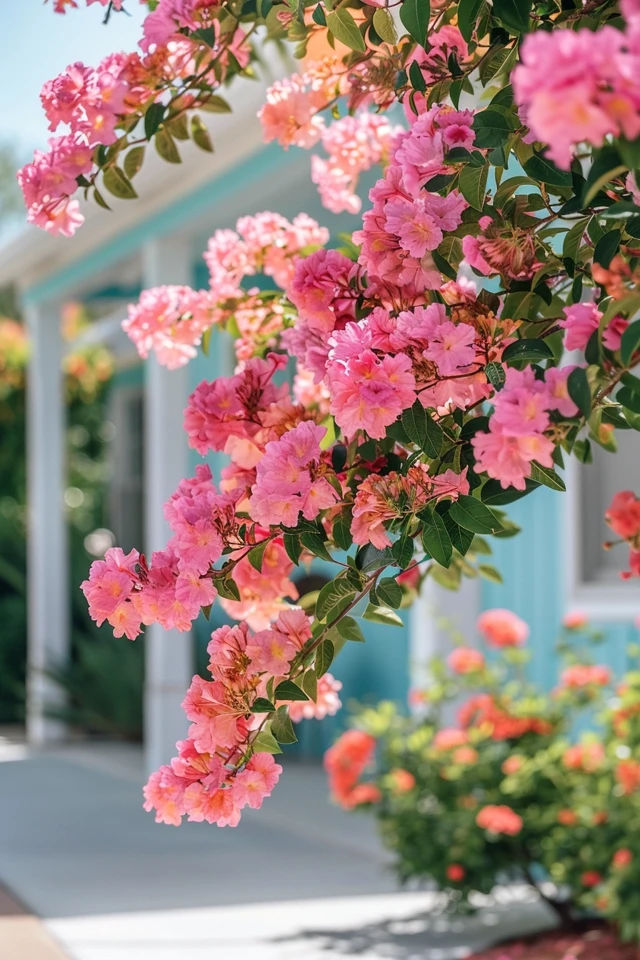
Crepe Myrtle Landscaping Ideas for Stunning Gardens
The crepe myrtle is often called the “lilac of the South,” but its architectural beauty works in garden zones far beyond just the deepest southern states. As a designer, I love these trees because they are true multi-taskers in the landscape. They provide vibrant summer blooms, incredible fall foliage, and sculptural, peeling bark that adds texture during the winter months.
However, simply plunking a crepe myrtle in the middle of a lawn rarely does it justice. To create a truly cohesive look, you need to treat the tree as an anchor for a broader design scheme. We need to consider scale, color echoes, and the ground layer to make the tree feel intentional rather than accidental.
You will find a curated Picture Gallery at the end of this blog post to inspire your own garden design.
1. Choosing the Right Variety and Placement
The most common mistake I see in landscape consultations is a homeowner choosing a variety that is far too large for their space. Crepe myrtles range from shrub-sized dwarfs (3 feet tall) to towering trees (30+ feet tall).
If you plant a “Natchez” (white blooms, grows up to 30 feet) directly under a single-story eave, you are setting yourself up for a lifetime of aggressive pruning. This ruins the tree’s natural shape.
Understanding Scale and Spacing
For a standard suburban front yard, scale is everything. You want the tree to frame the house, not consume it.
- Large varieties (20-30+ feet): These function best as shade trees or driveway linings. Keep them at least 15 to 20 feet away from your home’s foundation. Examples: Natchez (White), Muskogee (Lavender).
- Medium varieties (10-20 feet): ideal for anchoring a garden bed or softening a corner. Plant these 8 to 10 feet from the structure. Examples: Tuscarora (Coral Pink), Catawba (Violet).
- Dwarf/Semi-Dwarf (3-10 feet): These work well in large containers or as a tall hedge. Examples: Tonto (Red), Pocomoke (Rose).
Sunlight Requirements
Crepe myrtles are not shade plants. They require full sun to bloom proficiently and maintain a healthy shape.
You need a minimum of six hours of direct sunlight daily. If you plant them in the shade, they will become “leggy,” reaching desperately for light, and the bloom production will be sparse. They are also more susceptible to powdery mildew in shady, stagnant locations.
Designer’s Note: The “Rule of Odds”
When planting in an open space, avoid planting just two trees unless you are framing a specific entry point like a driveway.
In the landscape, odd numbers generally look more natural. Planting a cluster of three crepe myrtles of varying heights (or the same height spaced irregularly) creates a grove effect. This looks significantly more high-end than a single soldier standing in the grass.
2. Designing Focal Points and Allees
Once you have the right tree, you need to decide on the layout. The placement dictates the formality of the garden.
The Driveway Allee
One of the most impactful ways to use crepe myrtles is lining a driveway or walkway. This creates an “allee,” a formal design technique that guides the eye toward the home.
For this look, consistency is key. You must use the exact same variety for uniform growth rates and bloom color.
Spacing for Allees:
- For large varieties, space the trunks 20 to 25 feet apart on center.
- For medium varieties, space them 15 feet apart.
- Ensure the trunks are at least 4 to 5 feet back from the pavement edge to prevent delivery trucks from hitting the canopy.
The Sculptural Specimen
In a courtyard or patio setting, a multi-trunk crepe myrtle serves as living sculpture. The bark is the highlight here.
I often use varieties like ‘Natchez’ or ‘Muskogee’ because their bark exfoliates (peels) to reveal gorgeous cinnamon and cream tones underneath. To emphasize this, I recommend up-lighting the tree (more on this in the lighting section).
What I’d do in a real project:
If I am designing a small backyard with a patio, I will place a single medium-sized crepe myrtle in a corner bed. I will strip the lower branches up to about 5 or 6 feet. This allows guests to sit near the tree without branches hitting their faces, while the canopy provides dappled shade.
3. Layering and Companion Planting
A crepe myrtle with a ring of mulch around it looks unfinished. To integrate the tree into your landscape, you must layer plants underneath.
However, crepe myrtles have shallow, fibrous root systems. You cannot dig massive holes around the base of an established tree without damaging it. You should use smaller starter plants (4-inch pots or quart sizes) rather than large 3-gallon shrubs when underplanting.
Texture and Color Coordination
You want contrast. Since crepe myrtle leaves are small and medium-textured, pair them with broad-leaf plants or fine grasses.
Option A: The Formal Look
- Base Layer: Boxwood varieties like ‘Winter Gem’ or ‘Sprinter’ kept low (18 inches).
- Accent: White variegated Liriope (Monkey Grass) to border the bed.
- Why it works: The evergreen structure of the boxwoods looks good even when the crepe myrtle is bare in winter.
Option B: The Southern Cottage Look
- Base Layer: Hydrangeas (Oakleaf hydrangeas work well nearby, but give them space).
- Ground Cover: Ajuga or creeping Jenny.
- blooms: Daylilies or Agapanthus.
- Why it works: The large leaves of hydrangeas contrast beautifully with the peeling bark of the tree.
Option C: The Modern Minimalist
- Base Layer: Mass planting of ornamental grasses like Muhly Grass or Carex.
- Why it works: The movement of the grass complements the stillness of the tree trunks. The pink plumes of Muhly grass in fall often coincide with the changing foliage of the crepe myrtle.
Common Mistakes + Fixes: Underplanting
Mistake: Planting sun-loving flowers directly under a mature crepe myrtle.
Fix: While the tree needs sun, the area directly under the canopy is shady. Choose shade-tolerant plants like Hostas, Ferns, or Heuchera (Coral Bells) for the area closest to the trunk. As you move toward the “drip line” (the edge of the branches), you can transition to sun-lovers like Lantana or Salvia.
4. Pruning and Structural Aesthetics
We have to talk about “Crepe Murder.” This is the industry term for topping the tree—hacking off the top branches to leave ugly, thick stumps.
Please, never do this.
It ruins the natural vase shape of the tree. It creates weak, whip-like branches that cannot support the weight of heavy blooms, causing them to droop to the ground after a rain. It also prevents the beautiful bark formation.
The Correct Way to Prune
Pruning should be done in late winter (February), while the tree is still dormant but before new growth begins.
The “Pencil Rule”:
In my design firm, we generally follow the rule that if a branch is smaller than a pencil, you can cut it. If it is larger, you need a good reason.
Steps for a Polished Look:
- Remove the “4 D’s”: Dead, Damaged, Diseased, and Deranged (crossing) branches.
- Lift the Canopy: Remove the lower lateral branches to expose the trunk. This is what turns a shrub into a tree. Ideally, you want 4 to 5 main trunks.
- Clean the Center: Remove small, twiggy growth from the center of the tree to allow air circulation and sunlight to reach the inner bark.
- Remove Suckers: Cut off the small shoots growing from the base of the trunk (root suckers) all the way to the ground.
Restoring a Butchered Tree
If you inherit a home with “murdered” crepe myrtles, you can fix them, but it takes patience.
You will need to select the strongest 2 or 3 shoots growing from each “knuckle” (the cut point) and remove the rest. Over the next 3 years, you will train these new shoots to become the new canopy. Eventually, the knobby knuckles will fade into the growing wood, though they may never disappear entirely.
5. Integrating Hardscape and Lighting
A stunning garden appeals to the senses day and night. Lighting is the secret weapon of landscape designers.
Lighting Techniques
Crepe myrtles are arguably the best trees for night lighting because of their branching structure.
Up-Lighting:
Place well lights (lights buried flush with the ground) or bullet lights about 2 to 3 feet away from the trunk. Aim them upward into the canopy.
For multi-trunk trees, I prefer to use two lights on opposite sides to eliminate dark shadows and highlight the sculptural quality of the trunks.
Color Temperature:
Stick to warm white LEDs (2700K to 3000K). This spectrum brings out the warm tones of the cinnamon bark and the pink/red blooms. Cool white (4000K+) will make the tree look artificial and ghostly.
Hardscaping Considerations
Crepe myrtle roots are generally not aggressive enough to crack a foundation, but they can lift pavers if planted too close.
If you are planting within a patio cut-out or near a walkway:
- Root Barriers: Install a plastic root barrier 18 inches deep along the edge of the hardscape.
- Permeable Pavers: Use gravel or permeable joint sand to allow water to reach the roots without heaving the stones.
- Distance: Keep the center of the trunk at least 3 feet from the edge of concrete walkways to allow for trunk expansion over time.
Final Checklist
Before you head to the nursery or break ground, run through this checklist to ensure your design is solid.
Planning Phase:
- Have I measured the distance from the house foundation? (Aim for 15ft+ for large varieties).
- Have I checked the overhead clearance? (Look for power lines).
- Does the spot get 6+ hours of direct sun?
- Have I selected a variety that matures at the right height for my space?
Planting Phase:
- Is the hole 2x wider than the root ball, but no deeper?
- Is the root flare (where the trunk meets the roots) slightly visible above the soil line?
- Have I watered it deeply immediately after planting?
Styling Phase:
- Have I chosen an odd number of trees for natural grouping?
- Have I planned for underplanting that tolerates shade near the trunk?
- Is the lighting positioned to graze the bark texture?
FAQs
When is the best time to plant a crepe myrtle?
Fall is actually the best time in many zones (especially zones 7-9). The soil is still warm, which encourages root growth, but the air is cool, which reduces stress on the leaves. Spring is the second-best option. Avoid planting in the heat of mid-summer unless you can water it daily.
Why isn’t my crepe myrtle blooming?
The most common culprit is lack of sun. If it gets less than 6 hours, blooms will be scarce. Other reasons include “Crepe Murder” (pruning too late in the season removes new buds) or excessive nitrogen fertilizer, which promotes leaf growth over flower production.
Do crepe myrtles attract pests?
They are relatively hardy, but they can attract crepe myrtle bark scale (a white, felt-like insect) and aphids. The sticky residue these pests leave behind causes black sooty mold on the leaves. Treating the soil with a systemic drench in spring can prevent this. Also, choosing modern hybrids (like those with Native American names: Natchez, Muskogee) usually ensures better disease resistance.
Can I keep a crepe myrtle in a pot?
Yes, but you must choose a dwarf or semi-dwarf variety. A full-sized tree will become root-bound quickly. Ensure the pot has excellent drainage and is large enough (at least 20-24 inches in diameter) to insulate the roots during winter freezes.
Conclusion
Crepe myrtles are a staple of landscape design for a reason. They offer a rare combination of durability and elegance that few other trees can match. By respecting the scale of the tree, avoiding the urge to over-prune, and thoughtfully layering plants underneath, you can transform a standard yard into a curated garden.
Remember that landscape design is about patience. A crepe myrtle you plant today will look good next year, but it will look spectacular in five years. Treat the tree as the backbone of your garden room, light it well, and let its natural form shine.
Picture Gallery


