
Title: Cutting Board – Display Ideas for Stylish Kitchens
Introduction
Cutting boards have transitioned from purely utilitarian tools to essential decor elements in modern kitchen design. They add immediate warmth, texture, and a sense of “lived-in” luxury that sterile stone countertops often lack. In my design projects, I frequently use them to bridge the gap between functionality and styling.
A well-placed collection of boards can hide unsightly outlets, protect delicate surfaces, and serve as a grounding element for smaller accessories. Whether you prefer vintage French bread boards or sleek marble slabs, the way you display them matters just as much as the board itself. If you are looking for visual inspiration, you can jump right to the Picture Gallery at the end of this post.
Many clients worry that displaying cutting boards will make their kitchen look cluttered. However, when you apply specific design principles regarding scale and grouping, these items actually streamline the visual noise of a kitchen. Here is how to style them effectively while keeping your workspace functional.
1. The Art of the Backsplash Layer
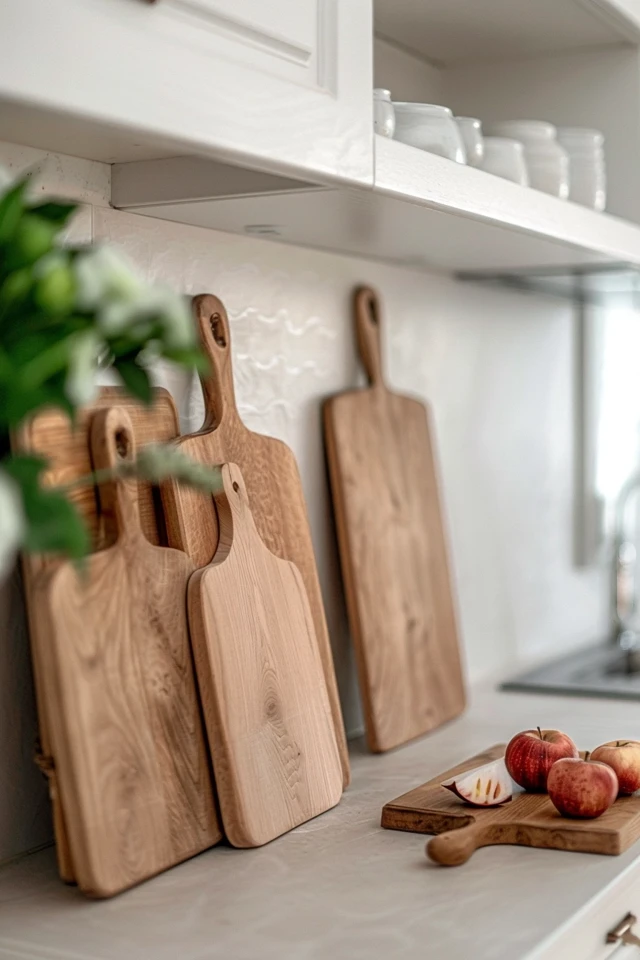
The most common and effective way to display cutting boards is by leaning them against your kitchen backsplash. This utilizes vertical space that often goes unused and brings a natural element to eye level. However, simply propping a board up isn’t enough to create a “designed” look.
You need to rely on the principle of layering to create depth. I rarely display a single board alone unless it is an exceptionally large, sculptural vintage piece. Instead, I group them in odd numbers, usually sets of three.
Start with your largest board in the back. This should be a rectangular or large square shape that covers a significant portion of the backsplash height. Standard backsplash height is typically 18 inches; aim for a back board that is roughly 14 to 16 inches tall to fill the visual void without jamming into the upper cabinets.
Place a slightly smaller board with a different shape, such as a round paddle board, in front of the large one. Offset it slightly to the left or right so the back board is still visible. Finally, layer a small, contrasting element in front, like a marble cheese board or a small ceramic salt cellar.
Designer’s Note:
One thing that often goes wrong with leaning boards is slippage. If your countertops are polished quartz or granite, wood boards will slide down over time. To prevent this, I adhere small clear rubber bumpers to the bottom edge of the board. This keeps them upright and prevents water from pooling underneath the wood near the sink.
Common Mistakes + Fixes:
- Mistake: Blocking your only usable outlets with heavy boards.
- Fix: Lean boards over outlets you rarely use. If you need the outlet, use a “footed” cutting board that raises the wood off the counter, allowing the cord to pass underneath, or simply lean the board to the side of the plate rather than directly over it.
2. Hanging Collections on Vertical Rails or Pegs
If you have limited counter space, getting your collection off the horizontal surfaces is a priority. Hanging cutting boards is a fantastic way to fill a blank wall or the side of a cabinet run. This technique works particularly well in cottage, farmhouse, or eclectic kitchen styles.
My preferred method for this is installing a brass or iron utensil rail. You can use S-hooks to hang boards by their handles. This allows you to slide them around and mix them with other tools like copper pots or dried herbs.
When installing a rail, mounting height is critical. If hanging above a counter, the rail should be approximately 20 to 22 inches above the countertop surface. This ensures that even your longest boards (usually 18-20 inches) won’t drag on the counter.
If you are renting or cannot drill into a backsplash, consider using the side of a pantry cabinet or a refrigerator enclosure. A vertical row of shaker pegs can turn an awkward, narrow strip of cabinetry into a stunning feature wall.
What I’d do in a real project:
- Measure the longest board in your collection first.
- Install the highest hook or peg at a height that allows the bottom of that board to hang 4 to 6 inches above the floor or counter.
- Space multiple hooks vertically with at least 3 inches of clearance between the bottom of the top board and the handle of the next board.
3. The Kitchen Island Vignette
The kitchen island is often a magnet for mail, keys, and clutter. To combat this, I use a large, substantial cutting board as a “tray” to ground the space. This designates a specific zone for decor and prevents the island from looking messy.
Scale is the most important factor here. A standard 8×10 inch cutting board will look like a postage stamp on a large island. You need a board that feels generous—think 18×24 inches or a large oversized round board.
Once the board is placed, treat it as a foundation. I typically style this with three elements: something tall (like a vase with branches), something low (like a candle or bowl of citrus), and something practical (like a stack of napkins or a pepper mill).
This setup also protects your island countertop. If you have marble or soft stone, keeping oils, wines, and citrus confined to the wood board prevents etching and staining on your permanent surfaces.
Designer’s Note:
Be mindful of the “wood-on-wood” look. If you have a wood island top, do not use a wood cutting board as decor; it will blend in and look heavy. Instead, use a large white marble or slate board to create contrast against the wood surface. Conversely, if you have stone counters, a rich walnut or oak board provides the necessary warmth.
4. Integration into Open Shelving
Open shelving is a daunting feature for many homeowners because it requires constant curation. Cutting boards are the secret weapon for styling these shelves because they take up a large amount of visual space while remaining neutral.
When styling shelves, I use cutting boards as the “backdrop.” Lean a square or rectangular board against the back wall of the shelf. This breaks up the depth and provides a high-contrast background for white dishes or clear glassware placed in front of it.
If you have deep shelves (12 inches or more), you can stack boards horizontally. A stack of 3 or 4 heavy wooden boards creates a sculptural look. This works best on lower open shelves due to the visual weight.
Pay attention to the wood tones. If your shelves are white oak, try to avoid matching the cutting boards exactly to the shelf wood. It can look washed out. Aim for a few shades darker (like walnut) or lighter (like maple) to ensure the boards pop.
Common Mistakes + Fixes:
- Mistake: Leaning round boards on high shelves without securing them. Round boards roll easily.
- Fix: Use a small dab of museum wax on the bottom edge where it meets the shelf. This is invisible but holds the board firmly in place, even if the shelf is bumped.
5. Selecting Materials for Aesthetic and Use
Not all cutting boards are worthy of display, and not all display boards are good for cutting. In a high-end kitchen, the material quality is what separates a cluttered look from a curated one.
For display purposes, I look for woods with complex grain patterns. Olive wood is spectacular for small accent boards because of its swirling, high-contrast grain. For larger foundation boards, Maple and Walnut are the industry standards for durability and rich color.
Mixed materials are also trending. A board that features a wood body with a marble handle, or a marble strip down the center, acts as a piece of art. These are generally better for serving cheese or charcuterie rather than heavy chopping, as the knife will dull on the stone.
Maintenance is part of the aesthetic. A dried-out, graying board looks neglected on display. To keep your display boards looking rich and intentional, you must oil them regularly. I recommend a food-safe mineral oil and beeswax blend.
My Real-World Maintenance Checklist:
- Monthly: Apply a heavy coat of board oil to all display boards. Let it sit overnight and wipe off the excess in the morning. This keeps the wood grain popping.
- For Scratches: If a board is heavily used and displayed, sand it lightly with 220-grit sandpaper once a year to remove deep knife marks, then re-oil.
- Hygiene: I always advise clients to keep one “ugly” plastic board hidden in a drawer for raw chicken and fish. Keep your beautiful wood display boards for bread, veggies, and serving.
Final Checklist
If you are ready to style your kitchen, run through this quick checklist to ensure a balanced look.
- Check the Scale: Is the board big enough? It should occupy about 1/3 of the vertical space if leaning.
- Check the Contrast: Does the board stand out against the counter or wall? Dark on light, or light on dark.
- Secure the Lean: Have you added rubber feet or museum wax to prevent sliding?
- Group in Threes: Have you layered the board with two other items (a smaller board, a vase, or a utensil holder)?
- Protect the Wood: Is the board oiled and positioned away from direct splashes near the sink faucet?
- Clear the Cord: Are you hiding an outlet, or blocking one you need? Ensure functionality remains priority.
FAQs
Can I actually use the cutting boards I display?
Absolutely. In fact, boards look better with some wear. The key is to wash and dry them immediately after use. Do not let them soak in the sink, as this causes warping. Once dry, place them back in their display spot.
How do I mix different wood tones?
The general rule is to keep the undertones consistent. If your cabinets have warm, yellow undertones, stick to warm woods like maple or honey oak. If you have cooler-toned floors or cabinets, walnut or ash often works better. However, mixing wood is generally safer than trying to match it perfectly and failing.
What is the best way to clean a vintage board?
Vintage boards should be treated gently. Scrub with coarse salt and half a lemon to remove odors and stains without harsh chemicals. Rinse with warm water and dry immediately with a towel. Never put a vintage (or any wood) board in the dishwasher.
My board is wobbling when I chop. How do I fix it?
If a board has warped slightly, place a damp kitchen towel underneath it while you are working. This creates a stable, non-slip base. For display, you can use felt pads on the bottom corners to level it out against the wall.
Conclusion
Displaying cutting boards is one of the most accessible ways to elevate a kitchen’s aesthetic. It requires no renovation, very little budget, and adds immediate soul to the room. By following the rules of scale, layering, and material contrast, you can turn a simple kitchen tool into a defining feature of your home. Remember that the most beautiful kitchens are those that feel used and loved—so don’t be afraid to take those boards down, use them, and prop them back up.
Picture Gallery


