
Title: Denim Sorted: Clever Jeans Storage Ideas Unveiled
Introduction
There are few wardrobe staples as versatile and beloved as a good pair of blue jeans. However, denim is notoriously difficult to store neatly due to its bulk, weight, and varying rigidity. Make sure to scroll through to the bottom, because the Picture Gallery is at the end of the blog post to visualize these concepts.
For many of my clients, the “jean pile” is a constant source of frustration. Whether they end up draped over a chair or stuffed haphazardly into a drawer that won’t close, denim demands a specific strategy. As an interior designer, I approach jean storage by balancing accessibility with visual calmness.
In this guide, we will move beyond basic folding. We will look at architectural solutions, spatial planning for bulky fabrics, and specific measurements to ensure your closet functions as well as it looks.
1. The Shelf Stack: Mastering Open Storage
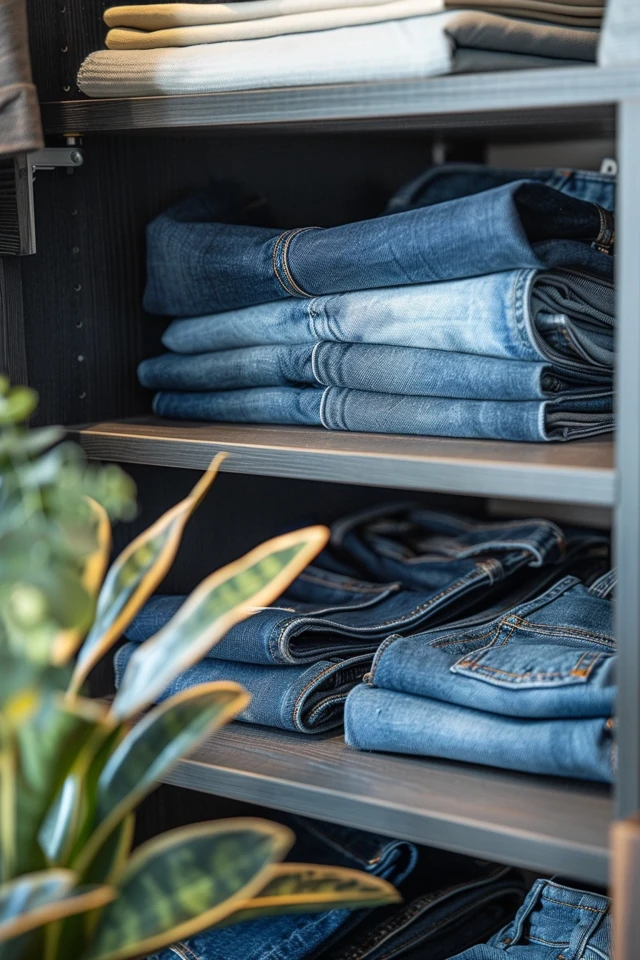
Open shelving is often the go-to solution for denim enthusiasts who want to see their collection at a glance. However, without strict rules, shelves can quickly become messy. The key to a polished look lies in uniformity and structural support.
When designing a closet layout, I always allocate shelves with a depth of at least 14 to 16 inches for denim. Standard 12-inch shelves often leave the waistbands or hems hanging over the edge, creating visual noise. If you are renovating, push for that extra depth.
The “Boutique Fold” Technique
To achieve that retail-store look, you must fold with the intention of hiding the crotch seam and creating a smooth edge.
- Lay the jeans flat, buttoning the waist to maintain structure.
- Fold the jeans in half lengthwise (leg over leg).
- Tuck the crotch seam inward to create a clean rectangle.
- Fold the hem up to the waistband, then fold in half again.
This method creates a thick, uniform brick that stacks securely.
Height and Stability Rules
A common mistake is stacking too high. When a stack of denim exceeds 10 to 12 inches, it becomes unstable and difficult to pull from. In my projects, I place shelves on adjustable pins so we can keep the clearance tight—usually about 14 inches between shelves.
Designer’s Note: Never rely on gravity alone. I always install clear acrylic shelf dividers spaced 10 to 12 inches apart. This prevents the “toppling tower” effect and keeps different washes separated. If you are renting, slip-on acrylic dividers are a fantastic, non-permanent investment.
2. Drawer Dynamics: The Vertical File System
If you prefer your clothes tucked away, drawers offer a streamlined aesthetic. However, the standard horizontal stack (one on top of another) is the enemy of efficiency. You inevitably wear the top pair and forget about the bottom three.
The solution is “file folding.” This involves standing the folded jeans upright so you can see every single pair when you open the drawer. This method also reduces bulk compression, which preserves the elasticity in stretch denim.
Measurements That Matter
For this system to work, drawer depth is critical.
- Standard Drawers: Most dressers have drawers around 5 to 7 inches deep. This is tight for adult denim.
- Deep Drawers: For jeans, I specify drawers with an internal clearance of 8 to 10 inches. This allows the jeans to stand up without getting caught in the glides above.
Tension Dividers
Even with file folding, rows can start to lean as you do laundry and the drawer empties. Spring-loaded drawer dividers are essential here. Run them from front to back to create channels. I typically space these channels about 6 to 8 inches wide, which fits one column of folded jeans perfectly.
Common Mistakes + Fixes
Mistake: Stuffing too many pairs in one drawer.
Fix: Apply the “90% Rule.” Leave 10% of the drawer empty. If you have to force the drawer shut, the glides will eventually fail, and the friction will damage the fabric of your jeans.
3. Hanging Solutions: S-Hooks and The Long Hang
Hanging jeans is an excellent way to utilize vertical space, especially in closets with limited shelving. It is also the preferred method for raw denim enthusiasts who want to avoid crease lines from folding.
There are two primary ways to hang denim, and your choice depends on your available vertical hanging space.
The S-Hook Method
This method involves hooking the rear belt loop of the jeans onto a sturdy S-hook or a specialized denim hanger, allowing the pants to hang long.
- Pros: It is incredibly space-efficient horizontally. You can fit 10 pairs of jeans in the space of 4 standard hangers.
- Cons: It requires significant vertical height.
If you choose this route, ensure your hanging rod is mounted at least 45 to 50 inches from the floor or the shelf below. I often design a specific “mid-hang” section in closets just for this purpose.
The Savile Row Hang
For a more traditional approach, use sturdy wooden hangers with a pant bar.
- Fold the jeans lengthwise.
- Drape them over the bar.
- Crucial Step: Ensure the hanger has a non-slip velvet or rubber coating on the bar. Denim is heavy and will slide off smooth wood.
What I’d do in a real project: I usually reserve hanging space for dressier trousers and use shelves for jeans. However, if a client has a “long hang” section meant for dresses that is underutilized, I will convert part of it to S-hook denim storage to maximize the cubic footage.
4. Renter-Friendly and Small Space Hacks
Not everyone has a custom walk-in closet. When I work on apartments or smaller homes, we have to get creative with external storage that doubles as decor. Denim, with its rich textures and blue tones, can actually look good out in the open if styled correctly.
The Ladder Display
A leaning blanket ladder is a fantastic, drill-free way to store 4 to 5 pairs of your most-worn jeans.
- Lean the ladder against a bedroom wall.
- Fold jeans neatly over the rungs.
- Style Tip: Organize them by gradient—light wash at the top, dark wash at the bottom. This visual weight anchors the piece.
Ensure the ladder has wide, flat rungs rather than round dowels. Round dowels can create permanent creases in the fabric if the jeans sit there for weeks.
Under-Bed Rolling Bins
For off-season storage or overflow, utilize the space under the bed. Avoid plastic, airtight bins for denim. Natural fibers need to breathe, and sealed plastic can trap residual moisture, leading to musty odors or mildew.
I recommend canvas under-bed bags with structured sides or rattan baskets on wheels. If you must use plastic for pest protection, toss in a few cedar blocks or silica gel packets to regulate humidity.
Freestanding Garment Racks
If closet space is non-existent, a sturdy industrial pipe rack can hold a significant denim collection. Since denim is heavy, look for racks rated for at least 100 lbs. Cheap composite racks will bow and eventually snap under the weight of 20 pairs of jeans.
5. Lighting and Categorization Logic
Storage is useless if you can’t find what you are looking for. One of the biggest complaints I hear is, “I can’t tell my black jeans from my dark blue jeans in the morning.” This is almost always a lighting issue.
Lighting Specs for Closets
To distinguish between dark indigo, charcoal, and black, you need high CRI (Color Rendering Index) lighting.
- Color Temperature: Aim for 3000K to 3500K. This is a bright, neutral white that doesn’t cast the yellow tint of warm bulbs (2700K) or the harsh blue of daylight bulbs (5000K).
- Positioning: If possible, install LED ribbon lighting on the underside of the shelf above your denim stack. This illuminates the front of the fabric directly.
Sorting Logic
How you organize your stack affects how messy it gets. I always advise clients to sort by Style first, then Wash.
1. Group 1: Skinny/Straight Leg (Everyday)
2. Group 2: Wide Leg/Flare (Statement)
3. Group 3: Relaxed/Boyfriend (Comfort)
Within those groups, arrange from light to dark. This way, when you know you need a specific silhouette for an outfit, you are only disrupting one specific pile.
Final Checklist: Designing Your Denim Zone
Before you reorganize, run through this quick checklist to ensure your system will last.
- Audit the Collection: Have you tried on every pair? If it doesn’t zip, it doesn’t get prime shelf space.
- Measure Shelf Depth: Do you have at least 14 inches? If not, are you prepared to fold differently?
- Check Lighting: Can you tell navy from black in your current light? Upgrade bulbs if necessary.
- Buy Supports: Do you have shelf dividers or drawer tensioners ready?
- Weight Check: Are your hooks or rods secured into studs? Denim is heavy.
- Breathing Room: Is there air circulation to prevent mustiness?
FAQs
Should I store jeans inside out?
Generally, it is not necessary for storage. However, washing them inside out is crucial for preserving color. If you are hanging raw denim that hasn’t been set, storing inside out can prevent dye transfer onto adjacent light-colored clothing.
Is it better to roll or fold jeans for packing?
For travel, rolling is superior. It saves space and prevents hard creases. For home storage, rolling is only recommended for shallow drawers or bin storage. On shelves, rolls tend to look messy and unstack easily.
Can I use wire hangers for jeans?
Absolutely not. Denim is too heavy for thin wire hangers. They will distort the waistband, leave permanent “shoulder” bumps in the fabric, and likely bend under the weight. Always use wood or sturdy molded plastic.
How do I stop my jeans from smelling musty in storage?
Humidity control is key. Never store damp jeans. If your closet is near a bathroom, keep the door closed during showers. I also like to place blocks of cedar wood on the shelves between denim stacks. Cedar naturally repels moths and absorbs moisture while adding a fresh, woody scent.
Conclusion
Organizing your denim collection is about more than just tidying up; it is about respecting the investment you have made in your wardrobe. By choosing the right method—whether it is the boutique fold on open shelves, the file fold in deep drawers, or a vertical hanging system—you can extend the life of your jeans and make getting dressed an effortless experience.
Remember to consider the constraints of your space. A renter in a studio apartment will need a different system than a homeowner with a custom walk-in. Regardless of the method, the goal is visibility and accessibility.
Take the time this weekend to pull everything out, audit your collection, and implement a system that works for your daily routine. Your future self (and your tidy chair) will thank you.
Picture Gallery


