
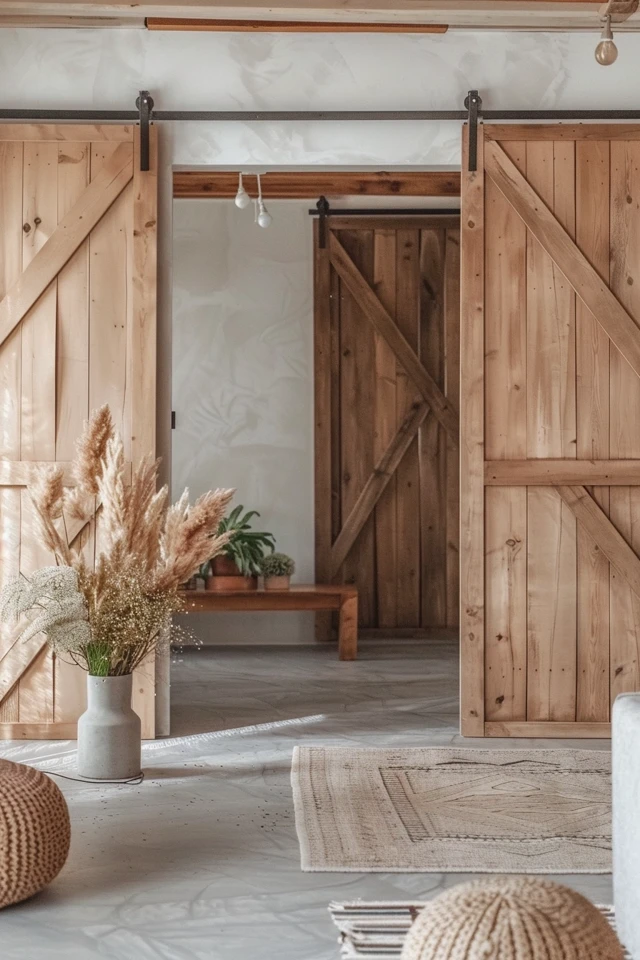
Double Barn Door Ideas for Stylish Home Decor
Double barn doors create a dramatic focal point that standard swing doors simply cannot achieve. They bridge the gap between open-concept living and the need for privacy, allowing you to transform a room’s function in seconds. I often recommend them for wide openings between dining rooms and living areas, or as a statement entrance to a home office.
There is a misconception that barn doors only fit a rustic “farmhouse” aesthetic. In reality, the hardware and door style define the look. I have installed sleek, matte black glass doors in ultra-modern apartments and white oak shaker-style doors in traditional homes. It is all about how you treat the materials and the scale of the installation.
If you are looking for visual inspiration, you can scroll down to the Picture Gallery at the end of the blog post. However, before you buy, there are critical spacing rules and structural requirements you need to understand to ensure your new doors function as well as they look.
1. Choosing the Right Aesthetic for Your Space
The first step in selecting double barn doors is moving past the generic “reclaimed wood” look, unless that specifically suits your home. As a designer, I categorize barn doors into three main style buckets: Industrial, Transitional, and Rustic. Your choice needs to complement the existing millwork and flooring in your home.
For modern or industrial spaces, I almost always suggest steel and glass. Iron-framed glass doors allow light to flow between rooms even when they are closed. This is perfect for a home office where you need sound dampening but do not want to feel isolated in a dark box. The metal frames should match your window mullions or light fixtures for a cohesive look.
Transitional homes benefit from clean lines and painted finishes. A simple shaker-style door (a flat panel with a square frame) painted in the same color as your trim—or a moody contrast color like charcoal or navy—looks timeless. This approach prevents the “barn” aspect from feeling too literal or themed.
If you prefer a rustic or organic look, texture is key. Instead of rough, splintery pallets, look for refined, wire-brushed white oak or walnut. The goal is to bring warmth to the room without making it look like an actual barn. I recommend a matte clear coat to protect the wood while keeping the natural look intact.
2. The Math Behind the Install: Measuring for Success
This is where most DIY projects fail. Installing double barn doors requires precise calculations regarding wall space and overlap. Unlike a swing door that fits inside the frame, barn doors sit over the frame. If you just measure the opening, you will end up with light leaks and privacy gaps.
The Width Rule: Each door should overlap the opening by at least 1 to 2 inches on the side, and the doors should meet in the middle with a slight overlap or a specialized astragal seal if total privacy is needed. For a 60-inch opening, I generally specify two 32-inch or 33-inch doors. This ensures that when the doors are “closed,” you cannot see through the cracks at an angle.
The Height Rule: Barn doors must be mounted high enough to clear the floor. I usually leave a 1/2-inch gap between the bottom of the door and the flooring. This accounts for any unevenness in your subfloor. If you have high-pile carpet, you may need to increase this to 3/4 of an inch, though barn doors operate best over hard surfaces.
Wall Clearance: Double doors require double the wall space. If you have two 36-inch doors, you need at least 36 inches of clear wall space on both sides of the opening. I check for light switches, outlets, thermostats, and vents. You cannot slide a heavy door over a thick protruding light switch.
3. Room-Specific Considerations
Not every room is a good candidate for double barn doors. The intended use of the room dictates the material and the hardware you should choose. I assess the “privacy vs. flow” ratio before recommending this setup to a client.
The Primary Bedroom: Double doors leading into a bedroom or a primary closet add a grand hotel feel. However, because barn doors “float” off the wall, they do not block sound as well as swing doors. If you are a light sleeper and your partner watches TV in the adjacent room, solid wood core doors are mandatory to help dampen the noise.
The Kitchen Pantry: This is my favorite application for double barn doors. Pantries often have narrow walkways where a swing door gets in the way of traffic. Double sliding doors allow you to access the left or right side of the pantry without blocking the kitchen aisle. Here, you can be bolder with design—perhaps a chalkboard finish or a fun pop of color.
The Home Office: As mentioned earlier, visibility is usually desired here. If you use glass doors, consider the glass opacity. Clear glass offers zero visual privacy. Frosted or reeded glass (which has a vertical texture) obscures the view enough to hide a messy desk while still letting daylight pass through.
4. Hardware Selection and Structural Support
The track system is the engine of your double barn doors. Cheap hardware leads to grinding noises, stuck doors, and eventually, sagging rails. I always insist on high-quality box rail or flat track hardware made of solid steel or aluminum, never hollow metals.
The Header Board: This is non-negotiable for heavy double doors. Standard drywall anchors cannot support the dynamic weight of two rolling doors. If you do not have solid blocking behind the drywall (which you likely don’t in a retrofit), you must install a header board. This is a piece of 1×6 or 1×8 lumber bolted into the studs, which the track is then mounted to. Paint the header board the same color as the wall to make it disappear.
Soft-Close Mechanisms: Just like kitchen drawers, you can get soft-close actuators for barn doors. This catches the door slightly before it hits the stop and gently pulls it closed. This prevents the doors from bouncing back open and reduces the noise of metal slamming against metal. It is a small upgrade that makes the doors feel luxurious.
Floor Guides: You cannot let the bottom of the doors swing free. A floor guide is a small bracket that keeps the door vertical. For double doors, I prefer a T-guide that fits into a groove cut into the bottom of the door. This is invisible from the outside and prevents the door from swinging out and hitting the baseboards.
5. Styling Around Your Double Doors
Once the doors are installed, you have to style the room differently. The sliding mechanism claims the wall space on either side of the opening, which means you cannot hang thick artwork or place deep furniture against those walls.
Wall Decor: If you want to hang art on the wall behind where the door slides, it must be flush. I usually avoid this entirely to prevent scratches. Instead, focus your styling above the header if you have high ceilings, or focus on the adjacent walls. If the doors are the focal point, let them breathe. Do not crowd them with clutter.
Furniture Placement: Keep a “slide zone” clear. I recommend keeping furniture at least 3 to 4 inches away from the wall where the door rests when open. Side tables or console tables are risky here unless they are very shallow. If the door has a large handle, that handle will protrude into the room, so ensure your walkway clearance accounts for that extra 2 or 3 inches.
Lighting: Sconces look beautiful flanking a doorway, but with barn doors, they are a hazard. The door will slide right into them. If you want sconces, they must be placed beyond the open position of the doors. Alternatively, install recessed lighting or a directional picture light above the header board to illuminate the doors when they are closed.
Designer’s Note: The Reality of “Soundproofing”
I have to be honest with clients about acoustics. Barn doors are beautiful, but they are not soundproof. Because they sit off the wall to slide, there is an inherent air gap. Sound travels through air.
My workaround: If sound privacy is a major concern (like in a bathroom or media room), I use a few tricks. First, I order the door slightly wider to increase the overlap with the wall. Second, I use a “brush sweep” or weather stripping on the back edge of the door to seal the gap against the wall. It helps significantly, but it will never equal the seal of a traditional pre-hung door.
Common Mistakes + Fixes
Mistake: Forgetting the recessed handle.
Most people buy a big, beautiful pull handle for the front. But they forget the back. If you want the door to open fully, you need a flush pull (recessed handle) on the back side. Otherwise, the door will stop where the handle hits the wall, cutting off part of your walkway.
Mistake: Ignoring the baseboards.
If you have thick baseboards, the door might rub against them.
Fix: Install a thicker header board to push the track further off the wall, or replace the baseboard behind the door area with a flat stock trim.
Mistake: Choosing the wrong finish for the track.
Mixing metals can be chic, but a chrome track with bronze light fixtures often looks disjointed in this context.
Fix: Match the track hardware to the other architectural hardware in the room (doorknobs, hinges) rather than the decorative fixtures (faucets, lamps).
What I’d Do in a Real Project: A Mini Checklist
If I were managing your renovation, this is the checklist I would run through before ordering anything:
- Check Structural Support: Locate studs. If they aren’t where the track holes line up, plan for a header board.
- Measure Vertical Clearance: Ensure there is enough room between the top of the door opening and the ceiling (or crown molding) for the track wheels. You usually need at least 6 inches.
- Select the Core: For bedrooms/bathrooms, choose solid core. For pantries/closets, hollow core is acceptable (and lighter).
- Plan the Guide: Decide if I’m drilling into the floor for the guide (tile/wood) or using a wall-mounted guide (saves the floor).
- Hardware Audit: Confirm the kit includes stoppers, anti-jump discs (safety feature), and the correct length lag bolts.
Frequently Asked Questions
Can I lock double barn doors?
Yes, but it requires specific hardware. A “teardrop” latch attaches to the jamb and slides into a receiver on the door. For double doors locking together, there are hook-and-eye latches or specialized privacy bolts that install on the inner edges.
Do double barn doors save space?
They save floor space because you don’t need a clear radius for the door to swing. However, they use wall space. They are excellent for tight corridors or rooms with plenty of furniture in the center but clear walls.
How wide should the track be?
For double doors, the track usually needs to be at least four times the width of a single door leaf, minus a bit for overlap. However, many double door kits come with two tracks and a connector. Ensure the total length allows both doors to clear the opening fully.
Are barn doors out of style?
The aggressively rustic, distressed pallet-wood barn doors are trending down. However, the function of a sliding door is timeless. Sleek, painted, or metal-framed sliding doors are a staple in high-end design because they solve architectural problems elegantly.
Conclusion
Double barn doors offer a unique blend of high drama and practical problem-solving. They allow you to manipulate the flow of your home, opening up spaces for entertaining or closing them off for cozy privacy. By focusing on the right materials—moving toward sleeker woods or glass—and nailing the installation math, you can add significant value and style to your home.
Remember that the success of this project lies in the preparation. Measure twice, check your wall clearance, and invest in heavy-duty hardware that glides silently. With the right approach, your double doors will be a feature you love using every single day.
Picture Gallery


