
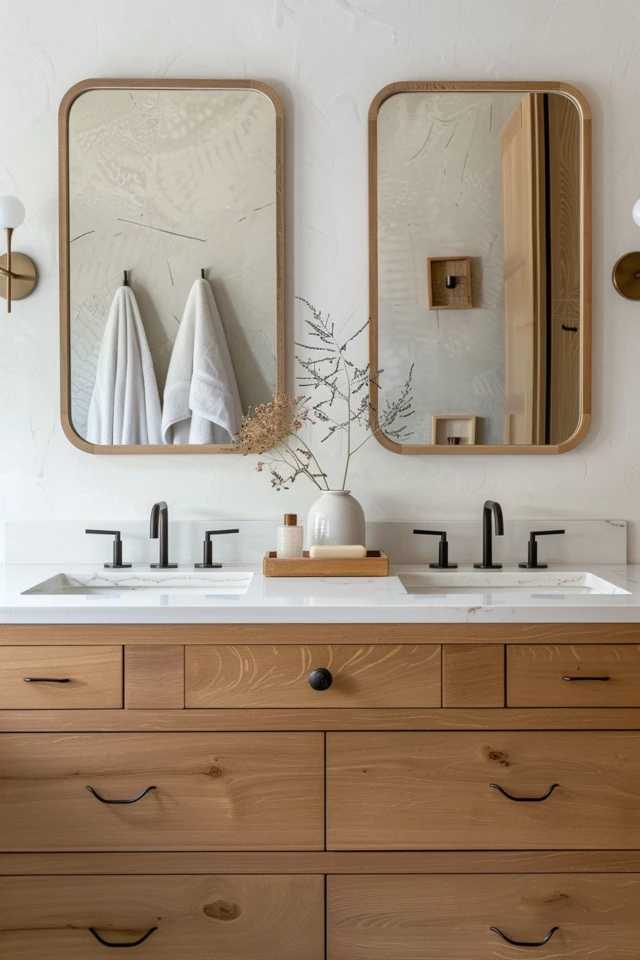
Double Vanity Bathroom Mirror Ideas I Love
Designing a bathroom with a double vanity is one of the most rewarding challenges in interior design because it requires a perfect balance of symmetry and functionality. You have twice the plumbing, twice the lighting needs, and twice the opportunity to make a serious style statement. The mirrors you choose act as the anchor for the entire wall, dictating where the lights go and how the room feels.
I often tell clients that while the vanity is the furniture, the mirrors and lighting are the jewelry. They draw the eye up and bounce light around the room, which is critical in spaces that often lack large windows. Choosing the wrong scale or shape can throw off the proportions of even the most expensive cabinetry.
Whether you are renovating a master ensuite or updating a shared kids’ bathroom, getting the mirror situation right is the difference between a builder-grade look and a custom design. Be sure to browse the curated Picture Gallery at the end of this post for visual inspiration.
The Great Debate: Two Mirrors vs. One Large Sheet
The first decision you have to make is structural. Do you want two distinct mirrors hanging over each sink, or do you want one expansive sheet of glass spanning the entire width of the vanity?
I typically lean toward using two separate mirrors in my projects. This approach creates distinct “zones” for each user, which feels more luxurious and intentional. It also allows us to install wall sconces in the middle, providing superior lighting for grooming.
However, the single large mirror has its place, especially in smaller or darker bathrooms. A continuous sheet of glass reflects more light and visually doubles the size of the room. It offers a clean, contemporary line that works well in minimalist designs.
If you choose the single mirror route, I recommend framing it. A raw edge of glass glued to the wall often feels unfinished or dated. Adding a simple wood or metal frame gives it the presence of furniture rather than just a functional surface.
Sizing and Placement Rules of Thumb
Getting the measurements right is where most homeowners get stuck. If the mirrors are too small, they look floating and lost; if they are too big, the space feels crowded and heavy.
When using two separate mirrors, the width of the mirror should generally be slightly narrower than the width of the sink cabinet below it. For example, if your double vanity consists of two 24-inch sink bases, I would aim for mirrors that are roughly 20 to 22 inches wide. This leaves breathing room on either side.
Height is equally important. I usually look for mirrors that are at least 30 to 36 inches tall. The goal is to maximize the vertical line, drawing the eye up toward the ceiling. The top of the mirror should sit at least a few inches above the eye level of the tallest person using the bathroom, usually landing somewhere between 75 and 80 inches off the floor.
Distance between the mirrors is dictated by your vanity length. You need enough space between them to prevent the area from looking cluttered. If you plan to put a sconce in the middle, you need a minimum gap of 6 to 8 inches, though 10 to 12 inches is ideal for visual comfort.
Shape shifting: Beyond the Rectangle
While rectangular mirrors are timeless, playing with shape is the easiest way to add personality to a double vanity.
Arched Mirrors
Arched mirrors are currently my favorite way to soften a bathroom. Bathrooms are full of hard, cold surfaces like tile, stone, and porcelain. Introducing a curve at the top of the vanity breaks up the grid and adds an architectural element.
Round Mirrors
Round mirrors work exceptionally well in powder rooms or smaller double vanities where wall space is tight. They leave more negative space on the wall, which lets your tile or wallpaper shine through. Just be careful with height; ensure the center of the circle is at face level for the average user.
Pivot Mirrors
For a traditional or farmhouse aesthetic, pivot mirrors are unbeatable. These are mounted on side brackets that allow the glass to tilt up or down. They add lovely hardware detail and are highly practical if you have users of significantly different heights sharing the space.
Lighting Integration Strategies
You cannot choose your mirrors without simultaneously choosing your lighting. They are a package deal.
The gold standard for bathroom lighting is eye-level illumination. This usually means placing sconces on either side of the mirrors. In a double vanity setup, this typically requires three lights: one on the far left, one in the middle, and one on the far right.
If you don’t have the width for three sconces, you can use a double sconce in the center or switch to library lights installed above the mirrors. If you go with lights above the mirror, ensure the fixture is roughly 75% of the mirror’s width. A tiny light over a huge mirror looks unbalanced.
For a sleek, modern look, consider backlit LED mirrors. These have integrated lighting behind or around the glass. They provide excellent, even light for applying makeup because the light comes directly from the front, eliminating shadows under the eyes and nose.
Material Finishes and Coordination
A common question I get is whether the mirror frame needs to match the faucet. The short answer is no. In fact, a little contrast often looks more designed.
If you have chrome faucets, a matte black mirror frame can look stunning and grounding. If you have unlacquered brass plumbing, a warm wood mirror frame can bridge the gap between the metal and the cabinetry.
However, you should aim for cohesion. If you are mixing metals, try to repeat the mirror finish somewhere else in the room, perhaps in the cabinet hardware or the towel bars.
If you are worried about durability, look for mirrors specifically rated for high-moisture environments. Wood frames should be sealed properly. Metal frames should be powder-coated or treated to resist rust, which is common in bathrooms with poor ventilation.
Designer’s Note: The Medicine Cabinet Dilemma


