
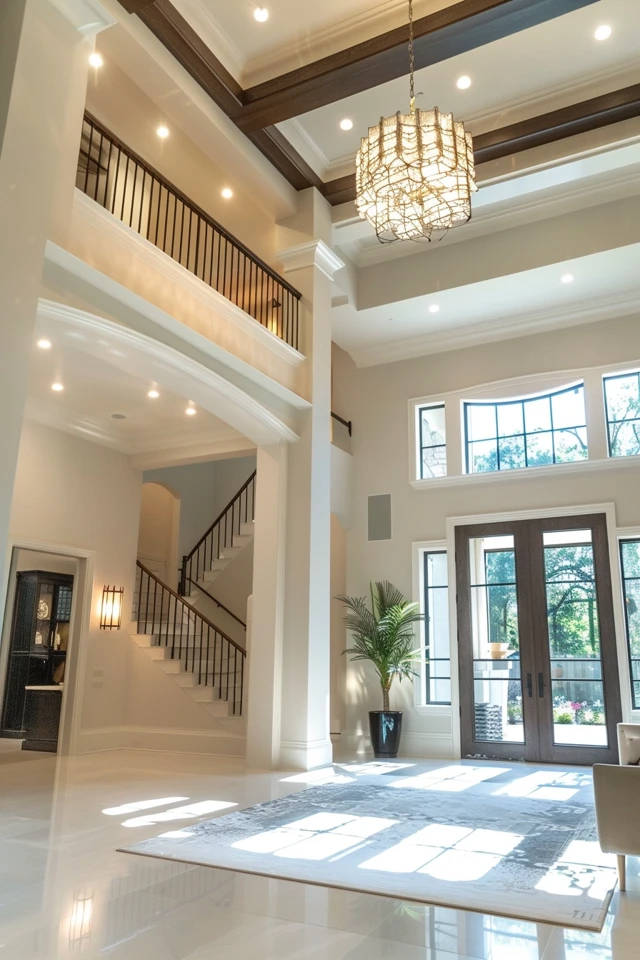
Elevate Your Entryway with High Ceiling Foyer Lighting
Walking into a home with a soaring, two-story foyer is an experience that immediately signals luxury and openness. However, styling these vertical expanses is one of the most intimidating challenges homeowners face. If you get the scale wrong, your lighting fixture looks like a toy hanging in a cavern; get it right, and you anchor the entire home’s design language the moment the front door opens. Check out our curated picture gallery at the end of the post for visual inspiration.
When I walk into a project with a high-ceilinged entryway, my first thought isn’t just about style—it is about volume. The air space in a foyer is a massive architectural element that needs to be filled, not just illuminated. Many people make the mistake of treating a twenty-foot ceiling like a standard eight-foot room, resulting in lighting that feels lost and disconnected from the furniture below.
In this guide, we are going to break down the specific math, the layering techniques, and the installation logistics required to light a high foyer correctly. Whether you are dealing with a grand staircase or a compact entry with significant vertical height, the goal is to bridge the gap between the ceiling and the floor, creating a welcoming transition into your home.
Understanding Scale and The “Rule of Thumb”
The single most common error in high-ceiling lighting is choosing a fixture that is too small. When you are standing in a showroom, a 24-inch wide chandelier looks massive. When you hang that same fixture in a two-story foyer, it effectively disappears. To avoid this, designers rely on specific calculations to ensure the fixture commands enough visual weight.
The primary rule for determining width is simple: add the length and width of the room together in feet, and convert that sum to inches. For example, if your foyer is 12 feet by 14 feet, the sum is 26. Therefore, your chandelier should be roughly 26 inches in diameter. However, for double-height ceilings (17 feet or higher), I often advise clients to bump that number up by 20 to 30 percent. In a tall space, volume matters as much as diameter.
Height is the second critical metric. A flat or shallow fixture will look underwhelming in a tall space. You generally want a fixture that has significant vertical body—tiered chandeliers, lanterns, or multi-pendant clusters work best. A good baseline is to allow 2.5 to 3 inches of fixture height for every foot of room height. If you have a 20-foot ceiling, a fixture that is 50 to 60 inches tall is not unreasonable.
Designer’s Note: The Volume Lesson
I once worked with a client who insisted on a minimalist, single-tier ring chandelier for a 19-foot foyer. Despite my warnings, we installed it. It looked like a hula hoop floating in a gym. We had to replace it two weeks later with a three-tier version of the same light. The lesson? In high-ceiling spaces, “too big” is rarely the problem. “Too sparse” is the enemy.
Placement and Hanging Height
Determining how low to drop the fixture is just as important as the size of the fixture itself. If you hang it too high, you lose the intimacy and the light doesn’t reach the floor. If you hang it too low, it interferes with sightlines or the door swing.
For a standard single-story foyer, the bottom of the light should be at least 7 feet off the floor. However, in a two-story foyer, that rule changes. The light usually needs to hang lower than the second-story ceiling line so that it is visible through the window from the outside (a classic curb appeal trick) and visible from the second-floor landing.
A practical approach is to center the fixture in the window frame if there is a large window above the door. If there is no window, aim to have the bottom of the fixture hang no lower than 8 to 9 feet from the floor. This keeps it feeling grand but grounded. You want the light to feel like it belongs to the first floor, not like it is stuck to the roof.
Addressing the “Second Floor View”
If your foyer has a balcony or landing that overlooks the entryway, you must consider what the fixture looks like from the top. You do not want to be looking down at bare bulbs or messy wiring. Choose a fixture that is aesthetically pleasing from all angles. Lanterns and fully enclosed glass fixtures are excellent for this because they look finished from above, below, and the sides.
Layering Light: Don’t Rely on One Source
A high-ceiling chandelier creates ambient light, but it is often too far away to provide functional task lighting for the entryway. If you only rely on the ceiling fixture, you will end up with the “cave effect,” where the ceiling is bright, but the floor area feels dim and shadowy.
You must layer your lighting. This means adding light sources at eye level. If you have space for a console table, place a pair of substantial table lamps on it. The top of the table lamp should generally be 58 to 64 inches from the floor. This brings a warm glow down to human scale, making the space feel welcoming rather than imposing.
If a console table doesn’t fit, consider wall sconces. In a tall foyer, sconces help break up the massive vertical expanse of the walls. Place them roughly 60 to 66 inches from the floor, or slightly higher if the room is truly massive. They act as architectural jewelry and provide soft accent lighting that makes the space feel wider.
Common Mistakes + Fixes
- Mistake: Using a fixture with downward-facing shades only.
Fix: High ceilings need uplighting and omnidirectional lighting to illuminate the walls and ceiling structure. Downlights create harsh shadows on guests’ faces.
- Mistake: Forgetting the dimmer switch.
Fix: High-output bulbs needed for a large room can be blinding at night. A dimmer is non-negotiable for setting the mood.
- Mistake: Ignoring the chain length.
Fix: Standard fixtures often come with only 3 to 6 feet of chain. For a 20-foot ceiling, you might need 10 to 12 feet of chain/wire. Always check the specs and order extra chain and wire if needed.
Material Selection and Finish Coordination
The finish of your foyer lighting sets the tone for the rest of the house. Since the entryway is the first impression, the materials here should foreshadow what guests will see in the living room and kitchen. However, you do not need to match everything perfectly.
If your door hardware is matte black, you don’t necessarily need a black chandelier. In fact, a contrasting metal can look stunning. For example, an aged brass chandelier pops beautifully against white walls and coordinates well with black door handles. The key is to maintain a consistent style—modern, traditional, transitional—rather than matching the exact metal.
Think about maintenance when choosing materials. A clear glass globe fixture looks incredible when clean, but in a high foyer, it is difficult to dust. Every speck of dust or spiderweb will be backlit and visible. Textured glass, seeded glass, or open-frame metal fixtures are much more forgiving. They hide dust better and require less frequent deep cleaning.
Weight and Structural Support
Large scale usually means heavy weight. A massive iron lantern or crystal chandelier can easily weigh 50 to 100 pounds or more. A standard plastic junction box is rated for about 50 pounds. Before you fall in love with a heavy fixture, you need to know if your ceiling is reinforced.
If you are renovating, ask your contractor to install a fan brace or a heavy-duty metal junction box. This ensures the fixture won’t pull out of the drywall. If you are unsure what is currently installed, hire an electrician to inspect and reinforce the box before installation.
The Practical Side: Bulbs and Maintenance
The most annoying aspect of high-ceiling lighting is changing the bulbs. You do not want to be renting a 15-foot A-frame ladder every six months. This is where LED technology is your best friend.
Invest in high-quality, dimmable LED bulbs with a lifespan of 15,000 to 25,000 hours. This creates a “set it and forget it” situation for several years. When choosing bulbs, pay attention to the Kelvin temperature. For residential interiors, 2700K (warm white) or 3000K (soft white) is the standard. Avoid 4000K or 5000K, which looks like a hospital or a garage and will make your entryway feel cold and sterile.
For the ultimate in luxury and practicality, consider installing a motorized light lift. This is a mechanical winch system installed in the ceiling joists that allows you to lower the chandelier to floor level with the turn of a key. It makes cleaning and bulb changing effortless. While it is an investment (usually adding $1,000+ to the project), it pays for itself by eliminating the need for professional cleaning services or scaffolding rentals.
What I’d Do in a Real Project: The Mini Checklist
If I were consulting on your entryway today, here is the mental checklist I would run through to ensure success. You can use this to vet your own choices.
- Measure the door clearance: If there is a window above the door, ensure the chandelier centers nicely in it from the street view.
- Check the voltage: Ensure the total wattage of the new fixture doesn’t exceed the dimmer switch rating. (LEDs usually solve this, but check anyway).
- Verify the chain length: Did I order extra chain and wire? The standard 6 feet is rarely enough for a 19-foot ceiling.
- Rug Coordination: Does the visual weight of the chandelier balance the rug? A heavy iron chandelier usually needs a grounded, substantial rug, not a flimsy flatweave.
- Shadow play: Does the fixture cast weird shadows? Intricate metal cages can cast “spider legs” on the walls. Frosted bulbs help diffuse this.
Final Checklist for Homeowners
Before you click “buy” or schedule the electrician, run through this final punch list to ensure you haven’t missed a critical detail.
1. Calculate Size: Room Length + Width (in feet) = Fixture Diameter (in inches).
2. Calculate Height: 2.5 inches of fixture height for every 1 foot of ceiling height.
3. Determine Drop: Bottom of fixture ideally 8 to 9 feet off the floor for very high ceilings.
4. Order Components: Fixture, bulbs (2700K-3000K), extra chain, extra wire.
5. Schedule Install: Confirm the electrician has a ladder tall enough (many only carry 8-foot ladders).
6. Plan the Switch: Ensure the switch is in a logical place near the door and is dimmer-compatible.
7. Inspect the Box: verify weight rating of the ceiling junction box.
FAQs
Q: Can I hang a chandelier if my ceiling is sloped?
A: Yes, but you must choose a fixture that hangs by a chain or a cord. Fixtures with rigid metal stems (downrods) require a special “sloped ceiling adapter” to hang straight. Without it, the stem will follow the angle of the roof, and your light will hang crooked.
Q: Is it okay to use a fan in a two-story foyer?
A: Functionally, yes, it helps circulate heat. Aesthetically, it is rarely the best choice. A ceiling fan generally lowers the “perceived value” of a grand entry. If you must have airflow, look for a “fandelier” (a chandelier with hidden blades) or ensure the fan is extremely high-end and architectural.
Q: How do I clean a chandelier that is 20 feet up?
A: If you don’t have a motorized lift, you have two options. One: Hire a professional window/lighting cleaning service once a year. Two: Use an extendable pole duster. However, pole dusters only knock dust off; they don’t scrub glass. For deep cleaning, you will need a tall ladder or scaffolding.
Q: My foyer is narrow but tall. What shape should I get?
A: For narrow, tall spaces, look for “lantern” style fixtures or multi-pendant cascades. These emphasize the verticality without overcrowding the width. A wide, round chandelier might feel like it is touching the walls in a tight corridor-style entry.
Conclusion
Lighting a high-ceiling foyer is about embracing the drama of the architecture while maintaining the comfort of a home. It requires a brave approach to scale—trusting the math that tells you to buy the bigger fixture—and a thoughtful approach to layering. By combining a statement overhead piece with warm eye-level lighting, you transform a cavernous echo chamber into a grand, welcoming embrace.
Remember that this fixture is the jewelry of your home’s façade. It is likely the only piece of interior decor visible from the street at night. Take the time to measure correctly, invest in quality materials, and ensure your installation is safe and maintainable. When done right, your entryway will not just be a passageway; it will be a breathtaking introduction to your life at home.
Picture Gallery


