
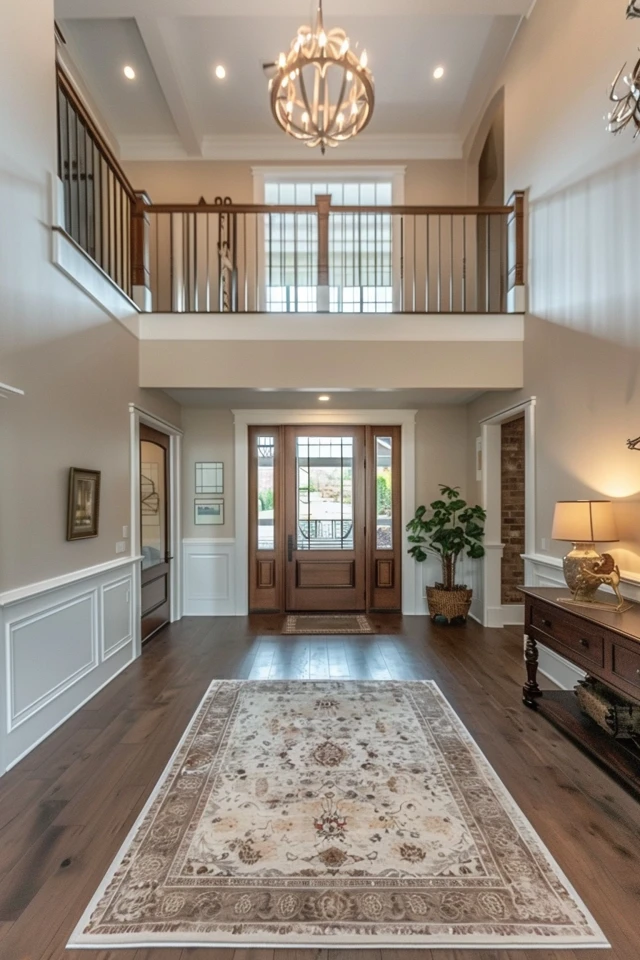
Elevate Your Entryway with Two Story Foyer Wall Decor Ideas
Walking into a home with a two-story foyer is an experience in itself. The vertical volume creates an immediate sense of grandeur and openness that standard ceilings simply cannot match. However, that same architectural drama often leaves homeowners feeling paralyzed when it comes to decoration.
I recall a project early in my career where a client had left her twenty-foot entry walls completely bare for five years. She told me she felt dwarfed by the space, worried that anything she hung would look like a postage stamp on a billboard. The solution wasn’t to fill every square inch of drywall, but to understand how to ground the space so it felt welcoming rather than cavernous.
If you are staring up at those looming walls and wondering where to begin, you are in the right place. For those seeking immediate inspiration, a comprehensive picture gallery is waiting at the end of this blog post. But first, let’s break down the design principles, measurements, and practical strategies you need to tackle those high ceilings with confidence.
Understanding Scale and the “Two-Zone” Approach
The biggest mistake I see in tall foyers is a failure to understand scale. When you have eighteen or twenty feet of vertical space, standard 8×10 picture frames will virtually disappear. You have to recalibrate your eye to think in larger volumes and heavier visual weights.
To make the task manageable, I divide tall walls into two distinct zones: the “Human Zone” and the “Architecture Zone.” The Human Zone is the bottom eight to nine feet of the wall. This is where the eye naturally rests and where the majority of your detail work should live.
The Architecture Zone is everything above that nine-foot mark. This upper area does not always need artwork. In fact, leaving negative space high up can often highlight the architecture. The goal is to draw the eye up gently, not to clutter the stratosphere with decor you can barely see.
Designer’s Note: The 57-Inch Rule Adjustment
In a standard room, we hang art so the center is 57 to 60 inches from the floor. in a two-story foyer, you can cheat this up slightly to 60 or 62 inches to account for the volume of the room. However, never hang art so high that you have to crane your neck to see it. If you are hanging a piece in the “Architecture Zone,” it must be large enough to be read from the ground floor.
Grounding the Space with Furniture and Anchors
Before you even put a nail in the wall, you need to look at the floor. A tall wall needs a heavy anchor at the bottom. If you hang a large piece of art on a massive wall with nothing underneath it, the art will look like it is floating aimlessly in space.
Start with a substantial console table, a chest of drawers, or a bench. The furniture provides visual weight and connects the wall decor to the floor. This creates a foundation that makes the height of the room feel intentional rather than overwhelming.
Rules of Thumb for Console Tables:
- Width: The table should be substantial. Avoid spindly legs if possible. A solid wood chest or a table with a bottom shelf adds necessary mass.
- Decor Ratio: Any art or mirror hung above the console should generally span about two-thirds to three-quarters of the table’s width. If your table is 60 inches wide, your art display should be roughly 40 to 45 inches wide.
- Clearance: Leave 4 to 8 inches of breathing room between the bottom of the frame and the top of the table decor (lamps, books, trays).
Oversized Art and Gallery Walls
Once you have your furniture anchor, you have two primary paths for the wall itself: one massive statement piece or a curated collection.
The Statement Piece
A single, oversized piece of art is often the cleanest solution for a two-story foyer. It feels modern and less cluttered. However, “oversized” in this context means truly large. You are likely looking for canvases that are at least 48 inches by 60 inches, often larger.
If you fall in love with a piece that is slightly too small, you can visually expand it. Frame it with a wide mat (4 to 6 inches) and a chunky frame. This adds inches to the overall footprint without changing the art itself.
The Vertical Gallery Wall
If you prefer a gallery wall, the grid layout is usually superior to an eclectic “salon style” layout in a tall foyer. A precise grid of 6, 9, or 12 matching frames creates a sense of order that calms the chaotic height of the room.
Common Mistakes + Fixes:
- Mistake: Spacing frames too far apart to “fill” the wall.
- Fix: Keep frames tight. 2 to 3 inches apart is ideal. If you spread them 6 inches apart, the eye reads them as separate islands rather than one cohesive installation.
- Mistake: Using small mats.
- Fix: Use oversized mats with smaller photos. A 20×20 frame with an 8×8 photo looks high-end and architectural.
Architectural Molding and Trim Work
Sometimes the best wall decor isn’t decor at all—it’s architecture. Adding molding is the most effective way to address the full twenty-foot height of a foyer without making it look busy. It breaks up the vast expanse of drywall and adds shadow lines that create depth.
Wainscoting and Board and Batten
A popular approach is to install board and batten or wainscoting on the lower portion of the wall. In a standard room, this might stop at 36 inches. In a two-story foyer, I often recommend taking this woodwork up to 6 or 7 feet. This essentially lowers the visual scale of the room, making the entry feel cozy while maintaining the airiness above.
Picture Frame Molding
For a more traditional or transitional look, floor-to-ceiling picture frame molding (box molding) is stunning. This involves applying trim in rectangular shapes up the entire wall.
Why this works:
- It fills the “void” without requiring you to buy twenty pieces of art.
- You can paint the molding the same color as the wall for subtle texture, or a contrasting color for drama.
- It solves the “Architecture Zone” problem. The upper boxes can remain empty because the molding itself is the decor.
What I’d Do in a Real Project:
If the budget allows, I almost always push for molding in two-story foyers. I would paint the wall and the trim in a rich, warm neutral—like a “greige” or a soft taupe. This envelops the visitor and reduces the starkness of white drywall.
Lighting as Wall Decor
Lighting is functional, but in a foyer, it is also sculptural. Sconces are your best friend in a high-ceilinged space. They add a layer of light at the human level, which creates ambiance so you don’t always have to rely on the high chandelier.
Sconce Placement and Scale:
If you have a mirror or art above a console, flanking it with sconces widens the visual impact of the arrangement. If your art is 40 inches wide, adding two sconces can extend that focal point to 60 or 70 inches.
When selecting sconces for a two-story space, go bigger than you think. A tiny 8-inch fixture will look like a toy. Look for sconces that are 15 to 24 inches tall. Vertical shapes tend to compliment the room’s height better than round, compact fixtures.
The Chandelier Connection:
While not technically “wall decor,” your chandelier interacts visually with your walls. If your walls are fairly empty, an elaborate, multi-tiered chandelier can act as the jewelry of the room.
Ensure the chandelier is hung correctly. The bottom of the fixture should generally be no lower than 7.5 feet from the floor if people walk under it. If it hangs over a center table, it can drop lower.
Mirrors, Textures, and Acoustics
Two-story foyers have a notorious functional downside: acoustics. They tend to be echo chambers. Hard floors, drywall, and glass create a lot of noise bounce. Therefore, your wall decor choices should double as sound dampening where possible.
Fabric and Tapestries
Large-scale textile art or modern tapestries are excellent for this. They add softness and warmth to the hard surfaces. A framed vintage rug or a macramé installation can act as a sound absorber while adding significant texture.
Mirrors
Mirrors are classic for entryways, but placement matters. A mirror reflects whatever is opposite it. In a two-story foyer, ensure the mirror isn’t just reflecting a blank wall or a messy coat closet.
If you use a mirror, choose one with an interesting frame—wood, metal, or leather. This adds material interest. For extremely high walls, you can use a “pier mirror” (a very tall, narrow mirror) to accentuate the height elegantly.
Wallpaper and Murals
If you want to make a bold statement, wallpapering the entire two-story rise is a showstopper. However, this is a commitment in terms of cost and installation (you will need scaffolding).
Pattern Scale
The rule of scale applies here too. Avoid tiny, ditsy floral prints. From the ground floor, a small pattern will just look like texture or dirt on the upper walls.
Opt for large-scale botanicals, geometric shapes, or murals. A mural that fades as it goes up (like an ombre effect or trees that reach upward) can be magical in a foyer, drawing the eye up toward the light.
Rental Friendly Options
If you are renting or not ready for permanent paper, peel-and-stick murals have come a long way. You might choose to paper just one focal wall—usually the one opposite the front door or the wall running up the staircase—rather than the entire room.
Designer’s Checklist: What I’d Do in Your Home
If I were walking into your home today to fix a boring two-story foyer, here is the mental checklist I would run through. You can use this to plan your own renovation.
- Check the Acoustics: Is it echoing? If yes, I am prioritizing canvas art, tapestries, or adding a runner rug before I choose mirrors or metal art.
- Establish the Anchor: I would find the largest console table that fits the space without blocking traffic flow. I’m aiming for at least 60 inches wide.
- Define the Human Zone: I would focus 80% of the budget on the bottom 9 feet. I would ensure the lighting and art look perfect at eye level before worrying about the top tier.
- Select the “Jewelry”: I would choose sconces that coordinate with the overhead chandelier but don’t match it perfectly. Mixing metals (like black and brass) adds sophistication.
- Safety Check: For anything heavy hung high up, I would plan to use French cleats rather than wire. They are more secure and keep artwork perfectly level.
FAQs
How do I clean artwork hung 12 feet up?
This is a practical concern many forget. You do not need a ladder every week. Invest in a high-quality telescoping duster with a microfiber head. For glass-fronted art, you will need to get up there occasionally, which is why I often prefer canvas or open textures for hard-to-reach spots.
Do I have to decorate the wall going up the stairs?
Not necessarily. The staircase wall is often the hardest to decorate because of the angles. A gallery wall that follows the slope of the stairs is a classic choice, but leaving it blank and letting a beautiful railing or runner be the star is perfectly acceptable modern design.
Is it okay to leave the upper walls completely empty?
Yes, absolutely. Negative space allows the eye to rest. If you have beautiful molding, a stunning light fixture, or a great architectural window, you don’t need to compete with it. Silence in design is as important as the noise.
How do I hang things safely on such high walls?
For heights over 10 feet, do not rely on a standard A-frame ladder unless you have a spotter and experience. For true two-story heights, renting a small section of scaffolding or hiring a professional art installer is cheaper than a hospital bill. Professional installers also have the right hardware to ensure heavy pieces never fall.
Conclusion
Decorating a two-story foyer is about managing volume. It is easy to feel intimidated by the sheer square footage of the walls, but by breaking the space down into zones, the project becomes approachable. Remember to anchor your design with substantial furniture, focus your attention on the “Human Zone,” and use scale to your advantage.
Whether you choose the architectural elegance of molding, the drama of a large-scale mural, or the curated precision of a gallery grid, the goal is to create a transition space that feels grand yet grounded. Your foyer is the handshake of your home—make it firm, warm, and memorable.
Picture Gallery


