
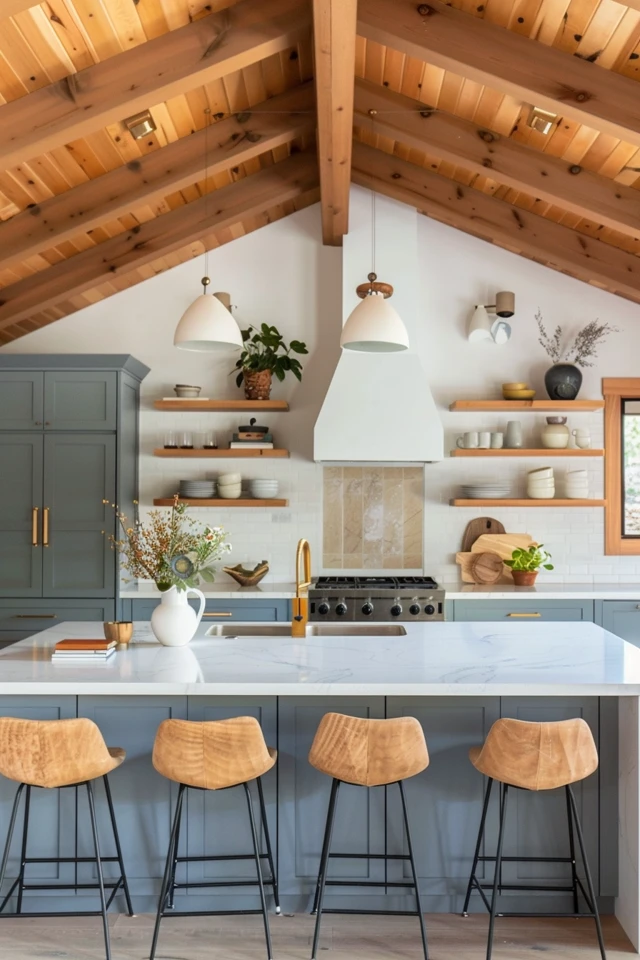
Elevate Your Space with Vaulted Ceiling Kitchen Ideas
There is something undeniably breathtaking about walking into a kitchen with a vaulted ceiling. The extra volume immediately creates a sense of luxury and openness that standard eight-foot ceilings simply cannot match. It transforms a utilitarian workspace into the architectural heart of the home, allowing for dramatic design choices that might otherwise feel overwhelming in a smaller space.
However, designing for this vertical volume comes with a unique set of challenges. Without the right grounding elements, a high-ceilinged kitchen can feel cavernous, cold, or disconnected from the rest of the house. The goal is to celebrate the height while ensuring the room remains human-scaled and inviting for your morning coffee.
For a dose of visual inspiration, be sure to scroll to the bottom of this post because I have curated a stunning Picture Gallery designed to spark your creativity.
Mastering Scale and Proportion
The most common issue I see in vaulted kitchens is the “dollhouse effect.” This happens when homeowners select furniture, lighting, and cabinetry designed for standard ceiling heights, making them look tiny and lost in a grand room. When you have a vaulted ceiling, you must scale up.
Your kitchen island needs to be substantial to anchor the room. If space allows, I recommend an island depth of at least four feet rather than the standard three. This added weight helps the island hold its own against the soaring ceiling above.
Similarly, consider the vertical lines in the room. Standard upper cabinets often look awkward when they stop several feet below the ceiling line. You need to bridge that gap visually, either through architectural details, stacked cabinetry, or extended backsplashes.
Designer’s Note: The Rule of Thirds
When dealing with a vaulted wall, I always mentally divide the vertical space into thirds. The bottom third is your functional zone (counters, base cabinets). The middle third is your visual bridge (hood, windows, tall cabinets). The top third is the architectural zone (beams, trusses, or negative space). If you leave the top two-thirds empty, the room will feel unfinished.
Lighting Strategies for High Volumes
Lighting a vaulted ceiling is significantly more complex than lighting a flat one. You cannot rely solely on recessed cans. If you place recessed lights on a steep pitch without adjustable housings, they may shine directly into your eyes rather than on the counter.
You need to think in layers. First, address the ambient light. If you use recessed cans, ensure they are “gimbal” or “sloped ceiling” rated so the beam can be directed straight down.
Next, focus on your pendants. Tiny glass pendants will disappear in a vaulted room. You need oversized fixtures with significant visual weight. Look for pendants that are at least 15 to 20 inches in diameter if you are hanging two over an island. If you are hanging three, you can go slightly smaller, but aim for substantial materials like metal or woven textures rather than clear glass.
Common Lighting Mistakes + Fixes
Mistake: Hanging pendants too high. Because the ceiling is high, people instinctively shorten the chain, leaving the lights floating aimlessly in the ether.
Fix: Stick to the standard rule relative to the counter, not the ceiling. The bottom of your pendant should be 30 to 36 inches above the countertop. In a vaulted room, you might cheat this up to 38 or 40 inches to account for the scale, but never higher.
Beams, Trusses, and Architectural Details
One of the most effective ways to bring warmth to a vaulted kitchen is to lower the visual ceiling height without actually losing the volume. We achieve this through exposed beams or trusses.
Wood beams add rhythm to the ceiling and break up the vast expanse of drywall. They also serve a functional purpose by providing a place to hide wiring for lighting fixtures, which can be difficult to retrofit in vaulted spaces.
If your style is modern farmhouse or rustic, rough-hewn reclaimed wood beams are a perfect choice. For a more transitional or coastal look, consider smooth box beams painted in a crisp white or a soft greige that contrasts slightly with the ceiling color.
What I’d Do in a Real Project: Beam Sizing
If I am designing a kitchen with a 12-foot or higher vault, I never use a beam smaller than 8×8 inches. A 4×4 or 6×6 post will look like a toothpick. If the room is particularly wide (over 20 feet), I will size up to 10×10 or even 12×12 faux box beams to ensure they look structural, even if they are purely decorative.
Cabinetry and Vertical Storage Solutions
The question of “what to do with the space above the cabinets” is magnified in a vaulted kitchen. In a standard room, you might have a one-foot gap. In a vaulted room, you might have five or six feet of empty wall space.
My preferred approach is to stack cabinetry. This usually involves a standard 36-inch or 42-inch upper cabinet, topped with a smaller 15-inch to 18-inch glass-front cabinet. This draws the eye upward and provides storage for seasonal items you rarely use.
If stacked cabinets break the budget, consider a soffit that mimics the wall or ceiling color, or use a heavy crown molding stack on top of the cabinets to add height. Another option is to eliminate upper cabinets entirely on the vaulted wall and use floating shelves or a full-height backsplash to create an open, airy feel.
Real-World Constraint: Dust and Cleaning
If you choose to leave the space above the cabinets open, be honest with yourself about maintenance. That top ledge will collect dust and grease.
Designer Tip: If you leave a gap, paint the top of the cabinets (the actual horizontal surface that nobody sees) with a high-gloss paint. It makes wiping down the dust significantly easier than cleaning a raw or matte surface.
Range Hoods and Focal Points
In a vaulted kitchen, the range hood is your greatest opportunity for a “wow” moment. Because you have the vertical real estate, you can extend the hood cladding all the way up to the ceiling or a cross-beam.
A chimney-style hood that stops halfway up the wall looks truncated and awkward in a vaulted room. Instead, design a custom enclosure using drywall, plaster, or wood that tapers gracefully as it rises.
Plaster hoods are particularly trendy right now and work beautifully in vaulted spaces because they add texture without visual clutter. If you prefer metal, a custom stainless or copper flue that extends high up the wall creates a stunning industrial or French country vertical line.
Tile Rules for High Ceilings
If you are tiling the backsplash behind the range, do not stop at the bottom of the cabinets. Take the tile all the way to the ceiling or at least to the bottom of the highest architectural feature (like a beam). This vertical stripe of texture emphasizes the height in a deliberate, designed way.
Managing Acoustics and Sound
One factor that rarely shows up in photos but dominates the actual experience of living in a vaulted kitchen is noise. Hard surfaces like stone counters, tile floors, and drywall ceilings combined with a vaulted shape create an echo chamber.
To combat this, you need to introduce soft, sound-absorbing materials. This is where your window treatments and runners come into play.
Avoid bare windows if possible. Even if you don’t close them often, stationary fabric panels mounted high (just below the ceiling plate or beam) will help dampen sound.
Rug Sizing for Open Kitchens
If your vaulted kitchen opens into a dining or living area, use large area rugs to absorb sound.
Rule of Thumb: Ensure your runner between the island and the sink is at least 2.5 feet wide. A wider runner (3 feet) absorbs more sound and feels more luxurious underfoot.
Final Checklist: The “Designer’s Eye” Review
Before you finalize your vaulted kitchen renovation or build, run through this mental checklist. These are the steps I take to ensure the space feels grounded rather than cavernous.
- Check the Lighting Specs: Have you confirmed the lumen output of your high recessed cans? They need to be brighter than standard lights because they are further away.
- Verify Pendant Cord Length: Do the fixtures you selected come with enough chain or cord to hang at the proper height? Many standard fixtures only come with 6 feet of wire, which may not be enough.
- Anchor the Room: Is your island substantial enough? If the room feels too big, consider painting the island a darker, grounding color like charcoal, navy, or forest green.
- Human Scale: Have you included elements at eye level (sconces, shelves, art) so the room feels comfortable when you are sitting down?
- The Range Hood Test: Does the hood design account for the full height of the wall, or will it look like it’s floating?
FAQs
How do I clean high vaulted ceilings in a kitchen?
Maintenance is a valid concern. For dusting beams and high corners, you will need a telescoping dusting pole, which can reach up to 20 feet. For changing light bulbs, I highly recommend installing LED integrated fixtures or long-life LED bulbs so you only have to get the tall ladder out once every decade.
Will a vaulted ceiling make my kitchen cold?
Heat rises, so vaulted rooms can feel cooler in the winter. To mitigate this, consider installing a reversible ceiling fan. In the winter, you can run it clockwise at a low speed to gently push the warm air trapped at the ceiling back down to the living space without creating a draft.
Can I vault a ceiling in an existing kitchen?
This depends entirely on your roof structure. If you have a stick-framed roof, it is often possible but requires a structural engineer to design collar ties or new load paths. If you have manufactured trusses (common in homes built after the 1970s), you usually cannot cut them to vault the ceiling without completely rebuilding the roof system, which is cost-prohibitive for most budgets.
What is the best color for a vaulted kitchen ceiling?
While white is the classic choice to enhance airiness, don’t be afraid of color. Painting the ceiling a few shades lighter than the walls (but not stark white) can make the room feel cozier. In very large rooms, painting the ceiling a dark, moody charcoal can actually bring the visual height down and make the space feel intimate and dramatic.
Conclusion
Designing a kitchen with a vaulted ceiling is an exercise in balance. You are balancing the grandeur of the architecture with the intimacy of a family gathering space. It requires careful thought regarding lighting layers, acoustic management, and the scale of your furnishings.
However, when done correctly, the result is a space that feels both majestic and welcoming. It turns the kitchen from a mere service area into the true heart of the home, offering a sense of freedom and light that elevates your daily routine. Take your time with the details, invest in the right lighting, and embrace the volume.
Picture Gallery


