
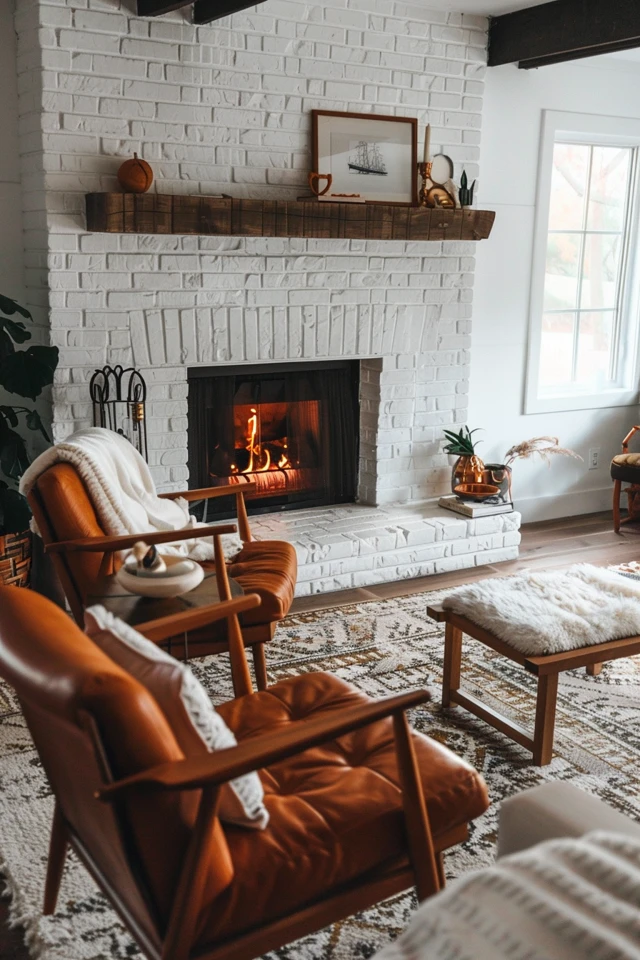
Elevating Style with Fireplace Ideas Vaulted Ceiling
There is something undeniably majestic about a vaulted ceiling. It draws the eye upward, creates a sense of airiness, and makes even a modest footprint feel like a grand hall. However, that vertical volume creates a specific challenge for interior designers: the “empty void.”
When you have a standard fireplace in a room with cathedral ceilings, the scale often feels off. The fireplace can look like a postage stamp stuck to a massive envelope. My goal when designing these spaces is to bridge the gap between human scale—where we sit and relax—and the architectural scale of the roofline.
This guide will walk you through exactly how to balance those proportions. For a massive dose of inspiration, make sure to check out our curated Picture Gallery at the end of this blog post.
1. Mastering the Vertical Scale
The single most common mistake homeowners make with vaulted ceilings is stopping the fireplace treatment at the standard eight or nine feet. In a room with 15-foot peaks, a standard-height mantel with drywall above it creates a visual disconnect. It leaves the top half of the room feeling unfinished and cold.
To elevate the style, you must treat the fireplace as a vertical anchor. The material surrounding the firebox should ideally extend all the way to the ceiling or the highest architectural break. This draws the eye up and emphasizes the height of the room rather than chopping it in half.
The Rule of Thirds for Chimney Width
When designing the “chase” (the column that houses the fireplace), width is just as important as height. If the column is too narrow and goes all the way up, it looks like a pencil.
A good rule of thumb is that the fireplace structure—including any immediate flanking elements like wood storage or pillars—should occupy roughly one-third of the wall’s total width if the wall is under 20 feet wide. For wider walls, aim for a minimum width of 6 to 8 feet for the central stone or cladding feature.
Designer’s Note: The “Step-Back” Technique
In a recent project with a 22-foot A-frame ceiling, the client worried that a full stone wall would feel too heavy. We compromised using a “step-back” design.
We built the main hearth and mantel section wide (about 8 feet) up to the 6-foot mark. Then, the chimney breast narrowed slightly to 5 feet wide as it ascended to the peak. This created a tapered, elegant look that felt grounded but not oppressive.
Common Mistakes + Fixes
- Mistake: Using a standard 50-inch mantel shelf on a massive two-story wall.
- Fix: Scale up your mantel. In vaulted rooms, I use mantels that are at least 6 to 8 inches thick (height) and 10 to 12 inches deep. A skinny shelf disappears in a large room.
- Mistake: Ignoring the crown molding or transition.
- Fix: If your fireplace material meets a sloped ceiling, ensure the cut is precise. For stone, scribble the scribe line accurately so no large mortar gaps are visible at the top.
2. Selecting Materials with Visual Weight
Because a floor-to-ceiling fireplace in a vaulted room requires a lot of square footage of material, your choice here dictates the entire room’s vibe. You are essentially adding an architectural feature wall.
Texture is your best friend in large spaces. Smooth drywall often looks flat and cheap when spread over a 20-foot vertical span because it highlights every seam and imperfection in the framing. Textured materials hide flaws and absorb light, making the room feel cozier despite the size.
Stone and Brick
Natural stone or brick is the classic choice for volume. It adds “visual weight,” making the room feel grounded. For vaulted ceilings, I prefer large-scale stones or “slab” aesthetics over small, busy mosaics.
If you use small stacked ledger stone on a massive wall, the thousands of horizontal lines can make the wall look busy and vibrating. Large format limestone, concrete-look tiles (24×48 inches), or over-grouted fieldstone offer a calmer presence.
Millwork and Shiplap
If stone is out of budget or too rustic for your taste, millwork is the answer. Vertical shiplap or board-and-batten grid paneling draws the eye upward and adds necessary shadow lines.
Cost-Saving Strategy:
If you are renting or on a strict budget, paint the drywall of the chimney breast a dark, moody color (charcoal or navy). Then, install substantial molding vertically up the sides and across the top. This mimics the look of paneling without the carpentry expense.
Real Project Constraints: Weight Loads
Designer’s Note: Before you decide to clad a 20-foot chase in heavy natural stone, check your floor joists. Real stone veneer is heavy (10-14 lbs per square foot plus mortar).
- What I do: If the fireplace is on a raised foundation or slab, you are usually fine.
- The Retrofit: If this is a second-story renovation or a retrofit, I almost always specify “thin brick” or cultured stone veneers which weigh significantly less.
- The Inspection: Always ask a contractor if the framing needs reinforcement before ordering 2,000 lbs of rock.
3. Furniture Layouts that Anchor the Room
A vaulted ceiling can make furniture feel like it is floating in a gymnasium. Your layout needs to define the “human zone” around the fireplace.
The goal is to create a “room within a room.” You want to create intimacy around the hearth so that when you are seated, you don’t feel dwarfed by the ceiling height.
Floating the Furniture
Never push your sofa against the wall in a room with vaulted ceilings. It exaggerates the empty space in the middle. Float your seating arrangement in the center of the room, facing or flanking the fireplace.
The Rug Rule for Large Rooms
The rug is the anchor. In a standard room, an 8×10 rug works. In a vaulted room, an 8×10 often looks like a bathmat.
Measurement specifics:
- Ideally, use a 9×12 or 10×14 rug.
- Ensure at least the front legs of all seating pieces are on the rug.
- Leave about 18 to 24 inches of bare floor between the rug edge and the hearth hearth.
What I’d Do in a Real Project: The L-Shape vs. Parallel
If the room is narrow and tall, I place two matching sofas perpendicular to the fireplace (facing each other). This draws lines directly to the fire.
If the room is wide and open to a kitchen, I use a large sectional in an L-shape to close off one side and create a cozy corner. I then place a heavy console table behind the sofa. This “backs up” the furniture so it doesn’t look lonely in the open space.
4. Lighting the Void
Lighting is the secret weapon for vaulted ceilings. During the day, these rooms are bright and airy. At night, however, all the light gets trapped in the peak, leaving the living space dark and cavernous.
You need to layer light specifically to bring the ceiling “down” visually in the evening.
The Importance of Sconces
I almost always install sconces on the fireplace face itself or the walls immediately flanking it.
Placement Rules:
- Height: Mount sconces roughly 60 to 66 inches from the floor to the center of the junction box. This keeps the light at human eye level.
- Scale: Use large fixtures. A tiny 8-inch sconce looks silly next to a 15-foot fireplace. Look for fixtures that are 18 to 24 inches tall.
Grazing the Texture
If you chose stone or textured tile, install recessed “gimbal” lights or track heads in the ceiling aimed at the fireplace face. This is called “wall grazing.”
When the light hits the stone at a steep angle, it highlights the texture and creates drama. Without this, a tall stone wall can just look like a dark, looming shadow at night.
Pendant Lighting
If you have a chandelier, ensure it hangs low enough. A common error is hanging the fixture too high because the ceiling is high.
The Drop Calculation:
The bottom of your chandelier should generally be about 8 to 9 feet off the floor in a two-story room, regardless of how high the peak is. This keeps the light associated with the seating area, not the rafters.
5. Decor and Flanking Built-ins
The space immediately to the left and right of the fireplace (the “alcoves”) is just as critical as the fireplace itself. In vaulted rooms, these spaces are often tall and awkward.
If you leave these alcoves empty, the fireplace looks isolated. You need to build mass here to support the central focal point.
Built-In Cabinetry
Custom built-ins are the gold standard. However, you don’t always have to go to the ceiling with them.
My preferred layout:
I often design closed cabinets at the base (30-36 inches high) for toy/cable storage, with open shelving above.
Stopping Point:
You can stop the built-ins at the 8 or 9-foot line. This creates a horizontal datum line that brings the scale back down to human level. You do not need to build bookshelves 18 feet up—nobody can reach them, and they are a nightmare to dust.
Window Treatments
If windows flank your fireplace, rod placement is vital.
- High Windows: If you have a lower set of windows and an upper set (clerestory), install curtains only on the lower set.
- Rod Height: Mount the rod at least 6 to 10 inches above the window frame, or halfway between the frame and the ceiling molding if available.
- Fullness: Skimpy curtains look terrible in tall rooms. Ensure your panels have 2x to 3x fullness so they look substantial when closed.
6. Art and the Over-Mantel Dilemma
The “over-mantel” area is the space directly above your shelf. In a vaulted room, you might have 10 feet of empty wall space here. Do not feel compelled to fill the entire vertical space.
The “Quiet Space” Rule
Negative space is okay. If you have a beautiful stone facade, you don’t need to cover it. The stone is the art.
However, if you have drywall or shiplap, you need a focal point.
Art Sizing and Placement
The Ratio: The art piece (or mirror) should be roughly 2/3 the width of the mantel shelf. If your mantel is 72 inches wide, your art should be roughly 48 inches wide.
Vertical Placement: Leave about 4 to 8 inches of breathing room between the bottom of the frame and the top of the mantel.
The Tilt:
Designer’s Secret: If you hang a mirror or glass-fronted art very high, it will only reflect the ceiling fan or the rafters. Use a wire to tilt the top of the frame slightly away from the wall (about 1-2 inches). This angles the reflection down toward the room so you see the furniture and people, not the ceiling vents.
The TV Debate
If you must mount a TV above a fireplace in a room with tall ceilings, the viewing angle can be a pain in the neck—literally.
The Solution: Use a “mantel mount” or pull-down TV mount. These brackets allow you to pull the TV down to eye level when watching and push it back up when not in use.
If you cannot use a pull-down mount, try to keep the mantel as low as code allows. Most gas inserts allow a mantel at 50-54 inches off the floor. Do not mount it at 65 inches just because the wall is tall.
Final Checklist: The Vaulted Fireplace Strategy
Before you finalize your design or start purchasing decor, run through this quick checklist. This is the same mental process I use to ensure the scale is correct for my clients.
Construction & Hard Finishes:
- Does the fireplace material extend to the ceiling or a major architectural break?
- Is the chimney chase wide enough (at least 1/3 of the wall width) to avoid looking like a “pencil”?
- Have I checked the weight rating of the floor joists if using natural stone?
- Is the hearth raised? (A raised hearth of 12-18 inches adds necessary weight and extra seating).
Lighting & Layout:
- Are sconces sized correctly (18″+ height) and placed at human eye level?
- Is the rug large enough (minimum 9×12) to anchor the furniture in the center of the room?
- Is there directional lighting (track or recessed) aimed at the stone face to highlight texture?
Decor & Styling:
- Is the art/mirror roughly 2/3 the width of the mantel?
- Are draperies hung high and wide with substantial fabric fullness?
- Have I left negative space near the ceiling peak to avoid clutter?
Frequently Asked Questions
How do I heat a room with a vaulted ceiling and fireplace?
Heat rises, which is the enemy of a vaulted living room. A standard fireplace will send heat straight to the rafters. To fix this, install a ceiling fan set to “winter mode” (clockwise rotation at low speed). This pushes the trapped warm air back down to the living level without creating a wind chill effect.
Can I paint my existing two-story brick fireplace?
Yes, and it is often the highest ROI project for a dated room. If the orange/red brick feels oppressive, use a masonry flat paint or a lime wash. Lime wash is preferable because it penetrates the brick and keeps the texture alive, whereas heavy latex paint can look plastic and artificial on such a large surface.
What is the best mantel height for a vaulted ceiling?
Ignore the ceiling height when setting the mantel height. The mantel relates to the human body, not the roof. Standard height is 54 to 58 inches from the floor. If you go higher than 60 inches, the fireplace starts to feel like a monument rather than a home feature, and it becomes impossible to decorate the shelf effectively.
How do I decorate the mantel if the fireplace is asymmetrical?
Asymmetrical fireplaces are common in mid-century modern homes with vaulted ceilings. Balance the weight, not the objects. If the firebox is on the left, place a large, tall piece of art or a vase on the far right of the mantel or hearth. This creates a “seesaw” balance that is visually pleasing without being perfectly mirrored.
Conclusion
Designing around a fireplace in a room with a vaulted ceiling is an exercise in managing scale. You are constantly balancing the grandeur of the architecture with the intimacy of a home.
By extending your materials vertically, anchoring your furniture with oversized rugs, and lighting the space to bring the focus down to eye level, you can turn that daunting volume into your home’s best feature. The goal is to make the room feel impressive when you walk in, but cozy when you sit down.
Take your time selecting materials that have enough texture to hold their own on a large wall, and don’t be afraid of empty space near the peak. Sometimes, the architecture speaks for itself.
Picture Gallery


