
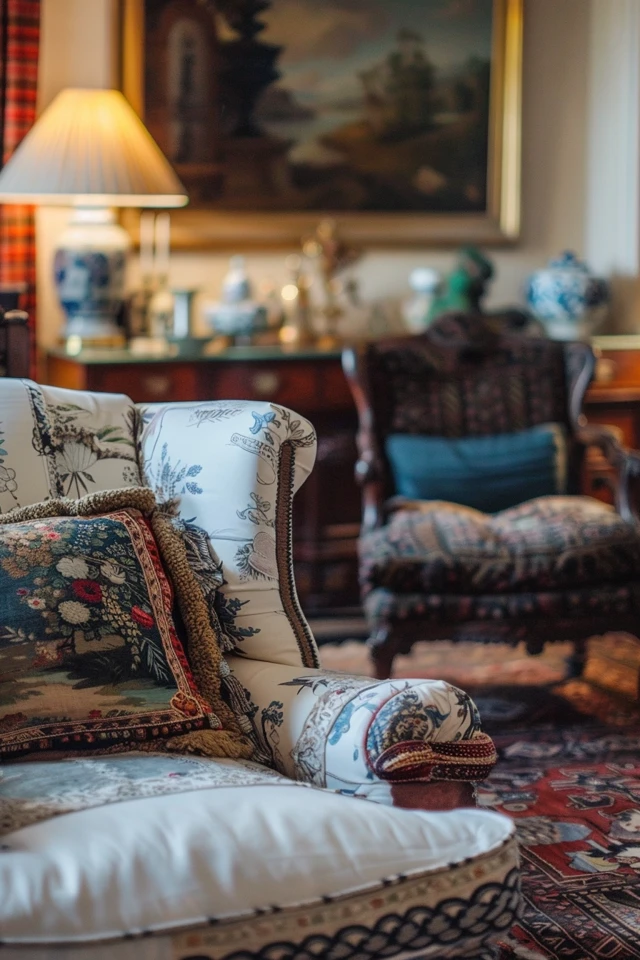
Embracing English Country Interiors Charm & Style
There is something undeniably magnetic about an English country home. It is a style that feels entirely unpretentious, prioritizing comfort above appearances, yet somehow managing to look effortlessly chic in the process. It welcomes muddy boots, sleeping dogs, and mismatched china with open arms.
The magic lies in the imperfections. Unlike modern minimalism, which demands constant tidying, this aesthetic embraces a “lived-in” quality that evolves over time. It is a collection of eras, patterns, and textures that tells the story of the people living there.
We are going to break down exactly how to achieve this look, whether you live in a sprawling cottage or a city apartment. If you need visual inspiration, you can find our curated Picture Gallery at the end of this blog post.
1. The Foundation: Color, Pattern, and Wall Treatments
The English country palette is rarely stark white. Instead, it leans heavily into “muddy” or historic colors that feel grounded and cozy. We are looking for hues that change with the light of the day.
Think sage greens, dusky pinks, buttery yellows, and deep teals. These colors act as a neutral backdrop, even though they are technically saturated. They wrap a room in warmth, making large spaces feel intimate and small spaces feel jewel-box cozy.
Mastering the Mix of Patterns
One of the most intimidating aspects of this style is the fearless mixing of patterns. It is common to see floral wallpaper, a striped rug, and plaid upholstery in a single room. The key to pulling this off without inducing a headache is scale.
You generally want to follow a hierarchy of scale to keep the eye moving comfortably.
- The Hero Pattern: Choose one large-scale print, usually a floral or a toile, for curtains or a statement armchair.
- The Supporting Pattern: Select a medium-scale geometric, like a buffalo check or a wide stripe, that pulls a color from the hero pattern.
- The Grounding Texture: Use a small-scale print or a solid with heavy texture, such as herringbone wool or velvet, to rest the eye.
Designer’s Note: The Wallpaper Rule
In my projects, clients often hesitate to wallpaper an entire room, opting for an “accent wall” instead. I strongly advise against this for the English country look. An accent wall feels modern and disjointed.
If you commit to wallpaper, wrap the entire room. If the budget is tight or the pattern feels too intense, install wainscoting or beadboard on the bottom third of the wall and paper the top two-thirds. This creates a cozy, architectural envelope that feels authentic to the style.
2. Furniture: The Art of the “Unfitted” Look
English interiors reject the idea of the “matched set.” You should never buy a bedroom suite where the nightstands, dresser, and bed frame all come from the same manufacturer line. That looks like a catalog, not a home.
The goal is an “unfitted” look, suggesting pieces were acquired over generations. This means mixing wood tones is not just allowed; it is encouraged. A dark mahogany chest can sit happily next to a scrubbed pine farm table.
Prioritizing Comfort
The sofa is the anchor of the English living room, and it must be comfortable. We are talking about deep seats, rolled arms (often called Howard style), and turned wooden legs on casters.
Pro Rule of Thumb for Seating:
Avoid stiff, upright foam cushions. Opt for down-wrapped foam or feather-blend cushions. They require fluffing, but the “squish” factor is non-negotiable for this aesthetic.
Layout and Spacing Guidelines
When arranging your furniture, focus on conversation rather than the television. Pull furniture away from the walls to create intimacy.
- Coffee Table Distance: Keep 14 to 18 inches between the edge of the sofa and the coffee table. This is close enough to put down a drink but far enough to walk through.
- Conversation Circle: No seat should be more than 8 feet away from another. If your room is huge, create two separate seating zones rather than one giant, disconnected circle.
- Walkways: Ensure you have 30 to 36 inches of clearance for main traffic paths so the room feels cozy, not cramped.
Common Mistakes + Fixes
Mistake: Everything is brand new.
Fix: Every room needs at least one “brown furniture” antique or vintage piece. It adds instant gravity and soul. Check local auctions or estate sales for a beat-up side table or a wooden chest. The scratches just add to the charm.
3. Textiles and Window Treatments
Textiles are the workhorses of English country design. Because this style celebrates dogs, kids, and gardening, fabrics must be durable. We favor natural materials that age gracefully, such as wool, linen, and cotton velvet.
Window Treatments
Skip the blinds and roller shades. Curtains (drapes) add necessary softness and insulation, which is historically practical for drafty old homes.
Designer Rules for Curtains:
- Mounting Height: Mount the curtain rod at least 4 to 6 inches above the window frame, or all the way to the crown molding if possible. This makes the ceilings feel higher.
- Fullness: Skimpy curtains look cheap. The total width of your curtain panels should be 2 to 2.5 times the width of the window.
- Length: For this style, curtains should touch the floor. A “trouser break” (where the fabric hits the floor and buckles slightly, about 1 inch extra) is perfect. Avoid the “high water” look where curtains hover an inch above the ground.
Rugs and Layering
Wall-to-wall seagrass or sisal carpet is a staple in English homes. It adds a rustic, durable texture that hides dirt effectively.
To ramp up the cozy factor, layer a vintage Persian rug or a Turkish kilim on top of the seagrass. This defines the seating area and adds a splash of pattern.
Rug Sizing Logic:
A common error is buying a rug that is too small (the “postage stamp” effect).
- Living Room: The front legs of all furniture in the seating group must sit on the rug. Ideally, all four legs should be on it.
- Dining Room: The rug should extend 24 inches past the table on all sides so chairs don’t catch when pulled out.
4. The Heart of the Home: Kitchens and Utility Spaces
The English country kitchen is legendary. It is rarely a sleek, fitted laboratory. It feels more like a living room with a stove in it.
The Unfitted Kitchen Concept
Instead of banks of identical upper cabinets, mix in open shelving, plate racks, and freestanding furniture. A butcher block table often serves as an island. A standalone dresser or hutch holds dishware.
If you are renovating, look for “Shaker” style cabinetry. It is timeless. Paint the cabinets in a color—cream, sage, navy, or mushroom—rather than brilliant white.
The Boot Room (or Mudroom)
You cannot discuss this style without mentioning the boot room. Even if you don’t have a dedicated room, you need a dedicated zone near the entry.
This area bridges the messy outdoors with the cozy indoors. You need:
- Hooks: Lots of them. Install a peg rail at 60 inches high that wraps around the corner.
- Bench Seating: A place to sit while removing Wellington boots.
- Hardwearing Floor: Stone, brick, or tile that can handle water and mud.
What I’d Do in a Real Project (Budget/Rental Friendly)
If you can’t renovate your kitchen:
1. Swap Hardware: Replace tubular steel handles with brass knobs or wooden latches.
2. Add Lamps: Put a small table lamp on the kitchen counter. It instantly changes the mood from “utility” to “homey.”
3. Display Copper: Hang pots or pans on a rail. The metal adds warmth and texture.
5. Bringing the Garden In: Biophilia and Accessories
The connection between the house and the garden is vital. The interior should reflect the exterior landscape. This doesn’t mean you need a greenhouse, but you do need organic elements.
Botanicals and Florals
Fresh flowers are essential, but they shouldn’t look like they came from a florist. Avoid stiff, formal arrangements.
Grab a handful of wildflowers, branches, or greenery from the yard and plop them into a ceramic pitcher or a glass jar. The arrangement should look loose and slightly asymmetrical.
Lighting: The Atmosphere Creator
Lighting makes or breaks the English country vibe. You want to create pools of light rather than blasting the room with overhead brightness.
The “Big Light” Rule:
Rarely, if ever, use the main overhead ceiling light in the evening. Rely on table lamps, floor lamps, and wall sconces.
Lighting Specs to Look For:
- Color Temperature: Always choose bulbs between 2700K and 3000K (Warm White). Anything over 3000K looks like a hospital.
- Shades: Use pleated fabric shades (linen or silk) rather than plain paper drums. The pleats add texture even when the lamp is off.
Collections and “Clutter”
This style embraces “organized clutter.” Books should be stacked on tables, not just shelves. Ceramics should be displayed.
However, there is a fine line between curated and messy. Group small objects on trays to give them structure. If you have a collection (like china dogs or vintage boxes), group them together for impact rather than scattering them individually around the room.
Final Checklist: The English Country Makeover
Ready to transform your space? Use this checklist to stay on track.
- Color Check: Have I chosen a paint color with depth (not bright white)?
- Pattern Mix: do I have one large floral, one geometric, and one texture?
- Antique Element: Is there at least one piece of vintage or wood furniture in the room?
- Textiles: Are the curtains hung high and touching the floor? Is the rug large enough?
- Lighting: Do I have at least three sources of eye-level light (lamps/sconces)?
- Comfort: Is there a place to put a drink? Is the sofa squishy enough?
- Nature: Is there something green or living in the room?
FAQs
Q: Can I do this style in a small apartment?
A: Absolutely. In fact, small spaces work beautifully with this style because they naturally feel cozier. Use vertical space with tall bookcases and peg rails. Don’t be afraid of large-scale furniture; a few large pieces actually make a small room look bigger than lots of tiny pieces.
Q: Is this style kid and pet friendly?
A: It is arguably the most pet-friendly style there is. Use slipcovers on sofas that can be thrown in the wash. Choose wool rugs that are naturally stain-resistant. The “imperfect” nature of the style means a scratch on a table or a worn spot on a rug just adds character.
Q: What if I’m on a tight budget?
A: Start with paint and second-hand furniture. This style relies on patience. Scouring thrift stores for solid wood furniture and vintage art is far cheaper than buying new particle-board furniture. Use slipcovers to hide ugly sofas until you can replace them.
Q: How do I stop it from looking like a grandma’s house?
A: Edit your accessories. Keep the clutter curated. Mix in a few modern elements, like a contemporary piece of art or a modern lamp shape, to create tension. Ensure your color palette feels fresh, not dusty.
Conclusion
Embracing the English country interior style is about more than just buying floral curtains or a roll-arm sofa. It is a mindset shift away from perfectionism and toward hospitality. It prioritizes how a home feels over how it looks in a photo.
By layering textures, mixing eras, and creating spaces that encourage conversation and relaxation, you build a home that is truly timeless. It is a slow process of collecting and curating, but the result is a space that feels deeply personal and incredibly welcoming.
Picture Gallery


