
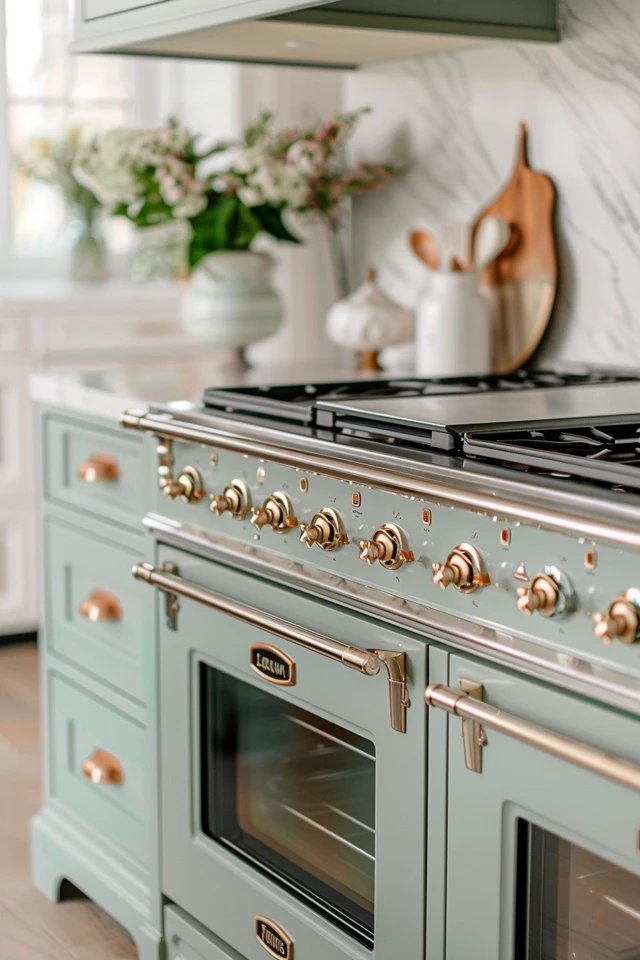
Experience French Elegance with Lacanche Ranges
Introduction
There is a distinct shift in the atmosphere of a kitchen when the focal point moves from a standard stainless steel appliance to a piece of functional art. In my years designing kitchens for clients who love to cook, few decisions spark as much joy—and initial debate—as the choice to install a Lacanche range. These ranges are not merely appliances; they are heirlooms built in Burgundy, France, bringing a specific culinary history into the modern American home.
While the aesthetic appeal is undeniable, choosing a Lacanche requires a shift in mindset regarding how you cook and how you layout your kitchen. It involves trade-offs between modern digital convenience and robust, analog reliability. If you are looking for design inspiration and want to skip straight to the visual examples, check out the Picture Gallery at the end of this post.
For those ready to understand the investment, we need to look beyond the pretty enamel. We will explore the ergonomic realities, the installation quirks, and the design rules necessary to make a Lacanche work in a US-based home.
1. Understanding the Heritage and Aesthetic Options
Lacanche ranges have been manufactured in a dedicated foundry in France for over 200 years. Unlike many commercial-style ranges that prioritize a rugged, industrial look, Lacanche offers a refined, jewelry-like presence. They bridge the gap between a high-performance machine and a piece of bespoke furniture.
The primary draw for most of my clients is the color palette. While stainless steel is standard in high-end kitchens, Lacanche offers over 30 distinct enamel finishes. From the deep, moody “Anthracite” to the classic “Burgundy Red” or the soft “Armor” (a beautiful grey-blue), the enamel is baked onto the steel at high temperatures for incredible durability.
However, selecting a color is high-stakes. A swatch on a computer screen looks vastly different than enamel on steel in your specific lighting conditions.
Designer’s Note: The Color Sample Rule
I never let a client order a colored range without seeing a physical metal chip in the space. Order the samples from the distributor and place them where the range will sit. Watch them at 8:00 AM, 2:00 PM, and 8:00 PM.
I once had a client fall in love with “Terracotta” online, but in her north-facing kitchen, it read too brown. We switched to “Coral Blue,” which brightened the entire room. Lighting temperature (3000K vs. 4000K) will drastically change how these complex enamel colors read.
2. Configuration: Sizing and Oven Logic
One of the most confusing aspects of buying a Lacanche for American homeowners is the sizing and oven configuration. These ranges are built to metric standards. The most popular models, like the Cluny 1400 or the Sully, do not align perfectly with our standard 30, 36, or 48-inch cabinet openings.
For example, the Cluny is roughly 39 3/8 inches wide. If your cabinet maker leaves a standard 40-inch opening without accounting for the specific filler strips or “spacers” required for door clearance, you will have a problem.
Furthermore, the ovens are smaller than American standards. A standard Wolf or Viking range fits a massive catering sheet. A Lacanche oven is more intimate. It heats up faster and cooks more evenly, but you cannot shove a 25-pound turkey into the smaller side ovens of a Cluny model without careful planning.
Oven Types Explained
You typically have a choice between gas and electric ovens within the same unit.
- Gas Ovens: These are moist heat ovens. They are incredible for roasting meats and poultry because the moisture prevents drying out. However, they do not have a broiler.
- Electric Convection: These provide dry, even heat. This is non-negotiable for bakers who need consistent temperatures for cookies, cakes, or soufflés. They usually include a broiler.
- The Warming Cupboard: Available on larger models, this is a game-changer. It allows you to slow-cook stews or keep plates warm, functioning similarly to a slow cooker but with more elegance.
Common Mistakes + Fixes
Mistake: Assuming your current baking sheets will fit.
Fix: Lacanche ranges come with their own racks and pastry sheets sized for the unit. Measure your favorite roasting pan before purchasing. If you host Thanksgiving for 20 people annually, you must opt for the “Sully” model or larger, which features larger ovens, or install a secondary wall oven.
3. Integrating the Range into Your Kitchen Layout
Designing a kitchen around a Lacanche requires specific attention to clearances and cabinetry protection. These ranges are powerful, and the sides can get warm. More importantly, the doors have robust hinges that require room to swing.
Cabinetry Spacers are Mandatory
You cannot butt wood cabinetry directly against the side of the range body. You generally need a stainless steel spacer (usually 50mm to 100mm) between the range and the cabinetry.
This serves two purposes:
- It protects the cabinet finish from heat transfer.
- It allows the heavy oven doors to open fully without scraping the adjacent drawers or handles.
Ventilation Requirements
Do not skimp on the hood. A Lacanche puts out significant BTUs.
- Capture Area: The hood should be at least as wide as the range, ideally 6 inches wider (3 inches overlap on each side).
- CFM Power: For a 40-inch+ range, I recommend a blower with at least 900 to 1200 CFM.
- Mounting Height: The bottom of the hood should generally sit 30 to 36 inches above the cooking surface. Any lower, and it creates a visual barrier; any higher, and smoke escapes into the room.
What I’d Do in a Real Project
If I am designing a kitchen with a “Sully” (55.5 inches wide), I ensure the aisle width in front of the range is at least 48 inches. This is wider than the standard 42 inches I use elsewhere. Why? Because you need space to crouch down to access the lower ovens, and if someone is walking behind you with a pot of water, you need that extra clearance for safety.
4. Finishes and Hardware Coordination
The “jewelry” of the Lacanche is its trim. You can choose from Brass, Brushed Stainless, Nickel, Chrome, or Copper. This choice dictates the metal story for the rest of the kitchen.
Mixing Metals Successfully
You do not need to match every piece of hardware in the kitchen to the range, but they must speak the same language.
- The Brass Route: If you choose brass trim on the range, I love pairing it with unlacquered brass cabinet hardware. Both will patina over time, developing a living finish that feels organic.
- The Mixed Approach: If the range has brass knobs, you can still use polished nickel faucets. The key is to repeat the brass elsewhere, perhaps in the lighting fixtures or a pot rail, to create balance.
Backsplash Considerations
Because the range is a visual heavyweight, I often keep the backsplash simple to let the appliance shine. A slab of marble or simple handmade subway tile works best.
If you are not using a stainless steel backguard (which Lacanche sells), verify your local code regarding combustible materials. You generally cannot have drywall or wood paneling directly behind a high-BTU gas range. You need tile, stone, or steel extending down to the floor behind the unit.
5. Living with a Lacanche: Maintenance and Practicality
Living with a French range is different from living with a digital appliance. There is no clock. There are no pre-programmed “pizza” modes. It is manual, tactile, and mechanical.
Cleaning the Enamel
The porcelain enamel is surprisingly easy to clean. It is glass fused to steel.
- Daily: Wipe with a damp microfiber cloth and warm soapy water.
- Deep Clean: For stuck-on grease, a non-abrasive cleaner works well. Avoid steel wool or harsh scouring pads, which can dull the glossy finish over time.
Brass Maintenance
If you choose brass burner caps or trim, know that they will change color. Heat turns bright brass into a golden bronze. You can polish it back to a shine with “Bistro” paste (often supplied with the range), but many of my clients eventually learn to love the patina. It shows the kitchen is a workspace, not a showroom.
Service and Reliability
These machines have very few circuit boards, which is a massive benefit. Circuit boards are usually the first thing to fail on modern appliances. A Lacanche is largely mechanical.
However, parts must come from France or a specialized distributor. You cannot call the average neighborhood repair technician. Before buying, confirm there is a certified servicer in your zip code.
6. The Cooking Experience: Burners and Accessories
The top of the range is customizable. You can choose standard gas burners, a French Top (simmer plate), or even induction modules.
The French Top (Plaque Coup de Feu)
This is a cast iron plate that sits over a gas burner. It gets intensely heat in the center and cooler towards the edges.
- Why Chefs Love It: You can manage multiple pots at once without adjusting knobs. You simply slide the pot to the edge to simmer and to the center to boil.
- The Trade-off: It takes about 20 minutes to heat up fully and radiates a lot of ambient heat into the kitchen. It is wonderful in winter, but something to consider if you live in a hot climate without strong AC.
Burner Power
The open gas burners are powerful. The grate system allows smaller pots to sit stable, but always check the BTU rating. I usually recommend a configuration that includes at least one 18,000 BTU burner for boiling water quickly and searing steaks.
Final Checklist: Before You Order
Buying a Lacanche is a project in itself. Use this checklist to ensure you don’t miss a critical step.
- Lead Time Calculation: These are made to order. Lead times can range from 16 to 24 weeks. If you are ordering in the spring, remember that France effectively shuts down in August. This can add a month to your delivery date.
- Fuel Type: Confirm if you have Natural Gas or Liquid Propane (LP). The range must be factory-set for your fuel type.
- Electrical Requirements: Even gas ranges need electricity for ignition and convection fans. Check if the model requires a 240v line (common for the electric ovens) or a standard 120v.
- Delivery Path: These ranges are incredibly heavy. Measure your front door, hallways, and kitchen entry. You may need a “white glove” delivery service that specializes in heavy machinery.
- Cabinet Integration: Have your cabinet maker review the “installation specifications” PDF from the manufacturer before building a single box. Confirm the spacer width.
FAQs
Are Lacanche ranges worth the price?
If you value longevity, repairability, and design, yes. They are built to last 20-30 years or more. However, if you rely heavily on digital timers, smartphone connectivity, or massive oven cavities for batch cooking, you might find the manual nature frustrating.
Why are there no windows on the oven doors?
This is a classic French design choice. The doors are solid and heavily insulated to maintain temperature consistency. To check food, you open the door. While this releases some heat, the small cavity recovers temperature very quickly. It forces you to cook by smell and timing rather than just looking.
Can I install a Lacanche in a kitchen island?
Technically, yes, but I advise against it. The back of the range is not always finished for display, and the required backguard can interrupt the visual flow of an island. Furthermore, venting a high-BTU range from an island requires a massive overhead hood which can block sightlines. They look best nestled against a wall.
Do the brass burners get ruined by spills?
They don’t get ruined, but they do get dirty. Boil-overs will leave marks on the brass burner caps. You can scrub them, but they will never look “out of the box” new after the first use. This is part of the character of the appliance.
Conclusion
Bringing a Lacanche range into your home is a declaration of design intent. It says that you value the process of cooking as much as the result. It prioritizes beauty and mechanical integrity over digital convenience.
As a designer, I see these ranges as the anchor of a home. They dictate the pace of the kitchen—slightly slower, more deliberate, and infinitely more stylish. If you are willing to learn the quirks of a smaller oven and manual controls, you will be rewarded with an appliance that feels like a true partner in your culinary adventures.
It creates a kitchen that doesn’t just look good for a photo shoot, but feels good to work in. It creates a space where the patina of the brass and the aroma of roasting chicken tell the story of a life well-lived.
Picture Gallery


