
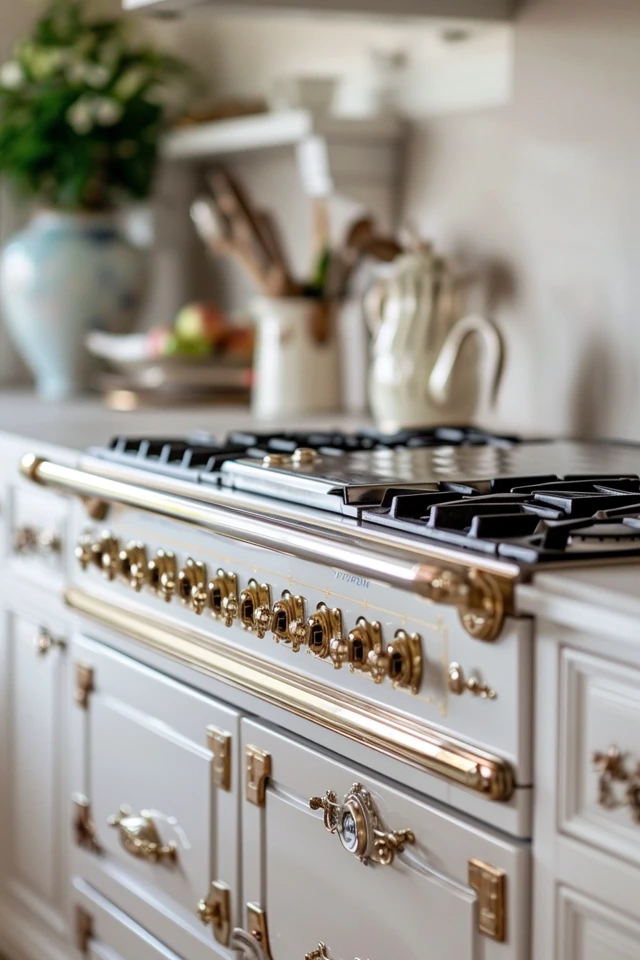
Kitchen and Stoves – Experience the Charm of a Lacanche Stove
There are very few appliances that act as the true heartbeat of a home, but a Lacanche range is certainly one of them. These French ranges are not just cooking tools; they are heirloom pieces of furniture that define the aesthetic of a kitchen. I have designed numerous kitchens around these stoves, and the conversation always shifts from “how do I cook?” to “how do I want to live?”
When clients come to me considering a Lacanche, they are usually drawn in by the stunning enamel colors and the classic brass trim. However, owning a French range requires a shift in mindset compared to using a standard American appliance. For a dose of visual inspiration, don’t miss our curated Picture Gallery at the end of this blog post.
In this guide, I will walk you through the specifics of specifying, installing, and living with a Lacanche. We will cover the quirky sizing nuances, the reality of the smaller ovens, and how to coordinate your cabinetry to frame this investment piece perfectly.
Understanding the Lacanche Ecosystem: Models and Sizing
The first hurdle in choosing a Lacanche is navigating their model names and sizes. Unlike American ranges that come in standard 30, 36, or 48-inch widths, Lacanche operates on the metric system.
This subtle difference has major implications for your cabinetry layout. You cannot simply swap a standard Wolf or Viking range for a Lacanche without adjusting your cabinet plans.
The Metric Conversion Challenge
Most US base cabinets are built to accommodate round numbers. Lacanche ranges, however, fall into unique width categories.
- The Cormatin (approx. 27.5 inches): This is smaller than a standard 30-inch range. It is ideal for small city apartments or historic cottages where space is tight, but you need to use filler strips if putting it in a standard 30-inch opening.
- The Cluny (approx. 39.5 inches): This is the most popular model. It bridges the gap between a 36-inch and 48-inch range. It offers five burners and two ovens, providing ample cooking space without dominating a medium-sized kitchen.
- The Sully (approx. 55.5 inches): This is the showstopper. It requires a significant wall run. At over four and a half feet wide, it serves as the primary focal point and requires a custom ventilation hood strategy.
Designer’s Note: The “Filler” Strategy
In a real project, I never design the cabinetry opening to the exact millimeter of the stove. Walls are rarely perfectly plumb, and floors are rarely perfectly level.
If you are buying a Cluny (39.5 inches), I recommend leaving an opening of 40 to 40.5 inches. We then use “scribe molding” or finished filler strips painted to match the cabinetry to close the gap. This allows the range to slide in easily for service while maintaining a built-in look.
Configuring the Cooktop and Ovens
One of the greatest luxuries of ordering a Lacanche is the ability to customize the top. You aren’t stuck with a standard burner configuration.
However, this freedom can lead to “analysis paralysis.” You need to match the configuration to your actual cooking habits, not your aspirational ones.
Top Configurations
- Classique (Open Burners): These are high-output gas burners. They are robust and simple. I recommend this for clients who do a lot of stir-frying or boiling large pots of pasta.
- Traditional Plate (French Top): This is a cast iron plate that sits over a gas burner. The center is extremely hot, while the edges are cooler. It allows you to simmer multiple saucepans by simply sliding them away from the center. It is brilliant for sauces but radiates a lot of heat into the room.
- Induction: Yes, you can get induction on a Lacanche. It is excellent for families with young children because the surface cools down immediately. It is also the easiest surface to clean.
The Oven Reality Check
The most common hesitation I hear involves the oven size. The Cluny, for example, features two smaller ovens rather than one cavernous one.
You cannot fit a massive commercial baking sheet in a standard Cluny oven. You will need quarter-sheet pans or specific Lacanche accessories.
However, smaller ovens preheat significantly faster. For 90% of daily cooking—roasting a chicken, baking a casserole, or roasting vegetables—the smaller cavity is actually superior because it maintains humidity better.
Common Mistakes + Fixes: The Thanksgiving Turkey
The Mistake: Clients panic that a 25-pound turkey won’t fit in the Cluny oven.
The Fix: A 20-pound bird fits comfortably in the Cluny oven. If you absolutely must cook a dinosaur-sized turkey once a year, I recommend spatchcocking the bird (removing the backbone so it lays flat). It cooks faster, stays moister, and fits easily on the rack. Alternatively, invest in the “Sully” model if large-format roasting is a weekly occurrence.
Color Theory and Hardware Coordination
The enamel finish is what makes a Lacanche iconic. The brand offers extensive color options, from matte black to vibrant Portuguese Blue.
Selecting a color for such a large appliance feels risky. I use a few rules of thumb to ensure the color ages well with the house.
Choosing Your Enamel
- The Neutral Route: Matte Black, Anthracite, or White. These are timeless. If you have busy countertops (like a veined marble or quartzite), a neutral stove grounds the space without competing for attention.
- The Statement Route: Burgundy, Delphi Blue, or Yellow. If you choose a bold stove, keep your cabinetry neutral. A navy stove looks incredible against white oak or creamy taupe cabinets.
- The Finish: Lacanche enamel is porcelain-based. It is incredibly durable and easy to clean. Unlike painted stainless steel, it won’t peel.
Mixing Metals
Lacanche ranges typically feature brass, chrome, or nickel trim.
- Brass: This is the classic choice. It is unlacquered, meaning it will patina and darken over time. Do not try to match your cabinet hardware perfectly to the stove. If the stove is brass, use unlacquered brass cabinet pulls, but accept that they will age at different rates.
- Nickel/Chrome: These offer a cooler, more modern look. They pair beautifully with stainless steel appliances (fridge/dishwasher) if you want a cohesive metal suite.
- Mixed Metals: It is perfectly acceptable to have a brass-trimmed stove and oil-rubbed bronze cabinet hardware. The stove is furniture; it doesn’t have to match the “architecture” of the room.
Installation and Technical Constraints
This is the unglamorous part that makes or breaks the project. A Lacanche is a powerful machine, and standard US residential hookups often need upgrading.
I strongly advise handing the specifications to your contractor or electrician weeks before the range arrives.
Gas and Electrical Requirements
Depending on your oven configuration (gas vs. electric), you may need specific hookups.
- Dual Fuel: Most clients choose gas burners and electric ovens. This requires a 240V electrical line, similar to an electric dryer. You cannot plug this into a standard kitchen outlet.
- Gas Connection: The gas inlet on a Lacanche is often in a different location than standard US ranges. You may need to move your gas line slightly to the left or right to ensure the range pushes flush against the wall.
- Anti-Tip Bracket: Because the doors are heavy, the range must be secured. Ensure your installer uses the provided stability bracket, especially if you have children who might climb on the open oven door.
Ventilation Logic
These stoves produce significant BTUs (heat output). A standard over-the-range microwave vent will not suffice.
You need a dedicated range hood. As a rule of thumb, the hood should be at least as wide as the range, ideally 6 inches wider (3 inches overlap on each side) to capture smoke effectively.
If you are buying a 39.5-inch Cluny, install a 42-inch or 48-inch hood. Do not skimp on the CFM (Cubic Feet per Minute) power. Aim for at least 600 CFM for smaller models and up to 1200 CFM for the Sully.
What I’d Do in a Real Project: A Mini Checklist
If I were specifying a Lacanche for your home today, this is exactly how I would approach the process to ensure success.
- Check the Lead Time: These are handmade in Burgundy, France. Lead times can range from 4 to 6 months. Order the stove before you even order your cabinets.
- Order the Swatches: Do not trust computer screens for color. Order the enamel chips from Art Culinaire (the US distributor). View them in your kitchen at morning, noon, and night.
- Plan for the Spacer: If placing the range at the end of a cabinet run near a wall, you must leave a 2-3 inch spacer. The oven doors swing wide; if the range is tight against a wall, the door will hit the drywall and won’t open fully.
- Coordinate the Plinth: The range sits on legs. You can leave them exposed for an airy look, or order a “plinth” (toe kick cover) to make it look solid. I prefer the plinth in modern kitchens to hide dust bunnies.
Living with a Lacanche: Maintenance and Quirkiness
Owning a Lacanche is a hands-on experience. There are no digital clocks, no timers, and no “self-clean” cycle that heats the kitchen to 900 degrees.
The “No Window” Factor
You will notice the oven doors are solid. There are no windows. This terrifies some cooks.
In reality, you learn to trust the thermostat. Opening the oven door to “check” food releases heat and ruins the convection airflow. You will learn to cook by smell and time. It makes you a better, more intuitive cook.
Cleaning the Enamel
The porcelain enamel is glass fused to metal. It is non-porous.
- Daily: Wipe down with warm soapy water and a microfiber cloth.
- Stubborn Spots: Use a non-abrasive cleaner like Bon Ami. Never use steel wool, which can scratch the glossy surface.
- Brass Trim: If you want it shiny, use a brass polish like Brasso. If you want the antique look, leave it alone. It will turn a dull, golden brown over time, which many enthusiasts prefer.
Durability for Families
I often get asked if these are safe for kids. The doors are heavy and insulated, so the front stays relatively cool compared to cheap ranges, but the top gets hot.
The lack of digital boards is a massive pro for longevity. If a part breaks, it is usually a mechanical valve or a heating element that can be replaced. There are no computer motherboards to fry after five years. This is a stove you keep for 30 years.
Final Checklist
Before you finalize your order, ensure you have ticked these boxes.
- Measure the Path: Can the stove fit through your front door and kitchen doorway? These units are deep and heavy.
- Verify Voltage: Have your electrician confirm if you have the amps to support the dual-fuel electric ovens.
- Select Accessories: Order the pastry sheet and the roasting pan that fit the specific oven size. Standard US pans may not fit.
- Plan Makeup Air: If your hood is over 400 CFM, local building codes may require a “makeup air” system to replace the air you are sucking out of the house. Check with your HVAC contractor.
- Gas Line Location: confirm the recess location on the back of the specific model you chose and mark it for the plumber.
FAQs
Do Lacanche ranges hold their value?
Yes, exceptionally well. Because they are mechanical rather than digital and have a timeless aesthetic, used Lacanche ranges often sell for a significant portion of their original price. They are considered desirable assets in real estate listings.
Is the oven really big enough for a family of five?
Yes. While the ovens look small, they are deep. You can cook a main dish in one oven and three sides in the other simultaneously. The convection fans are on the sides, not the back, which maximizes usable depth.
Can I install it myself?
No. You need a team to move it (it is incredibly heavy) and licensed professionals for the gas and electric connections to maintain the warranty. However, the final leveling and placement can be done by your contractor.
Does the brass get hot?
The burner grates get very hot. The brass knobs on the front control panel stay cool to the touch. The brass caps on the burners will naturally discolor with heat—this is normal and adds to the character.
Conclusion
Choosing a Lacanche stove is a declaration that you value the process of cooking as much as the result. It is a step away from the disposable culture of modern appliances and a step toward something enduring and substantial.
While the metric sizing and lack of automation require a brief adjustment period, the reward is a kitchen that feels warm, functional, and deeply personal. It anchors the room in a way that stainless steel simply cannot. When you run your hand along the enamel rail and ignite the burners, you aren’t just making dinner; you are engaging with a piece of art that works as hard as you do.
Picture Gallery


