
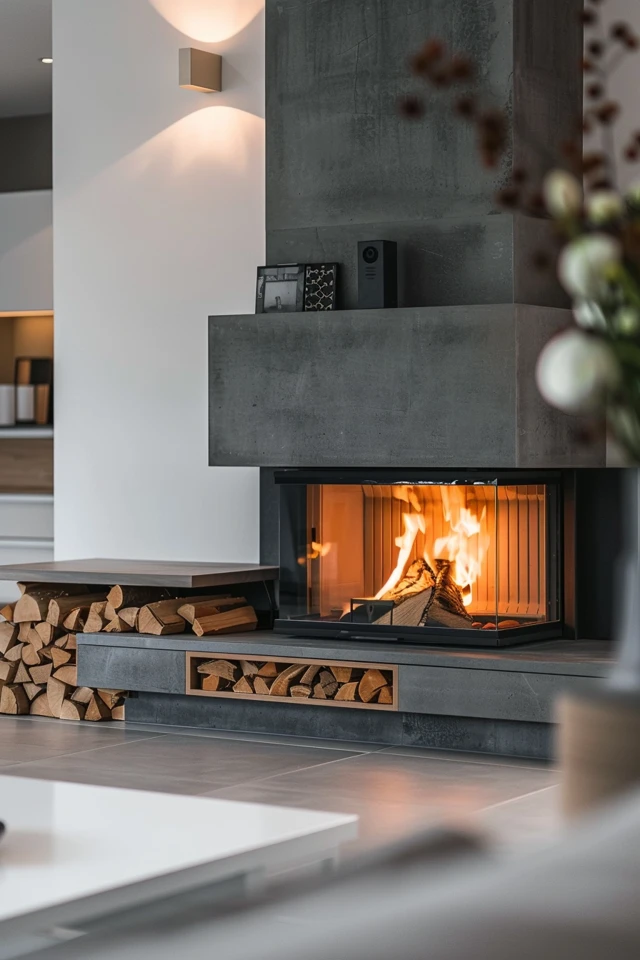
Floor to Ceiling Fireplace Ideas for Modern Homes
A fireplace is naturally the focal point of any living room, but taking it from the floor all the way to the ceiling transforms it into a true architectural statement. In modern homes, this vertical emphasis draws the eye upward, making ceilings feel higher and the room more expansive. It bridges the gap between cozy functionality and high-end design.
However, designing a floor-to-ceiling structure requires careful planning regarding proportion, materials, and engineering. It is not merely about stacking stone; it is about managing the visual weight of the room. You have to ensure the fireplace commands attention without overpowering the rest of your furniture and decor.
To see visual examples of everything discussed here, check out our curated Picture Gallery at the end of the blog post.
1. Selecting Materials for Vertical Impact
The material you choose will dictate the entire vibe of the room. When you are covering a surface area this large—often 10 to 20 feet high—the texture and finish become the dominant element in the space.
Large Format Porcelain Tile
For a sleek, modern look, large format tiles are a top contender. These huge slabs (often 24×48 inches or larger) minimize grout lines, creating a monolithic appearance that looks very expensive.
- Pro Tip: Match your grout color exactly to the tile. This makes the seams disappear and creates a seamless, slab-like effect.
- Finish: Matte finishes are generally more forgiving with reflections and lighting than high-gloss polished tiles.
Natural Stone Veneer
If you want texture and warmth, stone veneer offers the look of a traditional chimney with less weight. In modern design, we often use “stacked stone” or linear cut stone which lacks bulky grout joints.
- Scale: Avoid small, busy stones on a very tall wall. It can look cluttered. Opt for longer, linear stones to mimic the horizontal lines of modern architecture.
- Returns: Ensure you buy corner pieces. The biggest giveaway of a fake stone wall is seeing the raw edge of the stone on the side of the fireplace.
Board Formed Concrete or Plaster
For industrial or minimalist homes, concrete is king. Hand-troweled plaster (like Venetian plaster or Limewash) adds subtle movement and depth without the heavy texture of stone.
- Application: This is excellent for weight reduction. If your floor joists cannot support heavy stone, a framed wall with a plaster finish is lightweight.
- Color: Don’t just stick to grey. Warm greiges and charcoals are trending heavily in modern interiors.
2. Managing Scale, Proportion, and Layout
The biggest risk with a floor-to-ceiling fireplace is that it can look like a giant monolith that feels out of place. You need to balance the width of the fireplace with the height of the ceiling.
The Golden Ratio of Width
A narrow fireplace going up a 20-foot wall can look like a toothpick. As a general design rule, the taller the ceiling, the wider the fireplace structure should be to feel grounded.
- Standard Ceilings (8-9 feet): A fireplace width of 5 to 6 feet works well.
- Vaulted/Cathedral Ceilings (12+ feet): You generally want the structure to be at least 7 to 8 feet wide to hold its own against the volume of the room.
The Mantel Debate
In strictly modern homes, we often skip the mantel entirely. This emphasizes the vertical line and keeps the look clean. However, a mantel serves a functional purpose by deflecting heat away from a TV or art placed above.
- Mantel Height: If you use one, typical placement is 54 to 60 inches off the floor.
- Material: A simple reclaimed wood beam or a cast concrete shelf offers a nice break in the material without being too ornate.
TV Placement
If you plan to mount a TV on your floor-to-ceiling fireplace, neck strain is a real concern.
- Ideal Height: The center of the TV should ideally be at eye level when seated, which is roughly 42 inches. Most fireplaces force the TV higher (60+ inches).
- The Fix: Use a linear gas fireplace positioned very low to the ground (hearth at 6-12 inches). This allows you to mount the TV lower, keeping it closer to an ergonomic viewing angle.
3. Integrating Storage and Asymmetry
Modern design loves asymmetry. Instead of a perfectly centered fireplace with identical bookshelves on either side, consider an offset design. This creates a dynamic visual interest and solves storage problems.
The Offset Fireplace
Place the fireplace insert to one side of the chimney breast rather than the center. Use the wider side for a vertical wood storage niche or a floating hearth bench.
- Balance: If the fireplace is on the left, balance it with a heavy piece of furniture or artwork on the right side of the room.
- Materials: Mix materials here. If the fireplace is stone, make the bench wood or concrete.
Floating Shelves and Built-ins
When doing a floor-to-ceiling installation, built-ins should not compete with the fireplace. They should recede visually.
- Depth Rule: The fireplace bump-out should always be deeper than the adjacent cabinetry. If your fireplace bumps out 24 inches, your shelves should only be 12 to 14 inches deep. This ensures the fireplace remains the hierarchy leader.
- Lighting: Add LED strip lighting routed into the underside of floating shelves. It provides a soft ambient glow that highlights your decor.
4. Lighting the Vertical Space
Lighting a tall vertical surface requires a specific approach known as “wall grazing.” If you just rely on standard ceiling cans, the fireplace will look flat and dark at night.
Grazing and Washing
Install recessed gimbal lights or track heads in the ceiling, positioned about 18 to 24 inches away from the fireplace wall. Aim them sharply downward toward the surface.
- Texture Highlight: This technique creates shadows on stone or brick, emphasizing the texture.
- Spacing: Space the lights roughly 2 to 3 feet apart across the width of the fireplace.
Sconce Placement
Sconces add a human scale to a tall wall. They bring the eye down and create a cozy zone.
- Height: Mount sconces roughly 60 to 66 inches from the floor.
- Scale: Be careful not to use tiny fixtures. On a large stone wall, a small sconce will disappear. Look for fixtures that are at least 12 to 18 inches tall.
5. Hearth and Flooring Transitions
The transition from your room’s flooring to the fireplace is a critical detail. Modern codes generally require a non-combustible surface extending a certain distance in front of the firebox (usually 16 to 20 inches, depending on the fuel type).
The Flush Hearth
For the most seamless modern look, inset the hearth material so it is flush with your hardwood or carpet.
- Material: Use a slab of slate, granite, or concrete.
- Detailing: Use a metal Schluter strip or a cork expansion joint between the wood floor and the hearth stone to allow for movement and a clean line.
The Raised Hearth
A raised hearth provides extra seating, which is great for entertaining.
- Height: A comfortable seat height is 18 inches.
- Design: Cantilever the hearth (make it “float”) for a very contemporary look. Ensure you have steel brackets installed in the framing to support the weight.
Designer’s Note: The Importance of “Blocking”
Here is a lesson I learned the hard way early in my career. We designed a beautiful plaster fireplace and planned to hang a heavy, articulating TV mount and a large piece of art. When the time came to install, the contractor realized there was only drywall behind the finish.
The Fix: Before you close up the walls, install “blocking.” This means screwing solid 2×6 or 2×8 lumber horizontally between the studs exactly where you plan to hang your TV, mantel, or heavy art. Take photos of the wall with a tape measure visible before the drywall goes up so you know exactly where that wood is later.
Common Mistakes + Fixes
Mistake: Stopping the tile or stone a few inches from the ceiling.
The Fix: This usually happens because of crown molding. In a modern home, remove the crown molding on the fireplace wall. The stone or tile should disappear cleanly into the ceiling for that infinite, vertical look.
Mistake: Using a TV that is wider than the fireplace.
The Fix: Visual hierarchy matters. The supporting structure (the fireplace) should always look wider than the object it is “holding” (the TV). If your fireplace is 60 inches wide, your TV should be no more than 55 inches wide.
Mistake: Ignoring the “Returns.”
The Fix: As mentioned with stone, the sides of the fireplace bump-out are visible. Never end your tile at the corner with a raw edge. Use mitered edges (where tiles are cut at 45 degrees to meet perfectly) or specific corner pieces.
What I’d Do in a Real Project: A Mini Checklist
If I were designing a floor-to-ceiling fireplace for a client today, this is the exact workflow I would follow:
- Step 1: Verify the Heat Source. Check the manufacturer’s specs for the gas or electric insert. Specifically, look for “clearance to combustibles.” This tells me how close wood framing or a mantel can be to the opening.
- Step 2: Draw the Elevation. I sketch the wall to scale. I draw the firebox, the TV, and the furniture. This confirms that the firebox isn’t too high or too small.
- Step 3: Plan the Tech. I ensure there is an electrical outlet and an HDMI conduit (a tube in the wall) behind where the TV will go, running down to a side cabinet. No hanging wires allowed.
- Step 4: Select the “Slab.” Whether it is tile or stone, I pick the material and bring a sample into the room to see how it looks in the home’s specific lighting.
- Step 5: Lighting Rough-in. I mark exactly where the ceiling grazers go to ensure they don’t hit the face of the fireplace but wash down it.
Frequently Asked Questions
Is a floor-to-ceiling fireplace expensive?
It varies wildly. A drywall build-out with paint is affordable. Adding floor-to-ceiling natural stone veneer requires expensive materials and skilled masonry labor, often costing three to four times as much as a painted finish.
Can I put a TV over a wood-burning fireplace?
It is risky. Wood fires generate inconsistent, intense heat and smoke that can damage electronics. If you must, you need a deep mantel to deflect heat and a recessed niche for the TV helps. Gas or electric are much safer bets for electronics.
Do I need a hearth for a gas fireplace?
Many modern linear gas fireplaces are “zero clearance,” meaning they don’t technically require a hearth extension for safety. However, check your local building codes and the specific unit’s manual. Aesthetically, a hearth often helps ground the visual weight of the unit.
Conclusion
A floor-to-ceiling fireplace is one of the most impactful upgrades you can make to a modern home. It draws the eye upward, anchors the living space, and provides a perfect canvas for high-end materials like stone, tile, or plaster.
Success lies in the preparation. By paying attention to scale, integrating your technology properly, and choosing the right lighting to showcase the texture, you create a feature that is timeless rather than trendy. Remember to check your blocking, hide your wires, and respect the verticality of the space.
Picture Gallery


