
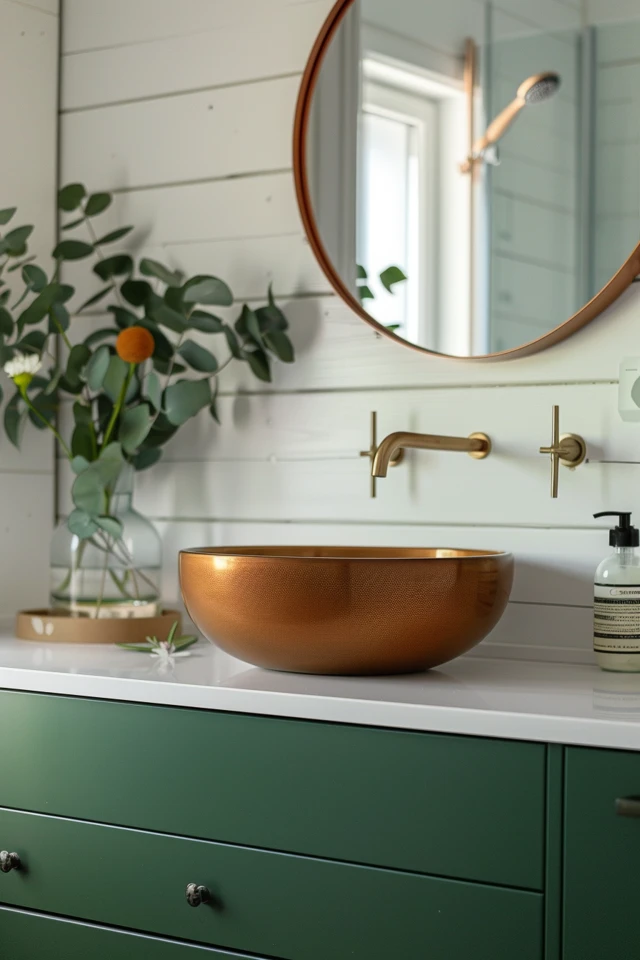
Fresh Bathroom Cabinet Paint Color Ideas
Painting your bathroom vanity is arguably the highest return on investment you can get in a bathroom renovation. A fresh coat of paint transforms a dated, orange-oak cabinet into a custom-looking piece of furniture without the dust and cost of a full demolition. It allows you to change the entire mood of the space, from a bright and airy spa retreat to a moody, dramatic powder room.
However, selecting the right color for a bathroom is trickier than picking a wall color for a living room. You are dealing with fixed elements like tile, stone countertops, and plumbing fixtures that cannot easily be changed. You also have to contend with unique lighting situations, often lacking natural light, which can drastically alter how a paint color reads.
For plenty of visual inspiration to guide your choice, be sure to check out the curated Picture Gallery located at the very end of this blog post. Before we get to the pretty photos, we need to cover the design theory, specific color families that are trending now, and the technical requirements for painting in a high-humidity environment. Let’s dive into how professional designers choose cabinet colors that last.
Understanding Undertones and Lighting
Before you buy a sample pot, you must understand how light affects paint in a bathroom. Bathrooms often rely heavily on artificial lighting. If your vanity lights are 2700K (warm white), they will cast a yellow glow that turns crisp whites into cream and cool grays into muddy greens.
I always recommend upgrading your bulbs to 3000K or 3500K LEDs before selecting a paint color. This provides a cleaner, more neutral light that allows you to see the true color of the paint. Once the lighting is addressed, you have to look at the Light Reflectance Value (LRV).
In a small bathroom with no window, a color with a low LRV (like navy or charcoal) will absorb light and make the vanity feel smaller but more grounded. A high LRV (like off-white or pale gray) will bounce light around. Neither is wrong, but you must decide if you want the vanity to recede or stand out as a focal point.
Designer’s Note: The “White” Mistake
A common issue I see is clients picking a “pure white” paint for their cabinets because they want a clean look. However, if your tile or countertop is an older almond or biscuit color, a bright white cabinet will make the rest of the room look dirty by comparison.
If your hard finishes have warm, yellow, or beige undertones, you must choose a creamy white or a warm greige for the cabinets. Never fight the fixed elements; bridge the gap with a transitional color.
The New Neutrals: Mushroom, Taupe, and Putty
The era of the sterile, all-white bathroom is fading. We are seeing a massive shift toward “warm neutrals.” These are colors that sit somewhere between gray and beige, often referred to as “mushroom” or “putty.”
These earthier tones add depth and sophistication that stark white lacks. They are particularly effective if you have brass or gold hardware, as the warm metal sings against a taupe background.
Why choose a warm neutral?
- Forgiving: These colors hide dust, water spots, and makeup smudges much better than pure white or black.
- Versatile: They bridge the gap between cool marble floor tiles and warmer wood accessories.
- Timeless: Unlike the cool gray trend of the 2010s, earth tones have historically aged very well in traditional and transitional homes.
When working with these colors, look for paints with names like “Revere Pewter,” “Natural Cream,” or “Accessible Beige.” These shades usually require a satin finish to look their best. A high-gloss finish on a mushroom color can sometimes look like plastic, so stick to a lower sheen for a velvety, high-end furniture look.
Bringing Nature Indoors: Greens and Blues
Bathrooms are spaces of restoration, so it makes sense to borrow palettes from nature. Green has become the new neutral for bathroom vanities, specifically sage, moss, and deep olive tones.
Green is incredibly versatile because it acts as a neutral in nature. Think about a garden; green stems go with every flower color. In a bathroom, a sage green vanity pairs beautifully with almost any hardware finish, from polished nickel to unlacquered brass.
Blue hues for serenity
If green isn’t your preference, consider the “spa blue” family. However, be careful not to go too pastel, or the room will look like a nursery. I recommend choosing a blue with a significant amount of gray in it. These “dusty” blues feel more mature and sophisticated.
Top pairings for blue and green cabinets:
- Countertops: Crisp white quartz or Carrara marble looks stunning against these cool tones.
- Flooring: Warm wood-look tile or slate floors provide excellent contrast.
- Accents: woven baskets, light oak shelving, and cream-colored towels.
Common Mistakes + Fixes
Mistake: Picking a color that clashes with the floor tile grout.
Fix: Place your paint swatch directly on the floor tile. If your grout is dirty or gray, a warm cream cabinet might make the floor look dingy. You might need to clean and stain the grout first, or choose a cabinet color that complements the existing grout tone.
Mistake: Using wall paint on cabinets.
Fix: Cabinet paint is a different chemical formulation. It is designed to dry harder and resist blocking (sticking) when doors are closed. Always buy “Urethane Alkyd” or specific “Cabinet and Trim” enamel.
Moody and Dramatic: Black and Charcoal
For powder rooms or larger master baths with plenty of light, a black or charcoal vanity makes a powerful statement. This high-contrast look is classic and elegant. It “grounds” the room, giving the eye a solid place to rest in a space that might otherwise be full of shiny tile and mirrors.
Soft Black vs. True Black
I rarely specify a true, jet black (like the color of a tires). It can feel too harsh and flat. Instead, look for “soft blacks” or “off-blacks.” These often have very subtle undertones of blue, brown, or green.
For example, a charcoal with a blue undertone looks incredible with chrome fixtures. A black with a brown undertone (think espresso) warms up a room with beige travertine floors.
What I’d do in a real project:
If I am designing a small powder room with a black vanity, I will almost always wallpaper the walls. The dark cabinet anchors the busy pattern of the wallpaper.
- Hardware Logic: Dark cabinets require hardware that pops. Matte black hardware will disappear. Go for Polished Nickel, Chrome, or Brass.
- Finish Choice: Dark colors show fingerprints. While satin is standard, you might want to consider a semi-gloss for dark cabinets simply for ease of cleaning, though it highlights imperfections in the wood more.
The Technical Side: Sheen and Durability
Choosing the color is only half the battle. In a bathroom, moisture is the enemy. You need a finish that seals the wood and repels water.
The Sheen Scale
- Flat/Matte: Never use this on bathroom cabinets. It is porous and will absorb hairspray, water, and toothpaste splatters. It will create permanent stains.
- Eggshell: Generally too dull for cabinetry. It lacks the hardness needed for doors that are constantly touched.
- Satin: The designer standard. It has a soft glow that looks like furniture. It is scrubbable but hides wood grain imperfections reasonably well.
- Semi-Gloss: The most durable option. It reflects a lot of light and is very easy to wipe down. However, it will highlight every ding, scratch, or uneven patch in your sanding job.
Preparation is non-negotiable
You cannot simply paint over an existing finish, especially if the current vanity is laminate or a glossy factory finish.
1. Clean: Scrub with a degreaser (TSP substitute) to remove hairspray and soap scum.
2. Sand: Scuff sand with 220-grit sandpaper. You don’t need to strip it to bare wood, but you must de-gloss it.
3. Prime: Use a high-adhesion bonding primer. This is the most critical step. If you skip this, your paint will peel off in sheets within a year.
Final Checklist: Before You Paint
Review this checklist to ensure you have covered all bases before opening the paint can.
- Check the Lighting: Have you tested the swatch under your specific bathroom bulbs at night and during the day?
- The “Open Door” Test: Paint a large sample board and prop it up against the vanity. Leave the bathroom door open and see how the color looks from the hallway or bedroom. Does it flow with the rest of the house?
- Measure Hardware: If you are changing hardware, measure the “center-to-center” distance of the screw holes on your current pulls. If the new ones are different, you must fill the old holes with wood filler and sand them smooth before priming.
- Clearance Check: Paint adds thickness. If your doors and drawers are extremely tight fitting, ensure you sand down the edges enough so they don’t rub and chip the new paint immediately.
- Buy the Right Tools: Do not use a wall roller. Buy a mini foam roller or a mohair roller specifically for cabinets to achieve a smooth, spray-like finish.
Frequently Asked Questions
Do I have to take the doors off to paint them?
Yes. It is technically possible to paint them in place, but it will result in drips, missed spots near the hinges, and a generally amateur look. Remove the doors and drawer fronts, label them clearly with painter’s tape (e.g., “Top Left”), and paint them on a flat surface. Gravity helps the paint level out for a smoother finish.
Can I paint a laminate vanity?
Yes, but the primer is the hero here. You must use a shellac-based primer or a high-bond primer specifically labeled for “shiny surfaces” or laminate. Standard drywall primer will not stick to laminate.
How long should I wait before using the bathroom?
Cabinet paint feels dry to the touch in a few hours, but it takes 21 to 30 days to fully “cure” (reach maximum hardness). You can gently reinstall the doors after 2 or 3 days, but treat them with extreme care for the first month. Do not scrub them or let water sit on them during the cure window.
Should I spray or roll my cabinets?
Spraying gives the most factory-like finish but requires significant masking of the room and equipment. Rolling is much more approachable for DIYers. If you use a high-quality self-leveling paint and a mohair roller, you can achieve a finish that is 90% as smooth as a sprayed finish with 10% of the hassle.
Conclusion
Refreshing your bathroom vanity with a new paint color is a journey of both creativity and precision. It allows you to inject personality into a utilitarian space, turning a standard bathroom into a custom retreat. Whether you choose a grounding charcoal, a spa-like sage, or a versatile mushroom taupe, the success lies in the preparation and the pairing.
Remember that the color on the chip is just a starting point. It will interact with your tile, your lighting, and your hardware. Take the time to test, prep, and prime. When done correctly, painted cabinets can last for many years, withstanding the humidity and daily wear of a busy household.
Be bold with your choice. A bathroom is a closed space, making it the perfect laboratory for experimenting with colors you might be too scared to put in your living room. Enjoy the process of transformation.
Picture Gallery


