
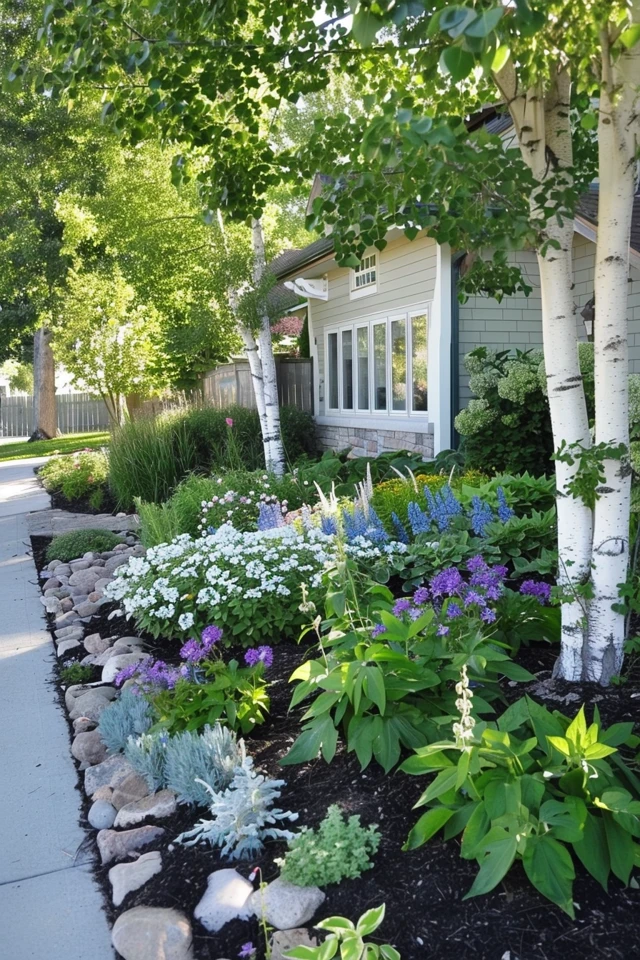
Front Yard Corner Lot Landscaping Ideas Revealed
Introduction
Living on a corner lot offers a unique set of opportunities and challenges that standard interior lots simply don’t face. You have twice the curb appeal potential, but you also deal with twice the traffic noise, a lack of privacy, and the dreaded “fishbowl” effect where it feels like everyone is watching you.
I remember a project I worked on in a suburban neighborhood where the homeowners were frustrated because neighborhood kids used their lawn as a shortcut to the bus stop. We didn’t just need to make it pretty; we had to use landscape architecture to subtly redirect foot traffic while creating a sense of enclosure.
Designing for two street frontages requires a shift in perspective, moving away from a flat, one-dimensional view to a 3D sculptural approach. If you are looking for visual inspiration, you can scroll down to the Picture Gallery at the end of the blog post.
1. The “Sight Triangle” and Safety Zoning
Before we buy a single plant or lay a paver, we have to talk about the most critical rule of corner lot design: the visibility triangle. This is the triangular area formed by the intersection of the two streets.
In professional design, we call this the “sight triangle.” Most municipalities have strict zoning laws prohibiting fences, walls, or tall plants in this specific zone to ensure drivers can see oncoming traffic.
Ignorance of this rule is the number one reason homeowners get fined or forced to tear out expensive landscaping.
Designer’s Note:
Always check your local municipal code before digging. The standard requirement usually restricts anything taller than 30 to 36 inches within a 25-foot triangle from the corner. I usually mark this area off with spray paint on the grass immediately so I know exactly where my “low zone” boundaries are.
Managing the Public vs. Private Transition
Because you have two exposed sides, you need to create a psychological barrier between the public sidewalk and your private space.
We do this through “layering.” Instead of building a fortress wall, which can look hostile, we use varied heights of planting to signal a transition.
Start with a low ground cover near the sidewalk, step up to medium shrubs (3–4 feet), and place larger specimen trees closer to the house. This creates a buffer that absorbs sound and filters the view without blocking it entirely.
2. Hardscaping: Redirecting the “Desire Path”
One of the biggest frustrations for corner lot owners is pedestrians cutting the corner across the lawn. In landscape design, we call this a “desire path”—the shortest distance between two points.
You cannot fight human nature with a “Keep Off Grass” sign. You have to fight it with hardscaping and physical barriers that look intentional.
I recommend installing a hard barrier exactly at the corner apex. This could be a decorative boulder, a raised planter box, or a rigid fence corner accent.
Walkway Widths and Materials
When designing the walkway leading to your front door, you have to account for the fact that the approach might come from two different directions.
For the main path to the front door, I never go narrower than 48 inches. This allows two people to walk side-by-side comfortably. If you have the space, 60 inches is luxurious and creates a grand entrance.
Common Mistakes + Fixes:
- Mistake: Using loose gravel on a corner sidewalk edge.
- Fix: Corner lots get heavy foot traffic and turning wheels. Loose gravel will end up on the sidewalk daily. Use concrete pavers, bluestone, or brick set in mortar for the first 3 feet bordering the sidewalk.
Connecting the Driveway
If your driveway is on the side street rather than the front, you need a clear, hardscaped connection to the front door.
Don’t make guests walk into the street to get around to the front. A secondary path, usually 36 inches wide, should wrap around the house, guiding guests from the driveway to the front entry.
3. Creating Privacy: The Wraparound Strategy
Achieving privacy on a corner lot is difficult because you cannot usually put up a 6-foot privacy fence in a front yard due to HOA or city rules.
To solve this, I use a technique called “broken screening.” Instead of a solid hedge, which can look severe and boxy, we plant groupings of evergreens staggered with deciduous shrubs.
The Rule of Odds
When planting for privacy, always plant in odd numbers. Groups of three, five, or seven plants look natural and organic. Even numbers tend to look like soldiers in a formation, which can feel rigid.
For a corner lot, I like to use a cluster of three ornamental trees (like Crape Myrtle or Japanese Maple) on the “side” street yard. This anchors the house and blocks the direct view into side windows.
Strategic Hedges
If you prefer a hedge, keep it maintained at about 4 feet tall. This is the sweet spot.
It is high enough to block the view of a sofa or dining table inside the house from the street, but low enough that it doesn’t feel like a barricade.
What I’d do in a real project:
- Layer 1 (Sidewalk edge): Liriope or Mondograss (12 inches tall). Tough, handles dog traffic well.
- Layer 2 (Mid-ground): Boxwoods or Dwarf Hollies (3 feet tall). Evergreen structure.
- Layer 3 (Near House): Hydrangeas or Ornamental Grasses (4–5 feet tall). Soft movement and color.
4. Anchoring the Corner: Focal Points
The actual corner of the property—where the two streets meet—is a prime spot for a focal point. However, it is often neglected or cluttered.
You want to anchor this space so the eye has somewhere to rest. Without an anchor, the yard looks like it is “leaking” into the street.
The Specimen Tree
A single, high-quality tree planted near the corner (respecting the sight triangle) can define the property line.
Choose a tree with a high canopy. You want the foliage to start above 6 feet so that visibility remains clear at eye level, but the tree provides a “ceiling” for the yard.
Signage and Lighting
Because you have two frontages, delivery drivers often struggle to find the address.
I love placing a substantial landscape boulder or a low masonry monument wall on the corner with the house numbers pinned to it. This serves a dual purpose: it stops people from walking on the grass, and it clearly identifies the home.
Designer’s Note:
Ensure the materials of your corner focal point match the architecture of the house. If your house has brick skirting, use matching brick for the corner planter. Disconnected materials make the yard feel cluttered.
5. Cohesive Lighting Design
Lighting a corner lot requires more fixtures than a standard lot because you have double the dark spots.
Security is a major factor here. A dark corner lot is vulnerable because it can be approached from two sides.
Uplighting vs. Path Lighting
Don’t just rely on path lights. While they are great for walkways, they don’t provide vertical interest.
I use uplights on the trees along both street sides. This creates a perimeter of light that defines the property boundaries at night.
Kelvin Temperature Matters
For residential landscapes, consistency is key. Stick to 2700K (warm white) or 3000K (neutral white).
Never use 4000K or 5000K “daylight” bulbs outdoors. They look blue and clinical, resembling a gas station rather than a welcoming home.
Lighting Placement Checklist:
- Place path lights every 6 to 8 feet along walkways.
- Place a spotlight on the house number at the corner.
- Wash the facade of the house on both street-facing sides to avoid a “dark side” effect.
Final Checklist: The Corner Lot Audit
Before you finalize your plan, run through this checklist to ensure you have covered the functional bases.
1. Traffic Check
- Have I identified the “sight triangle” and kept plants low in that zone?
- Is there a hard barrier to stop people from cutting the corner?
2. Privacy Check
- Do I have screening plants protecting the side windows?
- Are my privacy plants staggered to look natural?
3. Hardscaping Check
- Is the main walkway at least 48 inches wide?
- Is there a clear path from the driveway to the front door?
- Are the materials durable enough for street-side abuse (salt, dogs, bikes)?
4. Maintenance Check
- Can I reach all plants with a hose? (Corner lots dry out faster due to wind exposure).
- Is the grass strip between the sidewalk and street wide enough to mow easily?
FAQs
Does landscaping a corner lot cost more?
Generally, yes. You are essentially landscaping two front yards. You have more linear footage of sidewalk to edge, more beds to mulch, and you need more plants to make the space look full. I usually tell clients to budget 20–30% more for a corner lot renovation compared to a standard interior lot of the same square footage.
How do I stop dogs from peeing on my corner plants?
This is a very common issue. The corner of a lot is a “community message board” for neighborhood dogs. Avoid sensitive plants like boxwoods right on the corner, as urine burns them easily. Instead, use hardy ornamental grasses or rugged perennials like Daylilies or Liriope. Raising the bed with a 6-inch stone border also discourages dogs from walking directly into the planting bed.
Should I fence in the front yard of a corner lot?
A picket fence or a low estate fence (36–42 inches high) creates amazing definition for a corner lot. It instantly solves the “shortcut” problem and defines your private space. However, it is a significant expense. If you choose to fence, ensure you include gates on both street frontages if you have walkways connecting to them.
Conclusion
Designing a corner lot is about balancing exposure with enclosure. You want to welcome guests with a beautiful, open view while simultaneously protecting your home from the noise and busyness of the intersection.
By focusing on the “sight triangle,” using hardscaping to dictate foot traffic, and layering your plants for privacy, you can turn a fishbowl into a sanctuary.
Remember that you are setting the tone for two different streets. Take the time to ensure your design wraps around the corner seamlessly, creating a cohesive look that improves the value of not just your home, but the entire neighborhood.
Picture Gallery


