
Garage Paint – Ideas for a Fresh, New Look
Most homeowners treat their garage as an afterthought. It becomes a cavernous holding cell for holiday decorations, muddy sports gear, and cardboard boxes we swear we will recycle next week.
But as a designer, I see the garage as the hardest-working room in the house. It is often the first entry point for your family every single day, and it deserves the same intentionality as your foyer or kitchen. A fresh coat of paint does more than cover scuff marks; it changes how you feel when you arrive home.
If you are looking for visual inspiration, we have curated a stunning Picture Gallery at the end of the blog post. Before you scroll down, however, we need to discuss the technical side of things. Garage environments are harsh, subject to temperature swings, chemical fumes, and heavy impact, meaning standard interior rules do not apply here.
Choosing the Right Finish: Durability First
The most common mistake I see in DIY garage projects is using leftover paint from the living room. Standard interior latex is simply not built for the abuse a garage wall endures.
In a garage, you are dealing with exhaust fumes, grease splatter, and high humidity. You need a finish that seals the surface and allows for aggressive scrubbing.
For walls and ceilings, I almost exclusively specify a 100% acrylic latex paint in a semi-gloss or satin finish.
Why Sheen Matters
Flat or matte paint is a disaster in a garage. It is porous, meaning oil and dirt will soak right into the drywall texture. Once a tire mark or grease smudge hits a flat wall, it is there forever.
Semi-gloss is my gold standard here. It reflects light, which helps illuminate dark corners, and it creates a hard shell that you can wipe down with a damp rag and degreaser.
If you have older walls with unfinished taping or rough texture, semi-gloss might highlight those imperfections too much. In that case, drop down to a satin finish. It offers a balance of washability without acting like a spotlight on every dent in the drywall.
Designer’s Note: The “Hot Tire” Issue
When painting garage floors, the stakes are even higher. You cannot use standard floor paint if you park cars inside. The heat from your tires after a drive will soften standard latex floor paint, causing it to peel up when the tires cool and contract. This is called “hot tire pickup.”
For floors, you generally have three real options:
- Epoxy: A two-part resin system that cures extremely hard.
- Polyurea/Polyaspartic: Cures faster than epoxy and is more UV stable (great if you leave the garage door open often).
- Concrete Stain: Soaks into the pores rather than sitting on top, meaning it cannot peel, though it offers less protection.
Lighting and Color Theory in Windowless Spaces
Most garages have zero natural light. If they do have windows, they are usually small, high up, and covered in dust. This makes your paint color choice critical for visibility.
I treat garages like basements. You want to artificially boost the brightness. This is where Light Reflectance Value (LRV) comes into play.
LRV is a measurement of how much light a color reflects. Pure black is 0, and pure white is 100. In a garage, I aim for wall colors with an LRV of 60 or higher.
The White Wall Myth
Many people default to bright white because they want the space to feel clean. While practical for light reflection, bright white shows everything. Every spider web, every scuff from a bike handle, and every splash of mud becomes immediately visible.
Instead of stark white, consider these alternatives:
- Light Cool Gray: Hides industrial dust and concrete dust perfectly.
- Greige (Gray-Beige): Adds warmth to a space that usually feels cold and sterile.
- Pale Blue-Green: Surprisingly practical, as it feels fresh and airy but offers enough tone to hide minor smudges.
What I’d Do in a Real Project: The Two-Tone Approach
To balance style and durability, I often use a two-tone wall application.
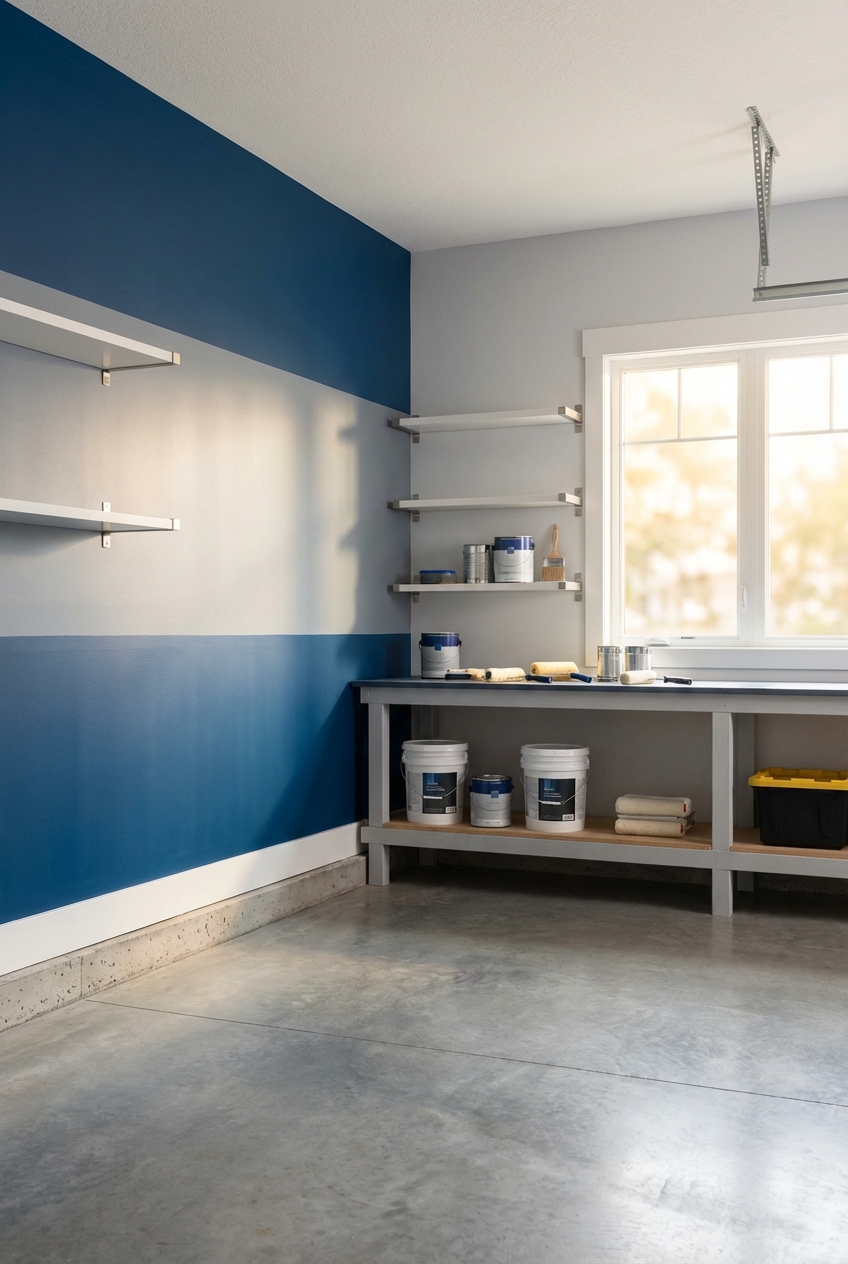
I paint the bottom 36 to 48 inches of the wall in a darker, darker-wearing color, like a charcoal gray or navy. This is the “impact zone” where car doors hit and kids kick off their boots.
Above that line, up to the ceiling, I switch to a much lighter shade like an off-white or soft gray to bounce light around the room. You can separate the two colors with a simple chair rail or just a crisp paint line.
Zoning Your Space with Color
If you use your garage for multiple purposes—parking, woodworking, home gym—paint is the cheapest way to define those zones without building walls.
Visual blocking helps the brain switch modes. It also encourages family members to return items to their proper place.
The “Workshop” Zone
If you have a workbench, consider painting the wall behind it a focused, non-reflective color. A medium slate blue or matte black pegboard area reduces eye strain.
Contrast is helpful here. If your tools are mostly dark, a lighter pegboard makes them easier to grab. If your tools are bright (like Ryobi green or DeWalt yellow), a dark charcoal background makes them pop visually so you aren’t fumbling for a drill.
The “Mudroom” Zone
For the entry door leading into the house, I like to create a designated drop zone. I often paint the door itself a high-energy color—like safety yellow, international orange, or a bright teal.
This does two things:
- It makes the door easy to spot when you are carrying heavy groceries.
- It creates a psychological “welcome” cue before you even enter the main house.
I also recommend painting a designated rectangle on the floor near the door using epoxy. This acts as a visual “rug” for muddy boots, which is much easier to hose down than an actual textile mat.
Floor Paint: The Foundation of the Look
The floor represents the largest uninterrupted surface in the garage. If the concrete is stained and cracked, the freshest wall paint in the world won’t make the room feel clean.
As mentioned earlier, standard paint fails here. We are looking for high-performance coatings.
Epoxy with Flakes
You have likely seen the speckled look in professional garages. Those vinyl chips (flakes) aren’t just for decoration.
The flakes provide texture. A high-gloss epoxy floor can be incredibly slippery when wet. If you drive a rain-soaked car in, you risk slipping the moment you step out.
In my projects, I specify a “medium to heavy” flake broadcast. This ensures grip. It also hides dirt incredibly well. A solid gray floor shows every dead leaf that blows in; a speckled floor camouflages debris until you are ready to sweep.
Concrete Staining
For a more organic, modern look, water-based concrete stain is a great choice. It creates a mottled, stone-like appearance.
This is ideal for landscape-forward homes or mid-century modern properties where you want the garage to feel like a natural extension of the hardscaping.
Common Mistake: Do not use acid stain if you have already patched cracks with different materials. The stain reacts with the lime in the concrete. Patched areas have different chemical compositions and will turn a completely different color, leaving your floor looking blotchy.
Prep Work: The Step Most People Skip
I cannot stress this enough: painting a garage is 80% preparation and 20% painting.
In an interior bedroom, you might get away with a quick wipe-down. In a garage, the walls and floors are coated in invisible contaminants like silicone, exhaust soot, and oil.
Degreasing is Non-Negotiable
Before you even think about primer, you must wash the walls with TSP (Trisodium Phosphate) or a TSP substitute. This cuts through the layers of exhaust film that standard soap won’t touch.
If you paint over grease, the paint will “fisheye,” creating little craters where the paint separates from the wall.
The Moisture Test (For Floors)
Before applying epoxy or floor paint, you must verify the concrete isn’t holding water.
Here is the pro test I use:
- Tape a 2-foot by 2-foot square of heavy plastic sheeting to the concrete floor.
- Seal all four edges completely with duct tape.
- Leave it for 24 to 48 hours.
- Peel it up. If the concrete underneath is dark, or if there are water droplets on the plastic, you have moisture issues.
If you have moisture coming up through the slab, epoxy will bubble and pop off within months. You will need a moisture-vapor barrier primer before applying the topcoat.
Exterior Coordination and Curb Appeal
We often forget that the garage door is a massive element of the home’s exterior facade. Depending on the architecture, the garage door can take up 30% to 40% of the visual frontage.
When painting the interior of the garage door (the side you see when it’s closed while you are inside), I usually match it to the walls to make the space feel larger.
However, check the manufacturer’s warranty. Some garage doors are insulated with vinyl backings that are not meant to be painted. Painting them can warp the vinyl or void the warranty.
Coordinating with Landscaping
If your garage creates an indoor-outdoor connection—perhaps you leave the door open for parties or hobbies—consider the sightlines.
If your driveway pavers are red brick, avoid a clashing orange-red epoxy floor. Go for a cool slate gray to neutralize the warmth.
If your landscape is heavy on lush greenery, a cool, dark green or charcoal floor helps transition the eye smoothly from the concrete to the grass.
Final Checklist: What I’d Do in a Real Project
If I were managing your garage renovation today, this is the exact workflow I would follow to ensure professional results.
Preparation Phase:
- Empty the garage completely. Do not try to work in sections.
- Sweep and vacuum ceilings, walls, and floors (in that order).
- Wash walls with TSP and warm water.
- Fill drywall dings with joint compound; sand smooth once dry.
- Degrease the floor with an industrial concrete degreaser.
- Etch the concrete with mild acid or grind it with a diamond grinder (rental tool) for proper adhesion.
Painting Phase:
- Tape off the garage door tracks, outlets, and window frames.
- Prime any raw drywall or bare concrete patches with a high-bonding primer.
- Paint the ceiling first using a roller on an extension pole.
- Paint the walls (cut in edges first, then roll). Two coats are mandatory for durability.
- Apply floor coating last. Plan your exit route so you don’t paint yourself into a corner.
The Drying Game:
- Let walls cure for 48 hours before hanging shelving.
- Let floors cure for at least 72 hours before walking on them, and 5 to 7 days before parking a car.
FAQs
Q: Can I just paint over oil stains on the floor?
A: No. Paint will not stick to oil. You must use an oil digester or degreaser to lift the stain. If the oil is deeply embedded, you may need an oil-blocking primer specifically designed for concrete.
Q: Do I need to prime already painted garage walls?
A: If the current paint is water-based and in good condition, you can usually paint right over it after cleaning. If the old paint is oil-based (common in older homes) and you want to use latex, you must use a bonding primer first.
Q: What is the best temperature for painting a garage?
A: Ideally, you want temperatures between 50°F and 85°F. If it is too cold, latex paint won’t form a proper film. If it is too hot (or the concrete is hot from the sun), the paint will dry too fast and leave lap marks.
Q: How do I calculate how much paint I need?
A: A gallon of quality paint covers about 350 to 400 square feet. However, unpainted drywall and raw concrete are “thirsty” and soak up more material. For raw surfaces, budget for 250 to 300 square feet per gallon for the first coat.
Conclusion
Transforming your garage with paint is one of the highest-return projects you can tackle. It turns a dark, dusty storage locker into a functional extension of your living space.
Whether you are building a showroom for your car or just want a cleaner path to the laundry room, the secret lies in the specs. Use the right sheen, prep the substrate aggressively, and don’t be afraid of color.
Treating your garage with the same design respect as your living room changes the way you maintain it. When the space looks crisp and intentional, the clutter tends to stay away.
Picture Gallery


