
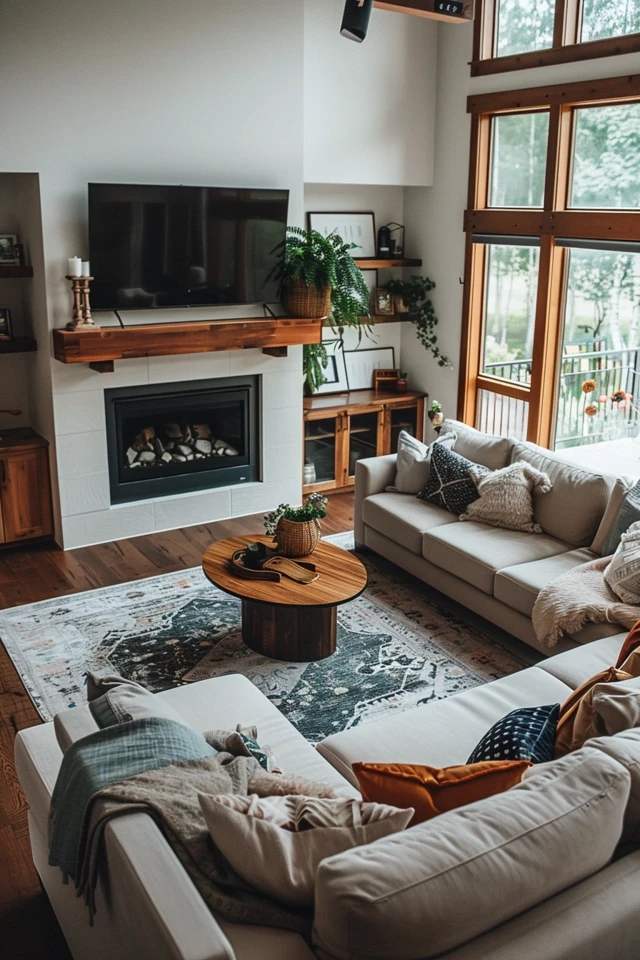
How To Arrange Living Room Furniture With TV And Fireplace: Functional Layouts
Designers often call the living room the “heart of the home,” but when you have two competing focal points, that heart can skip a beat. Trying to balance a fireplace, which provides architectural charm and warmth, with a television, which provides daily entertainment, is one of the most common layout headaches I solve for clients.
It creates a battle for attention. Do you orient the sofa toward the crackling fire or the latest streaming series? Without a plan, you often end up with a room that feels disjointed or causes neck strain.
The good news is that you do not have to choose one over the other. By understanding scale, traffic flow, and a few trade secrets, you can marry these two elements harmoniously. For plenty of visual inspiration to help you visualize these concepts, make sure to check out the Picture Gallery at the end of the blog post.
1. Assessing the Architecture and Traffic Flow
Before you push a single piece of heavy furniture, you need to understand the bones of your room. Every living room has a natural “path of travel” that you must preserve.
In my projects, I start by mapping out the walkways. You need a minimum of 30 to 36 inches of clearance for main traffic paths. If you block the way from the kitchen to the hallway with a recliner, the room will never feel right, no matter how pretty the styling is.
Identify your dominant wall first. In most older homes, the fireplace is the architectural anchor. In newer builds, you might have a blank wall intended for a media center. The relationship between these two points determines your layout strategy.
The “Squeeze” Factor
Small rooms require ruthless editing. If your room is under 12 feet wide, you cannot float furniture in the center. You will likely have to utilize the walls.
However, in larger spaces, pushing furniture against the walls is a major error. It creates a “waiting room” vibe and kills conversation. Bringing furniture closer together creates intimacy.
2. The Three Primary Layout Configurations
There are generally three ways to solve the TV-Fireplace equation. The right choice depends on your room’s shape and your viewing habits.
Layout A: The Stacked Approach (TV Above Fireplace)
This is the most controversial layout in the design world, but often the most practical for modern living. It unifies the focal points into one vertical line.
The main issue here is ergonomics. A TV mounted too high leads to neck strain. If you choose this route, the mantel height is critical. I recommend a low-profile mantel or installing the TV into a recessed niche.
Pro Tip: Use a specialized mount that allows the TV to pull down to eye level when in use. This gives you the aesthetic of a fireplace focal point with the function of a media room.
Layout B: The Side-by-Side Balance
If you have a long wall with a fireplace in the center, placing the TV on a console or in built-ins to the left or right is a classic move. This keeps the TV at optimal eye level (center of screen at roughly 42-45 inches from the floor).
To make this work, you need visual balance. If the TV is a black rectangle on the left, you need artwork or shelving with similar visual weight on the right. Without this balance, the room will feel like it is listing to one side.
Layout C: The Perpendicular Pivot
In this scenario, the fireplace is on one wall, and the TV is on the adjacent wall. This creates an L-shaped focal zone.
The best furniture piece for this is a large sectional sofa. One leg of the sectional faces the TV, while the other faces the fireplace. A swivel chair added to the mix allows guests to pivot between conversation by the fire and watching the game.
3. Measurements, Spacing, and Rug Rules
This is where the difference between a DIY job and a professional design becomes obvious. The math has to work.
The Rug Rule: Your area rug anchors the zone. A common mistake is buying a rug that is too small. For a living room, an 8×10 is usually the minimum. A 9×12 is often better.
At least the front two legs of every main furniture piece (sofa and armchairs) should sit on the rug. Ideally, all four legs should be on it. This physically connects the furniture, signaling that it belongs together as a single conversation group.
Critical Distances
- Coffee Table Gap: Keep 14 to 18 inches between the edge of the sofa and the coffee table. This is close enough to set down a drink but wide enough to walk through without banging your shins.
- Viewing Distance: The optimal distance from your TV is 1.5 to 2.5 times the diagonal screen size. For a 65-inch TV, your sofa should be roughly 8 to 13.5 feet away.
- Conversation Circle: People should not be more than 8 feet apart for comfortable conversation. If your room is huge, create two separate zones rather than spreading furniture too thin.
4. Managing Real-World Constraints
Design rules are great until reality hits. Renters, parents, and pet owners face specific challenges that glossy magazines often ignore.
The Rental Dilemma
If you cannot mount a TV or install built-ins, use freestanding bookcases. Flank the fireplace with matching tall bookcases to mimic the look of built-ins. Place the TV on a low media console on an adjacent wall, or use an easel-style TV stand which is sculptural and flexible.
Kid and Pet Friendly Design
If you have high traffic from kids or pets, the layout must be durable. Avoid placing fragile floor lamps near the main traffic artery.
Select round coffee tables. They lack sharp corners, which improves flow in tight layouts and prevents injuries for toddlers.
Material selection is part of the layout strategy. High-performance velvets or Crypton fabrics can withstand spills. If your layout puts the sofa back exposed to a dining area, ensure the back of the sofa is fully upholstered and attractive.
Dealing with Glare
A beautiful layout fails if you cannot see the screen. Check your window placement. If a window is directly opposite the TV wall, you will get glare.
Designer’s Note: I once designed a layout that looked perfect on paper, but at 4:00 PM, the sun hit the screen perfectly, rendering it useless. We had to install motorized solar shades. Always check the light at different times of day before drilling holes.
5. Styling to Merge the Zones
Once the furniture is placed, styling bridges the gap between the two focal points. The goal is to make the TV recede when not in use.
If you have the TV next to the fireplace, use a dark paint color or dark wallpaper on that wall. The black screen will blend into the background rather than standing out as a black void.
Lighting Layers
Never rely solely on overhead recessed lighting. It creates harsh shadows. You need three layers of light:
- Ambient: Your general overhead light.
- Task: A reading lamp by the armchair or swivel chair.
- Accent: Picture lights over the fireplace art or LED strips in the bookshelves.
Placement matters. A floor lamp next to the TV can cause eye strain. Place lamps behind the viewing line or use dimmable sconces.
The Mantlescape
If the TV is not above the fireplace, keep the mantel decor relatively simple. A large piece of art or a mirror leaning on the mantel adds height.
If the TV is above the fireplace, keep the mantel almost bare. A few small candlesticks on the ends are fine, but anything tall will obscure the screen.
6. Common Mistakes and Concrete Fixes
I see the same errors repeated in homes across the country. Fixing these can instantly elevate your space.
Mistake: The Floating Rug
This happens when a small rug sits in the middle of the room, touching no furniture. It looks like a postage stamp.
Fix: Buy a larger rug. If budget is an issue, buy a large, inexpensive jute rug and layer the smaller, nicer rug on top of it.
Mistake: The TV is Too High
Mounting the TV near the ceiling is an epidemic. It ruins the aesthetic and hurts your neck.
Fix: The center of the screen should be at eye level when seated. This is usually lower than you think. If you must go over the fireplace, mount it as low as possible to the mantel.
Mistake: Ignoring Scale
A tiny loveseat in a massive room looks lost. A huge sectional in a small room looks suffocating.
Fix: Measure your room. Draw it out on graph paper. Furniture should take up enough space to feel grounded but leave open corners for breathing room.
7. Real Project Checklist: What I Do First
When I walk into a new client’s home to tackle this specific layout, here is my mental checklist. You can use this too.
1. Locate the Cable Outlet: Is it movable? If not, that dictates the media wall.
2. Check the Heating: If the fireplace is gas or wood-burning, I check the heat clearance requirements. Electronics cook easily. You may need a deflector mantel.
3. Determine the “Power Seat”: Where is the best view? That is where the main sofa section goes.
4. Identify Glare Sources: Where are the windows relative to the screen?
5. Measure the Door Swings: Ensure no furniture blocks a door from opening fully.
Final Checklist for Your Layout
Before you finalize your room, run through this quick audit to ensure functionality.
- Is the traffic path at least 30 inches wide?
- Is the center of the TV screen visible from the main seat without twisting your neck?
- Are the front legs of the sofa on the rug?
- Is there a surface to put a drink down within reach of every seat?
- Can the fireplace be enjoyed even if the TV is on?
- Is there adequate lighting for reading that doesn’t glare on the screen?
- Is the volume of the furniture balanced (no “heavy” side of the room)?
FAQs
Q: Can I put a TV in front of a window?
A: It is not ideal, but sometimes necessary. If you do this, use a low console so the TV doesn’t block the whole view. You must have blackout curtains or shades to control the backlight, otherwise, the contrast will cause eye strain.
Q: What if my room is long and narrow?
A: Zone it out. Use the fireplace/TV area as one zone. Behind the sofa, create a second zone—perhaps a small home office desk or a reading nook with two chairs. Use a sofa table behind the couch to visually separate the areas.
Q: Are swivel chairs worth the money?
A: Absolutely. In a dual-focal room, they are the MVP. They allow you to turn toward the fire, the TV, or the sofa for conversation. Look for ones with a smooth 360-degree turn and a heavy base so they don’t tip.
Q: How do I hide the wires?
A: If you own the home, run them behind the drywall. It is easier than you think. If you rent, use paintable cord covers that run along the baseboard or vertically up the wall. Never let wires dangle visibly; it ruins the polish of the room.
Conclusion
Arranging a living room with both a TV and a fireplace does not have to be a compromise. It is about understanding the geometry of your space and how you actually live in it.
By prioritizing comfortable viewing angles, respecting traffic flow, and using the right scale of furniture, you can create a space that feels cozy for a fire-lit chat and functional for movie night. Remember to measure twice, buy the bigger rug, and never underestimate the power of a good swivel chair.
Picture Gallery


