
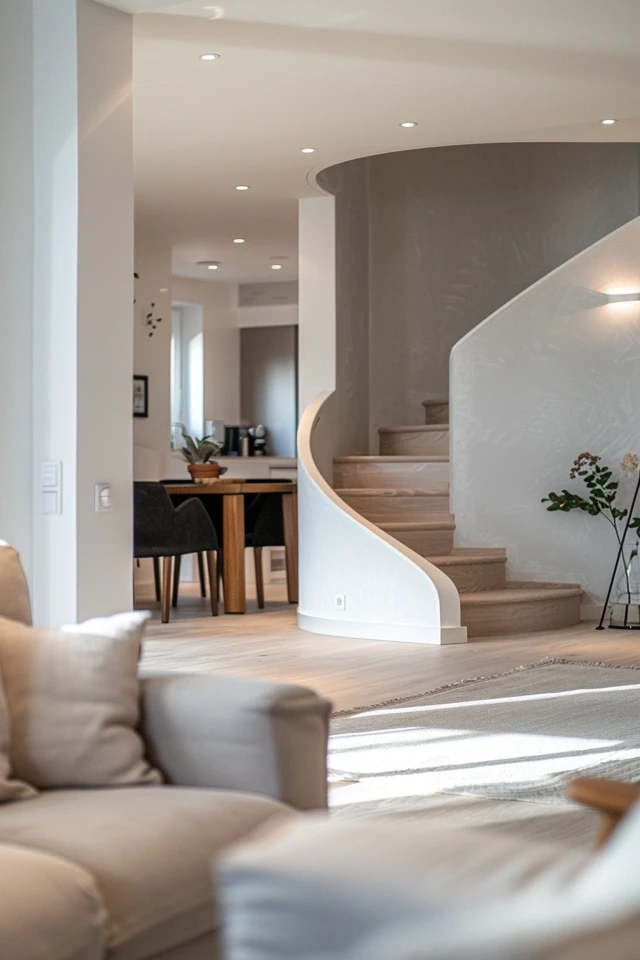
How To Decorate A Round Wall: Creative Styling Tips
Round walls are architectural gems that instantly add character, softness, and a sense of history to a home. Whether you are dealing with a turret in a Victorian home, a curved hallway in a contemporary build, or a rounded staircase landing, these features break up the monotony of rigid boxes. However, they are notoriously difficult to furnish and style. Standard furniture is square, frames are flat, and most advice assumes you have 90-degree corners to work with.
I have stood in many empty rooms with clients who love the idea of their curved wall but hate the reality of trying to live with it. The geometry fights against standard rugs, creates awkward gaps behind sofas, and makes hanging art a geometry puzzle. But when you get it right, a curved wall becomes the most stunning focal point in the house.
In this guide, I will walk you through the specific rules of thumb I use to conquer these tricky spaces. We will cover layout strategies, wall treatments that embrace the bend, and the technicalities of window dressings. For some serious visual inspiration, be sure to check out the Picture Gallery included at the end of this blog post.
1. Assessing the Curve and Planning the Layout
Before you buy a single piece of furniture, you need to understand the severity of the curve. A gentle sweep in a hallway requires a different approach than a tight, silo-shaped room.
The biggest mistake homeowners make is trying to force rectangular furniture against a round perimeter. This creates “dead zones”—wedge-shaped gaps behind the furniture that collect dust and visually clutter the room.
The “Floating” Rule
If your room is large enough, the best strategy is to float your furniture away from the walls. In a living room with a curved wall, I typically position the seating arrangement toward the center of the room.
Ideally, you want to leave a walkway of at least 30 to 36 inches between the back of your sofa and the curved wall. This allows the architecture to breathe and turns the curve into a backdrop rather than a barrier.
If you must push furniture back due to space constraints, do not use a long, straight sofa. Instead, use two smaller occasional chairs angled to follow the arc of the wall.
Matching Geometry with Geometry
The most harmonious way to furnish a round room is to repeat the shape. A round dining table or a round coffee table creates a concentric layout that feels intentional.
If you place a rectangular dining table in a round room, the corners will feel aggressive and tight against the walls. A round table creates an even perimeter for circulation.
Designer’s Note: The Rug Problem
One specific issue I see constantly is the “rug corners” dilemma. Rectangular rugs look terrible in round rooms because the corners inevitably encroach on the curved baseboards or leave awkward slivers of bare floor.
In a fully round room, always opt for a round rug. Size it so there is an even reveal of flooring around the edge—usually 12 to 18 inches of hard floor visible between the rug edge and the wall.
If the room creates a semi-circle (like a bay window area), you can sometimes get away with a rectangular rug if the front legs of the furniture sit on it, but the back legs remain on the hard floor. This tricks the eye into focusing on the furniture group, not the floor shape.
2. Wall Treatments: Embracing the Texture
Paint and wall coverings behave differently on curved surfaces. Light hits a curve in a gradient, meaning one side of your wall might be in shadow while the other is blown out by sunlight.
Standard flat paint can look underwhelming here. Because the light “rolls” across the surface, any imperfections in the drywall (bumps, tape lines) become highlighted.
Limewash and Roman Clay
My favorite treatment for curved walls is a textured finish like limewash, Roman clay, or Tadelakt. These finishes have inherent movement and depth.
When light hits a curved wall treated with Roman clay, the velvety texture absorbs the light rather than reflecting it harshly. It turns the wall into a sculptural element.
If you are renting, look for “suede effect” paints. They mimic this look without the permanent application of real plaster.
Flexible Molding and Paneling
Many people assume they cannot have wainscoting or chair rails on a round wall. This is false. Flexible polyurethane molding is a game-changer for these spaces.
This material looks exactly like wood but can bend to fit tight radiuses. You install it using construction adhesive and a few brad nails.
What I’d do in a real project:
- I often install vertical board-and-batten paneling on curves.
- The vertical lines emphasize the height of the room and draw the eye up.
- Because the vertical slats are narrow (usually 1.5 to 2 inches wide), they can navigate the curve easily without needing to be bent.
Wallpaper Considerations
Wallpaper can be stunning on a curve, but you must choose the pattern carefully. Avoid large-scale geometric patterns (like big squares or diamonds).
As the paper wraps around the curve, geometric lines can appear to warp or drift, making the installation look sloppy even if it is perfect.
Stick to organic patterns, florals, abstracts, or small-scale prints. These motifs forgive the distortion that naturally happens on a curved surface.
3. The Art of Hanging Decor on a Curve
Hanging flat objects on a round wall is a geometry problem. A wide frame is rigid; the wall is not. If you hang a large, wide landscape painting on a tight curve, the left and right edges of the frame will stick out significantly from the wall.
This creates ugly gaps where you can see the hanging hardware from the side. It also makes the artwork prone to wobbling.
The “Narrow Frame” Rule
To mitigate the gap issue, prioritize vertical (portrait) orientation over horizontal (landscape) orientation. Narrower frames sit flatter against the arc.
If you need to fill a wide horizontal space, do not use one large canvas. Instead, use a diptych or triptych (a series of two or three smaller frames hung side-by-side).
This allows the artwork to “segment” around the curve, keeping each piece relatively flush with the wall.
Gallery Walls
A gallery wall is actually easier to execute on a round wall than a single large piece. By using a collection of smaller frames (e.g., 8x10s or 11x14s), you can cover the entire surface without any single piece jutting out.
When planning a gallery wall on a curve, I recommend tightening your spacing. On a flat wall, I usually leave 2 to 3 inches between frames. On a curved wall, I reduce this to 1.5 to 2 inches. This helps the collection read as a single cohesive unit wrapping around the room.
Common Mistakes + Fixes
Mistake: Using wire to hang art on a curve.
Why it fails: Wire allows the picture to tilt forward, exacerbating the gap caused by the curve.
The Fix: Use French cleats or Command strips (for lighter items) on the bottom corners. You want to anchor the bottom of the frame to the wall so it follows the curve as much as possible. For heavier pieces, security hardware (T-screws) locks the bottom of the frame to the wall.
4. Lighting Strategies for Rounded Spaces
Lighting a round wall requires a different approach than lighting a flat plane. You want to emphasize the volume and the shape.
Grazing Light
The most dramatic way to light a round wall is with “grazing” light. This means positioning a light source close to the wall so the beam travels down (or up) the surface.
If you have textured walls (like stone or brick), install recessed downlights about 6 to 12 inches away from the wall edge. This highlights the texture and exaggerates the curve.
Sconces
Wall sconces are fantastic for curved hallways or staircases. However, you must check the width of the backplate.
Wide, rectangular backplates will not sit flush. They will rock and leave gaps on the sides. Look for sconces with narrow vertical backplates (less than 4 inches wide) or round backplates.
If you fall in love with a fixture that has a wide flat base, you may need a contractor to build up a small plaster “plinth” on the wall to create a flat mounting surface.
Floor Lamps
In a living room setting, use the empty wedges behind your furniture (the “dead zones” mentioned earlier) for lighting.
An arched floor lamp is a perfect match for a round room. The arm of the lamp mimics the room’s architecture. Place the base in the corner behind a floating sofa and let the shade hang over the seating area.
5. Window Treatments and Textiles
If your round wall includes windows (like a bay window or a turret), standard curtain rods will not work. You have three main options, ranging from DIY-friendly to high-end custom.
Option A: Individual Rods
If the windows are segmented with mullions or wall space in between, you can treat them as separate windows. Install short, straight curtain rods over each segment.
This is the most cost-effective method. However, it can look cluttered if you have many small windows.
Option B: Bendable Tracks
For a seamless look, you need a track that follows the ceiling line. There are bendable aluminum or plastic curtain tracks available online that can be mounted directly to the ceiling.
These tracks allow the drapery to glide continuously around the entire curve.
Designer Tip: If you use a ceiling-mounted track, ensure your curtains are floor-to-ceiling length. “Puddling” the drapes slightly (adding 1-2 inches of extra length) adds a romantic, soft vibe that suits round rooms perfectly.
Option C: Custom Rods with Elbows
If you prefer the look of a metal rod with rings, you will need to buy a system that includes “elbow connectors.” These are hinged joints that allow you to connect straight rod segments at various angles.
This requires precise measuring. You will need to measure the angle of each turn to ensure the elbows can accommodate the shape.
Blinds and Shades
Roller shades and Roman shades generally cannot be curved. They must be mounted on a straight headrail.
If you have a continuous curved glass wall (rare, but found in modern high-rises), you will likely need custom motorized shades that are installed in very narrow segments. This is expensive and usually requires a professional installer.
For most residential curved bay windows, installing individual blinds inside each window frame is the standard solution.
What I’d Do in a Real Project: A Mini Checklist
If I were hired to style a round entryway or living room today, this is the exact mental checklist I would follow to ensure success:
- Check the Traffic Flow: Ensure there is a 36-inch clear path. If the furniture blocks the flow, I would downsize the pieces immediately.
- Select the Rug First: I would source a round rug that anchors the center. I aim for the rug to be large enough that the front legs of all chairs sit on it.
- Test the Acoustics: Round rooms can have weird echoes. I would prioritize plush velvet upholstery, heavy drapes, and a thick wool rug to dampen the sound.
- Choose Organic Tables: I would swap out any square side tables for round or kidney-bean shapes. No sharp corners to bump into.
- Plan the Greenery: I would place a tall, large-leaf plant (like a Ficus Audrey or Bird of Paradise) in the tightest curve of the wall. Plants are organic shapes; they fill awkward curved voids better than any furniture can.
Frequently Asked Questions
Can I put a TV on a round wall?
It is possible, but difficult. A flat TV on a round wall looks disjointed. The best solution is to use a mounting bracket with an articulating arm. This allows you to pull the TV out and angle it toward the viewer, which masks the gap behind it. Alternatively, place the TV on a media console that is positioned on a flat interior wall, leaving the round wall for seating or art.
How do I handle baseboards on a round wall?
If you are renovating, use flexible baseboard molding. It is made of a rubbery synthetic material that paints just like wood. If you have existing rigid baseboards that are made of many small straight cuts (faceted), try to keep them painted the same color as the wall. This hides the “choppy” look of the segmented wood.
Is it expensive to decorate a round room?
It can be more expensive if you require custom joinery. Built-in curved bench seating is the gold standard for round nooks, but it requires a skilled carpenter. However, styling with retail furniture does not have to be expensive—you just have to be selective about shapes (round tables, curved sofas) rather than standard boxy items.
What if I am a renter?
If you cannot install tracks or paint the walls, focus on the floor and the lighting. A large round rug defines the space effectively. Use floor lamps to light the walls rather than installing sconces. For art, use small lightweight frames that can be held up with adhesive strips, allowing you to create a gallery wall without drilling into the tricky drywall.
Conclusion
Decorating a round wall requires a shift in perspective. You have to stop thinking in grids and start thinking in flows. While the geometry presents challenges regarding furniture placement and hanging decor, it also offers a unique opportunity to break away from the “boxy” feel of modern construction.
By choosing flexible materials, prioritizing organic furniture shapes, and using lighting to accentuate the curve rather than hide it, you can turn a structural oddity into the highlight of your home. Remember to respect the negative space—don’t crowd the curve. Let the architecture breathe, and the rest of the design will fall into place naturally.
Picture Gallery


