
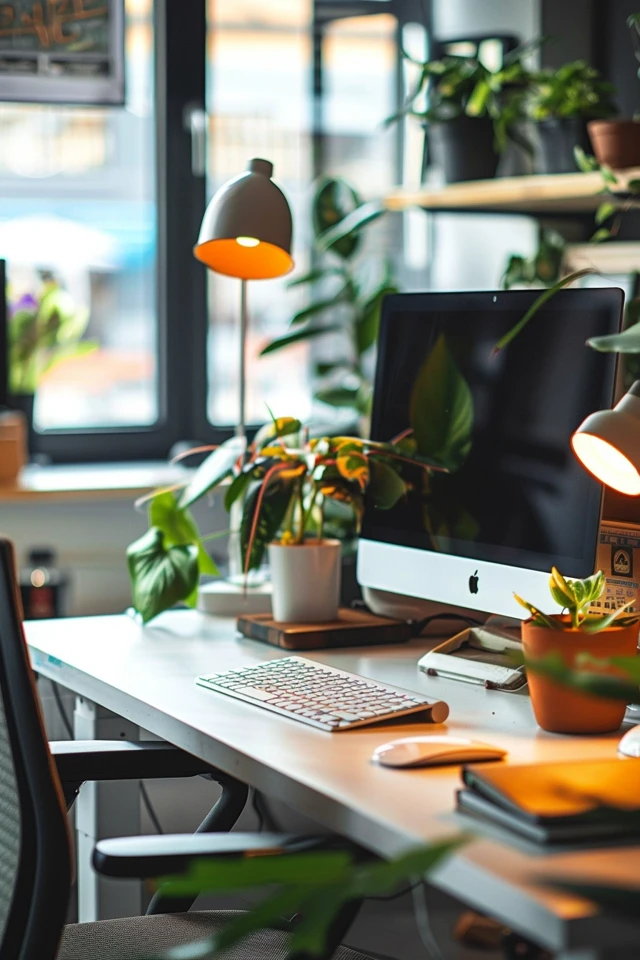
How To Decorate A Small Office With No Windows: Brightening Ideas
Working in a windowless room can often feel like you have been banished to a closet. I have seen many clients try to force these spaces to work, only to end up feeling lethargic and uninspired by 2:00 PM. However, a lack of natural light is actually an opportunity to create a completely controlled lighting environment that boosts focus.
With the right layering of artificial light and reflective surfaces, a windowless office can become the most productive room in your house. It allows you to eliminate screen glare completely and curate a mood that doesn’t change with the weather. For plenty of visual inspiration, be sure to scroll down to the Picture Gallery at the end of the blog post.
I am going to walk you through exactly how to transform a dark box into a bright, functional workspace. We will cover technical lighting specs, paint tricks that actually work, and furniture layouts that stop the room from feeling claustrophobic.
1. Master the Three Layers of Artificial Lighting
When you do not have windows, you cannot rely on a single overhead fixture. That is the quickest way to create harsh shadows and eye strain. You must simulate the nuance of daylight through layering.
In interior design, we use three distinct layers: ambient, task, and accent lighting. In a windowless office, you need all three working simultaneously to make the space feel three-dimensional.
Ambient Lighting (The Base)
This is your general illumination. If you are renting and have a standard “boob light” flush mount, try to swap it out for a semi-flush fixture with a drum shade. The fabric shade diffuses the light, pushing it out sideways toward the walls rather than just shooting it straight down.
If you have recessed cans, install a dimmer switch immediately. The ability to control intensity helps reset your circadian rhythm throughout the workday.
Task Lighting (The Workhorse)
This is the light directed specifically at your work surface. A high-quality desk lamp is non-negotiable here.
Designer’s Note: Position your task light on the opposite side of your writing hand. If you are right-handed, place the lamp on the left. This prevents your hand from casting a shadow across your notebook or documents while you write.
Accent Lighting (The Mood)
This is where you trick the eye. Use LED strips behind a monitor, inside a bookshelf, or under a floating shelf. This creates a “glow” that mimics the way light bounces around a room with windows.
The Golden Rule of Color Temperature
You must get the light bulb color right. In a windowless room, I strictly recommend bulbs between 3000K and 3500K.
- 2700K: Too yellow. It looks like a sleepy living room and will make you tired.
- 3000K – 3500K: The sweet spot. It is bright and crisp but still warm enough to feel welcoming.
- 5000K+: Too blue. It feels like a sterile hospital or a garage. Avoid this unless you are doing color-critical art work.
2. The Psychology of Paint and LRV
A common mistake is thinking that painting a windowless room stark white will make it brighter. Without natural light to reflect, pure white paint often turns flat, gray, and shadowy in the corners.
Instead, you need to look at the Light Reflectance Value (LRV) of your paint. This is a number from 0 to 100 that tells you how much light a color reflects.
For a Bright and Airy Feel
Look for off-whites, creams, or very pale greiges with an LRV between 60 and 75. These have enough pigment to hold their own against artificial light but are light enough to bounce that illumination around the room.
For a Moody, “Jewel Box” Feel
Sometimes, the best move is to lean into the darkness. Painting the room a deep charcoal, navy, or forest green can blur the boundaries of the room. When corners disappear into shadow, the room can actually feel larger and infinite, rather than small and boxy.
Sheen Matters More Than Color
Regardless of the color you choose, skip the matte finish. Matte paint absorbs light.
In a windowless office, I specify an eggshell or satin finish for the walls. This slight sheen helps bounce your artificial light sources around the room. It adds a subtle glow that helps the space feel alive.
3. Using Mirrors to “Fake” a Window
Mirrors are the oldest trick in the designer’s handbook, but placement is critical. A mirror reflecting a blank wall does nothing for the space.
The Windowpane Mirror Trick
Find a large mirror with a grid pattern (mullions). Hang this centrally on the wall where a window would logically be.
To sell the illusion, install a picture light above it or place a floor lamp directly in front of it. The mirror will reflect the light source, mimicking the brightness of a real window.
Scale and Positioning
Do not use small, dinky mirrors. In a small room, one large gesture is better than five small ones.
Look for a mirror that is at least 24 to 36 inches wide. If you have the floor space, a tall leaning floor mirror (roughly 65 inches high) can double the visual depth of the room.
Common Mistake: Hanging a mirror so that it reflects your clutter.
The Fix: Sit in your desk chair and check the angle. The mirror should reflect a light source, a piece of art, or a clean wall—not your printer or a stack of bills.
4. Furniture Layout and Ergonomics
In a small, windowless room, every inch of floor space counts. Heavy, blocky furniture will make the room feel like a storage unit.
The “Leggy” Rule
Choose a desk and chairs that have exposed legs. Avoid solid desks with heavy drawers that go all the way to the floor. Being able to see the floor underneath your furniture tricks the brain into perceiving more square footage.
Transparent Materials
Consider an acrylic chair or a glass-top desk. These items take up zero visual weight. If a glass desk feels too cold, you can warm it up with a leather desk pad.
Traffic Flow Measurements
You need room to breathe. Ensure you have at least 30 to 36 inches of clearance behind your desk chair to push back and stand up comfortably.
If you are squeezing a guest chair or a reading nook into the corner, leave a minimum of 18 inches between the coffee table or ottoman and the seat.
Vertical Storage Systems
Since floor space is premium, go vertical. Install floor-to-ceiling shelving.
Drawing the eye upward makes the ceiling feel higher. Use the top shelves for decorative items or archival storage, and keep the daily necessities at arm’s reach.
5. Biophilia: Bringing the Outside In
The biggest psychological drawback of a windowless office is the separation from nature. We have an innate need to connect with the outdoors (biophilia). You have to reintroduce this artificially.
Real Plants for Low Light
You do not have to buy fake plants just because you lack windows. Several species thrive in low-light conditions or can survive with standard room lighting.
- ZZ Plant (Zamioculcas zamiifolia): incredibly hardy and drought tolerant.
- Snake Plant (Sansevieria): grows vertically, making it perfect for tight corners.
- Pothos: a trailing plant that looks great on bookshelves; very forgiving.
If your room is pitch black when the lights are off, you may need to leave a small LED grow light on a timer, or rotate your plants to a sunny room on the weekends.
High-End Faux Options
If you don’t want the maintenance, high-quality faux greenery is acceptable. Look for “real touch” latex versions rather than fabric, which collects dust and looks cheap. Place a faux tree in a corner to soften the sharp angles of the room.
Landscape Art
Since you don’t have a view, hang one. Large-scale photography of landscapes—forests, oceans, or mountains—acts as a virtual window.
Avoid busy gallery walls in a tiny, windowless room. They can feel chaotic. One oversized piece of art (think 30×40 inches or larger) creates a focal point and a sense of calm.
What I’d Do in a Real Project: A Mini Checklist
If I were hired to design a 10×10 windowless home office today, here is exactly how I would execute it:
- Paint: I would choose a warm greige (like Benjamin Moore’s Edgecomb Gray) in a Satin finish to bounce light.
- Ceiling: I would paint the ceiling a stark, bright white (Chantilly Lace) to lift the room.
- Rug: I would size the rug to fill the room, leaving just 6 to 8 inches of bare floor around the edges. This expands the room visually.
- Lighting: I would install two wall sconces (plug-in if renting) on either side of the artwork to create eye-level brightness.
- Desk: I would position the desk “command style” facing the door, rather than pushing it against the wall. Facing a wall in a windowless room feels incredibly confining.
Common Mistakes + Fixes
Mistake: Relying on a single monitor for light.
Fix: This causes digital eye strain. Always have “bias lighting” (a soft light source) behind your screen to reduce the contrast between the bright screen and the dark wall.
Mistake: Over-cluttering the surfaces.
Fix: In small spaces, clutter reads as anxiety. Use closed storage (bins, boxes, drawers) for papers. Only keep daily tools and 1-2 decor items on the desk surface.
Mistake: Buying a rug that is too small.
Fix: A “postage stamp” rug floating in the middle of the room makes the room look smaller. Get a rug that is large enough for all the legs of your furniture to sit on it, or at least the front legs of the major pieces.
Final Checklist for Your Brightening Makeover
Ready to start? Use this checklist to ensure you haven’t missed a step.
- Audit your bulbs: Swap everything to 3000K-3500K LEDs.
- Add layers: Ensure you have at least 3 light sources (Ceiling, Desk, Floor/Accent).
- Check the paint: Is it matte? If so, plan to repaint with Eggshell or Satin.
- Mirror check: Add one large mirror that reflects a light source.
- Greenery: Add at least one plant (real or quality faux) to soften the space.
- Cable management: Hide cords. Visual chaos makes small rooms feel smaller.
- Airflow: If the room feels stuffy, add a small, stylish fan or air purifier to keep the air moving.
FAQs
How do I handle video calls in a windowless office?
The “raccoon eye” effect is common here. Do not rely on overhead light. Place a ring light or a soft desk lamp directly behind your webcam, slightly above eye level. This fills in the shadows on your face.
Is it unhealthy to work in a room without windows?
It can disrupt your circadian rhythm if you aren’t careful. To combat this, take breaks outside or in a naturally lit room every 90 minutes. Use 4000K-5000K bulbs (daylight balanced) in your lamps during the day to keep you alert, but switch to warmer lamps (2700K) if you work late at night.
What is the best flooring for a small office?
Light wood tones or light-colored carpet are best. Dark floors suck up light. If you have dark floors you can’t change, cover them with a large, light-colored area rug.
How do I make the ceilings look higher?
Hang curtains. Yes, even without windows! Hang floor-to-ceiling drapery along one wall. It softens the acoustics, adds texture, and tricks the brain into thinking there is a window hidden behind the fabric. Mount the rod as close to the ceiling as possible.
Conclusion
Decorating a small office with no windows is about control. You aren’t at the mercy of cloudy days or early sunsets. By layering your lighting, choosing reflective finishes, and carefully scaling your furniture, you can build a sanctuary that promotes deep focus.
Don’t let the lack of a view stop you from creating a beautiful space. With these adjustments, your “bunker” might just become your favorite room in the house.
Picture Gallery


