
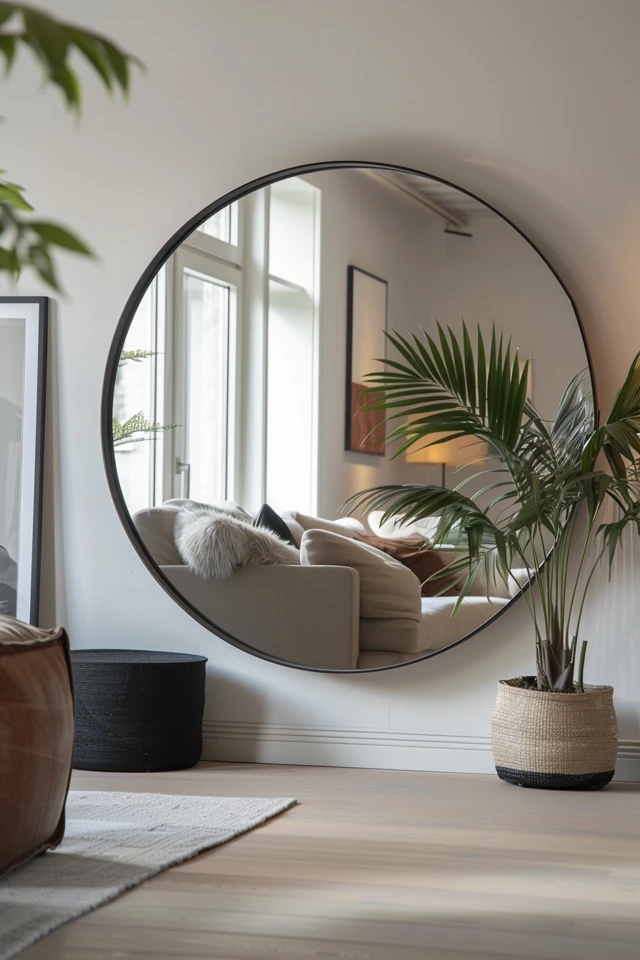
How To Hang Round Mirror: Stylish Display Techniques
Introduction
Round mirrors are the secret weapon in an interior designer’s toolkit. They instantly break up the rigid, straight lines of door frames, cabinets, and rectangular furniture. Adding a curve softens the entire room and creates a more organic, welcoming flow.
However, hanging a round object presents a unique set of challenges compared to traditional square art. Without corners to align, judging the correct height and scale can feel tricky. I have seen many beautiful mirrors floating aimlessly too high on a wall or looking tiny above a large sofa.
In this guide, I will walk you through the technical steps and styling rules I use on actual job sites. We will cover everything from selecting the right hardware to styling the console table beneath it. Make sure to look for the Picture Gallery at the end of the blog post to see these concepts in action.
1. The Technical Foundation: Hardware and Height
Before we discuss aesthetics, we must ensure the mirror stays on the wall safely. Round mirrors are often deceptive in weight; the glass and metal frames can be surprisingly heavy.
Finding the Studs vs. Using Anchors
Ideally, you should drive your screw into a wooden wall stud. This provides the most secure hold for heavy items. Use a magnetic stud finder to locate the beam behind the drywall.
If the perfect placement for your design does not align with a stud, you must use proper wall anchors. Do not use the cheap plastic plugs that often come in the box with the mirror. For mirrors weighing over 20 pounds, I strictly use toggle bolts or heavy-duty screw-in anchors (like E-Z Ancors). These expand behind the drywall to distribute the weight.
The Center Point Rule
The golden rule for hanging art and mirrors is to place the center of the piece at eye level. For most residential spaces, this means the center of the mirror should be approximately 57 to 60 inches from the floor.
If you are hanging the mirror over furniture, the rule changes slightly to focus on the relationship between the two objects. We will cover those specific gaps in later sections.
Designer’s Note: The Wire Trap
Many round mirrors come with a wire strung across the back. I usually remove this. Hanging a round mirror by a wire often causes it to lean forward away from the wall, reflecting the floor rather than the room.
Instead, use the D-rings attached directly to the frame. This keeps the mirror flush against the wall for a polished, high-end look.
2. Entryways and Console Tables
The entryway is the most common place my clients request a round mirror. It allows for a quick “outfit check” before leaving the house and bounces light into often dark hallways.
The Rule of Scale
The most common mistake here is buying a mirror that is too small for the console table. The mirror should generally span about two-thirds to three-quarters of the width of the console.
If your console is 60 inches wide, look for a mirror that is roughly 40 to 45 inches in diameter. If the mirror is too small, it will look like a floating dot. If it is wider than the furniture, the composition will feel top-heavy and unbalanced.
Mind the Gap
The space between the bottom of the mirror and the top of the table is critical. You want the mirror to feel connected to the furniture, not floating near the ceiling.
Aim for a gap of 4 to 6 inches between the console surface and the bottom rim of the mirror. This leaves enough room for styling objects but keeps the visual grouping tight.
Common Mistakes + Fixes
Mistake: The mirror feels disconnected from the table.
Fix: Use “bridging” decor. Place a tall vase with branches or a substantial table lamp on the console so that the item overlaps visually with the mirror. This physically connects the two elements.
3. Living Rooms: Over Sofas and Mantels
Round mirrors in the living room act as focal points. They are excellent for breaking up the rectangular monotony of a television, a long sofa, and a rectangular rug.
Placement Above the Sofa
When hanging above a sofa, ensure the mirror does not exceed two-thirds of the sofa’s width. A mirror that is too wide can make the furniture below it look diminutive.
Hang the mirror so the bottom edge is 8 to 10 inches above the top of the sofa back cushions. This prevents heads from bumping it when people sit down, but keeps it low enough to be part of the seating area.
The Fireplace Mantel Strategy
A round mirror over a mantel is a classic look. However, heat and height are concerns here. If you use your fireplace frequently, ensure the mantel is deep enough to deflect heat away from the glass backing, which can de-silver over time.
Leave a gap of 4 to 8 inches between the mantel shelf and the mirror. If you have very high ceilings, you can go slightly higher, but avoid the “floating” look.
Reflection Awareness
Before drilling holes, hold the mirror up (or have a helper do it) and check what is being reflected. In a living room, you might accidentally be reflecting a ceiling fan, an HVAC vent, or the messy kitchen counter opposite the fireplace.
What I’d Do in a Real Project
If the reflection isn’t great, I often tilt the mirror slightly downward using a specialized tilting bracket, or I might opt for artwork instead. Mirrors should double the beauty of a room, not duplicate its clutter.
4. Bathroom Vanities and Powder Rooms
Using round mirrors in a bathroom is a modern standard. It breaks up the heavy, boxy cabinetry and tile work typically found in these spaces.
Sizing for Vanities
For a single vanity, the mirror should be the same width as the sink basin or slightly wider. It should never be wider than the vanity cabinet itself.
For double vanities, you have two options: one massive round mirror spanning the center (if space allows) or, more commonly, two smaller round mirrors centered over each sink.
Lighting Considerations
Lighting a round mirror requires care. Overhead vanity lights can cast shadows on the face because the curve of the mirror often pushes the fixture higher up the wall.
I prefer to use wall sconces placed on either side of the mirror. This provides even, cross-illumination that is flattering for makeup and grooming. If you must use overhead lighting, ensure the fixture is long enough to cast light downwards over the curve of the glass.
Height for Function
In a bathroom, function trumps the “57-inch” rule. You must accommodate the users of the bathroom. The mirror should be low enough that the shortest user can see themselves, but high enough that the tallest user doesn’t get cut off.
A good baseline is to center the mirror 64 to 66 inches from the floor, provided this clears the backsplash by at least a few inches.
5. Design Features: Straps and Chains
Some round mirrors come with decorative leather straps, ropes, or metal chains for hanging. These are fantastic for adding texture and an industrial or nautical vibe.
The Triangle Effect
When hanging these, remember that the hardware hook will be significantly higher than the mirror itself. The strap creates a triangle shape that draws the eye upward.
You must account for this extra height when measuring. Measure the distance from the top of the strap (where it hits the hook) to the bottom of the mirror.
Choosing the Right Hook
Since the hanging hardware is visible, it becomes part of the design. Do not use a standard nail. Use the decorative knob or peg that usually comes with the mirror.
If you are buying a vintage mirror without hardware, source a substantial brass or matte black wall hook. A standard picture hook will look cheap and flimsy against a thick leather strap.
Stability Issues
Mirrors on straps tend to swing if a door slams or if there is a draft. I recommend placing a small piece of double-sided foam tape or a velcro command strip at the bottom curvature of the mirror. This secures it to the wall without being visible, keeping it perfectly level.
6. Enhancing Light and Space
Mirrors are not just for checking your reflection; they are tools for architectural manipulation. I use them to fix dark corners and small rooms.
The Window mimic
If you have a windowless dining room or a dark hallway, place a large round mirror directly opposite a doorway or an adjacent window. This bounces natural light into the dark zone.
A round mirror with a window-pane grid (mullions) works exceptionally well for this. It tricks the brain into perceiving it as an architectural aperture rather than just decor.
Expanding Small Spaces
In a small powder room or narrow entry, a large mirror blurs the boundaries of the wall. By reflecting the rest of the room, it creates a sense of depth that makes the square footage feel doubled.
Finish Coordination
When choosing the frame finish, look at the other metals in the room. You do not need to match everything perfectly. If your faucet is polished chrome, a matte black mirror creates a nice contrast. If you have brass lighting, a wood-framed mirror adds warmth.
Final Checklist: The Installation Day Protocol
Here is the step-by-step process I use on installation days to ensure no mistakes are made.
1. Trace a template: Cut a circle out of kraft paper or newspaper that matches the size of your mirror.
2. Tape it up: Use painter’s tape to place the paper template on the wall. Live with it for an hour. Step back and check the scale from different angles.
3. Mark the hardware: Measure the distance from the top of the mirror frame to the D-rings on the back. Transfer these measurements to your paper template on the wall.
4. Check for pipes/wires: If you are drilling near a bathroom or kitchen, be hyper-aware of plumbing lines behind the wall.
5. Level it: Once the anchors are in and the mirror is hung, place a small spirit level on top (if the frame is flat) or step back and eyeball it relative to the furniture below.
6. Secure the bottom: Add a small felt bumper to the bottom back of the mirror. This protects the paint and keeps the mirror parallel to the wall.
FAQs
Can I hang a round mirror with Command Strips?
I generally advise against this for mirrors. Glass is heavy and fragile. While some strips claim to hold the weight, humidity and paint texture can cause failure. Only use adhesive strips for very small, lightweight dorm-style mirrors (under 5 lbs). For anything substantial, use a screw and anchor.
How do I clean a round mirror without streaking?
Spray the glass cleaner onto a microfiber cloth, not directly onto the mirror. Spraying the mirror directly allows liquid to seep into the bottom edge of the frame, which causes “black edge” or de-silvering over time. Wipe in a circular motion, then buff with a dry cloth.
Does a round mirror work in a square room?
Absolutely. In fact, that is the best place for it. A square room has four corners and likely square furniture. A round mirror introduces a necessary counter-shape that softens the harsh geometry. It creates balance.
What if my mirror only has one hook on the back?
If there is a single keyhole slot or sawtooth hanger, you must be precise with your center measurement. The downside of single-point hanging is that the mirror shifts easily when cleaned. I recommend adding a little museum putty or blue tack to the bottom edge to keep it from swinging crooked.
Conclusion
Hanging a round mirror is one of the most effective ways to elevate a room’s style with minimal effort. It brings light, expands visual space, and softens the hard edges of modern architecture. By following the rules of scale—keeping it two-thirds the width of your furniture—and adhering to the correct height placement, you can achieve a professional look.
Remember that rules are guidelines. If your ceilings are exceptionally high or your family is exceptionally tall, adjust the measurements to fit your life. The goal is a home that feels balanced and functional. Take your time measuring, use the right anchors, and enjoy the new perspective your mirror brings to the space.
Picture Gallery


