
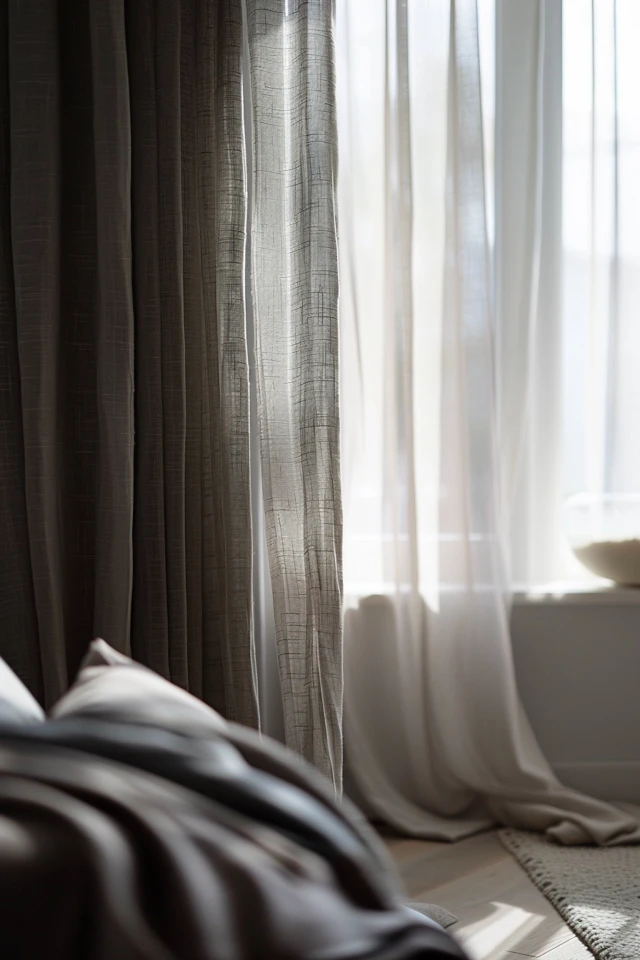
How To Install Sheer And Blackout Curtains: Layered Window Treatments
There is a reason why high-end hotel rooms always feel so serene and conducive to sleep. It almost always comes down to the window treatments. Specifically, the combination of airy sheers and heavy blackout drapes gives you total command over your environment. You get soft, filtered light during the day to protect your floors from UV rays, and absolute darkness when it is time to recharge.
Replicating this look at home is one of the most effective upgrades you can make to a bedroom or living area. It adds instant visual height, textural depth, and functional insulation. However, layering two different types of curtains requires more planning than throwing a single rod up on the wall. To help you visualize how these layers come together in real homes, I have curated a Picture Gallery at the end of the blog post.
In this guide, I will walk you through the professional method for installing layered window treatments. We will cover the specific hardware you need, the math behind perfect fullness, and the installation tricks I use on client projects to ensure the hardware stays secure. Whether you are dealing with a drafty rental apartment or a custom home, this layered approach works universally to elevate the space.
1. Choosing the Right Hardware System
The foundation of a successful layered window treatment is the hardware. You cannot simply squeeze two curtains onto one standard rod. You need a system designed to handle the weight of blackouts while allowing the sheers to glide independently behind them.
Double Curtain Rod Brackets
The most common solution for residential homes is the double rod set. These sets come with specialized brackets that hold two rods at different distances from the wall.
- The Back Rod: This is usually thinner (often 5/8 inch or 3/4 inch diameter) and sits closer to the wall. This is where your sheers go.
- The Front Rod: This is thicker (1 inch or 1.25 inches) to support the heavier blackout fabric. It sits further out to clear the sheer layer.
Ceiling Tracks (The Modern Alternative)
If you have very little space between the top of your window frame and the ceiling, or if you want a sleek, floor-to-ceiling architectural look, I recommend ceiling tracks.
- You install two parallel tracks directly into the ceiling drywall or joists.
- This creates a seamless “wall of glass” effect and makes the room feel significantly taller.
- This is often the best choice for wide sliding glass doors where a center support bracket on a rod would prevent the curtains from closing fully.
Designer’s Note: Watch Your Projection
One issue I frequently see in DIY projects is “projection conflict.” If your window has a protruding sill, a radiator, or chunky molding, standard double brackets might not stick out far enough. The sheers will get snagged on the handle or the sill. Measure the depth of your window sill. Your back rod needs to sit at least 1 inch past that protrusion to hang freely.
2. Measuring Like a Pro: The High and Wide Rules
The difference between a dorm room look and a designer look is entirely in the measurements. Most people hang their curtains right on the window frame. This makes the window look small and the ceiling look low. We want to do the opposite.
The Vertical Measurement (Height)
We almost never mount the hardware on the window molding itself.
- Rule of thumb: Mount your rod at least 4 to 6 inches above the top of the window frame.
- Ideally: Mount the rod halfway between the top of the window frame and the ceiling molding. If you have 8-foot ceilings, go as high as possible, leaving just an inch or two below the crown molding.
- Floor clearance: I prefer the “kiss” length, where the fabric just barely touches the floor. For this look, measure from your desired rod height down to the floor. If you want a cleaner look that is easier to vacuum, deduct 1/2 inch so the curtains hover slightly.
The Horizontal Measurement (Width)
To maximize natural light, you want the curtains to clear the glass when they are open. This is called the “stack back.”
- Extension: Extend your rod 8 to 12 inches past the window frame on each side.
- Why this matters: This allows you to push the blackout curtains completely off the glass during the day. It tricks the eye into thinking the window is 2 feet wider than it actually is.
Calculating Fabric Fullness
For a luxurious look, you cannot just match the width of the window. Flat curtains look cheap.
- Standard Fullness: Aim for 2 times the width of the rod coverage. If your window plus extension is 100 inches wide, you need 200 inches of fabric width total.
- Deluxe Fullness: For sheers, specifically, I often go for 2.5 times or 3 times fullness. Sheers are thin, and if they are not bunched generously, they can look skimpy and wire-like.
3. Selecting Fabrics and Header Styles
The “header” is the top part of the curtain that attaches to the rod. When layering, the header style dictates how well the two layers function together. If both layers have bulky headers, they will fight for space and look messy.
The Best Header for the Back Layer (Sheers)
For the sheer layer closer to the wall, you want something low-profile.
- Rod Pocket: This is okay for sheers that you rarely open or close, but it creates friction.
- Pinch Pleat or Pencil Pleat: This is the superior choice. It keeps the fabric organized and allows it to stack neatly.
- Tab Top: Avoid this for the back layer. It creates too much friction and is hard to move behind a heavy front drape.
The Best Header for the Front Layer (Blackouts)
The front layer is the star of the show.
- Grommets: These have large metal rings. They slide easily and have a modern look. However, the folds of a grommet curtain require a lot of depth (front to back). If using grommets, ensure your double bracket has a wide spacing between the two rods.
- French Pleat / Pinch Pleat: This is the classic, tailored choice. You use curtain rings with hooks. It looks expensive and slides effortlessly.
- Back Tab: A great budget-friendly option that mimics the look of a pleated drape without the need for rings. It slides reasonably well but not as smoothly as rings.
Common Mistakes + Fixes
Mistake: Using heavy velvet for the front and a stiff linen for the back.
Fix: Ensure your back layer is truly soft and pliable, like a voile or a soft poly-blend. If the back layer is too stiff, it will push the front layer out into the room, creating an awkward ballooning effect.
4. The Installation Process: Step-by-Step
Once you have your hardware and fabrics, it is time to install. You will need a drill, a metal tape measure, a pencil, a level, a hammer, and a sturdy step ladder.
Step 1: Mark Your Bracket Locations
Using the measurements from earlier (high and wide), mark the location of your center screw for the left and right brackets.
- Measure from the ceiling down to ensure both sides are level relative to the room. Houses settle, and floors are rarely perfectly level, so measuring from the ceiling is usually safer visually than measuring from the floor up.
- Use your level to ensure the two marks are horizontally aligned.
Step 2: Install the Anchors
Never screw directly into drywall without an anchor. The weight of double curtains (especially with blackouts) is significant.
- If you hit a wooden stud (use a stud finder to check), you can screw directly in. This is the strongest method.
- If you are in hollow drywall, use toggle bolts or heavy-duty threaded drywall anchors. Do not use the tiny plastic plugs that often come in the box with the rod; they will pull out over time.
Step 3: The Center Support
If your rod is wider than 60 inches, you absolutely need a center support bracket. Without it, the rods will sag in the middle, preventing the curtains from closing properly.
- Install the center bracket exactly at the midpoint.
- Double-check that the center bracket is leveled with the side brackets.
Step 4: Load the Curtains
This order is important to avoid frustration.
- Remove the finials (decorative ends) from the rods.
- Slide the sheer panels onto the thinner back rod. Place this rod into the back notch of the brackets.
- Slide the blackout panels onto the thicker front rod. Place this rod into the front notch.
- Tighten the small set screws on the brackets to lock the rods in place so they don’t slide when you pull the curtains.
What I’d Do in a Real Project: The “Return” Trick
To block that annoying sliver of light that leaks in from the sides, I use a “return.” I screw a small cup hook or an eyelet into the wall, right where the curtain ends. I then hook the very last curtain ring or the edge of the fabric to the wall. This wraps the curtain around the side of the bracket, sealing the gap for total darkness.
5. Styling and Training Your Drapes
Installation does not end when the drill is put away. New curtains often look stiff and have creases from the packaging. You need to “break them in” to get that soft, professional drape.
Steaming is Non-Negotiable
Do not try to iron large drapes; it is a logistical nightmare. Hang them first, then use a handheld garment steamer.
- Steam from the top down.
- For blackouts with a rubberized lining, be very careful. Steam only from the fabric side, not the lining side, to avoid melting the coating.
Training the Pleats
This is the secret to why showroom curtains look so orderly.
- Open the curtains fully so they are stacked back.
- Use your hands to arrange the folds neatly, ensuring the pleats fold forward and back uniformly.
- Take a strip of fabric, a soft ribbon, or even painter’s tape, and tie loosely around the gathered curtain at the top, middle, and bottom.
- Leave them tied up for 2 to 3 days. When you untie them, the fabric will “remember” the fold and hang in perfect columns rather than flaring out at the bottom.
Hemming for Perfection
If you bought standard length panels (like 96 inches) and they are dragging on the floor:
- No-Sew Option: Use iron-on hem tape. It works surprisingly well for heavy drapes.
- Clip Ring Cheat: If you are using curtain rings with clips, you can fold the top of the curtain over (toward the back) by an inch or two and clip it. This shortens the drape and adds a bit of stiffness to the header, which actually looks quite nice.
Final Checklist: The Layered Look
Before you declare the project finished, run through this quick checklist to ensure quality and safety.
Hardware Check
- Are all brackets firmly attached to the wall with no wiggle?
- Did you tighten the set screws on the brackets so the rod doesn’t jump when you pull the fabric?
- Are the finials screwed on tightly?
Functionality Check
- Do the sheers slide smoothly without hitting the window crank or handle?
- Do the blackout curtains overlap in the middle? (They should overlap by 1-2 inches to prevent a light gap).
- Does the “stack back” clear the glass enough to let light in?
Aesthetics Check
- Are the hems level across the floor?
- Have you steamed out the grid lines from the packaging?
- Are the side returns secured to the wall to block side light?
Frequently Asked Questions
Can I install layered curtains if I am a renter?
Yes, but holes are inevitable. Heavy blackout drapes are generally too heavy for tension rods, especially on wide windows. Your best bet is to install the proper brackets and simply patch the small screw holes with spackle when you move out. It takes five minutes to patch and saves you the headache of curtains falling down constantly.
How do I clean layered curtains?
This is the beauty of the two-rod system. You can remove just the sheers (which tend to get dustier or yellowed from sun exposure) and wash them according to the label, while leaving the heavy blackouts in place. Always vacuum your drapes with an upholstery attachment every few months to reduce dust buildup.
My window is right next to a corner wall. How do I measure?
If a window is jammed into a corner, use a special “end cap” finial on that side. It is flat and takes up almost no space. You may not be able to extend the rod 10 inches on that side, so just extend it as far as the wall allows. You will lose a little bit of view on that side, but it will still look polished.
Can I mix metal finishes?
I generally advise against it for the rod set itself. Keep the back rod, front rod, and brackets in the same finish (e.g., matte black or brushed brass). However, you can certainly mix the curtain fabric textures. A matte linen blackout pairs beautifully with a slightly shimmery sheer.
Conclusion
Installing layered sheer and blackout curtains is an investment of time and effort, but the payoff is daily comfort. You gain the ability to modulate the atmosphere of your room instantly. During the day, you have the privacy and softness of the sheers; at night, you have the cocoon-like security of blackouts.
By following the rules of “high and wide,” securing your hardware properly, and taking the time to train your fabric, you elevate a basic window into a design feature. It creates a finished, architectural look that blinds or shades simply cannot achieve on their own. Take your time with the measurements, buy the right anchors, and enjoy the luxury of a perfectly dressed window.
Picture Gallery


