
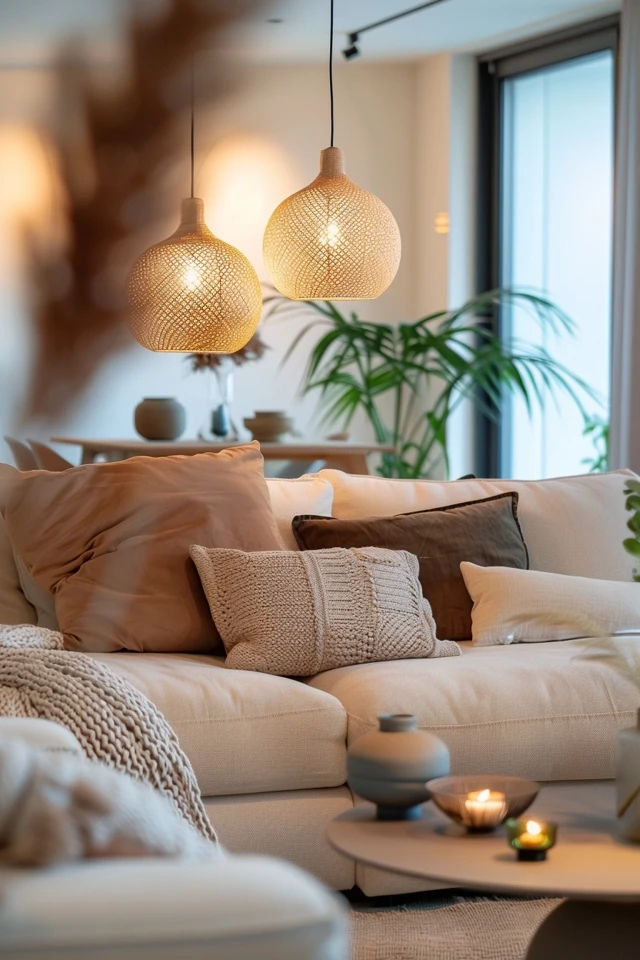
How To Light An Apartment Without Ceiling Lights: Ambient Lighting Ideas
Moving into a new apartment often comes with a few surprises, and a lack of overhead lighting is one of the most common issues in older buildings or concrete high-rises. You flip the switch by the door, and nothing happens—or worse, it only controls a single, lonely outlet in the corner. This creates what I call the “cave effect,” where a room feels small, dark, and unwelcoming.
Lighting a space without a central ceiling junction box forces you to think creatively about layers. You cannot rely on a single source to do all the heavy lifting. Instead, you have to build a system of floor lamps, sconces, and table lamps that work together to wash the room in light. For visual inspiration on how these layers come together, check out the Picture Gallery at the end of the blog post.
In my design practice, I often prefer rooms without harsh overhead “can” lights because lamp lighting is inherently more flattering and cozy. By using the right fixtures and positioning them correctly, you can make your rental feel intentionally mood-lit rather than dim.
1. Understanding Light Layers and Kelvin Ratings
Before buying a single lamp, you need to understand the mechanics of light. When you do not have ceiling lights, you are missing “ambient” light, which is the general illumination that lets you walk around safely. Your goal is to manufacture this ambient light using other sources.
To do this successfully, you must pay attention to the bulb temperature. This is measured in Kelvins (K). For a living room or bedroom, I strictly recommend 2700K or 3000K LED bulbs. 2700K is warm and cozy, similar to incandescent light, while 3000K is slightly crisp but still warm.
Never use 4000K or 5000K “Daylight” bulbs in a residential living space. They cast a blue, clinical light that feels like a hospital or a garage. When you rely solely on lamps, a blue tint will make the apartment feel cold and eerie.
Designer’s Note: The Lumen Formula
How much light do you actually need? A good rule of thumb for ambient lighting is 20 lumens per square foot. If your living room is 150 square feet (10 x 15), you need roughly 3,000 lumens total. A standard 60-watt equivalent LED bulb offers about 800 lumens. This means you need at least four light sources to properly light that room.
Common Mistakes + Fixes
- Mistake: Relying on one super-bright floor lamp in the corner.
- Fix: This creates harsh shadows. Use three to four lower-wattage sources spread across the room for even distribution.
2. The Power of Torchiere and Arc Floor Lamps
Floor lamps are your heavy lifters when ceiling lights are absent. However, not all floor lamps serve the same purpose. You need to distinguish between “uplighting” and “downlighting.”
A torchiere floor lamp is designed to shoot light upward. This is the closest substitute for a ceiling fixture because the light bounces off the white ceiling and scatters down into the rest of the room. This effectively turns your ceiling into a giant reflector.
Place torchiere lamps in corners. This brightens the dark edges of the room, which visually pushes the walls back and makes the space feel larger.
What I’d Do in a Real Project:
For a seating area where you need overhead light (like reading on a sofa), I use a large arc floor lamp. These have long, curved stems that reach over furniture.
- Placement: Position the base of the arc lamp behind the sofa or tucked beside a side table.
- Height Rule: The bottom of the shade should be roughly 58 to 64 inches from the floor. You want the light to clear your head when you stand up, but not be so high that you lose the intimacy.
- Safety: Ensure the base is heavy enough to prevent tipping, especially if you have pets or children.
3. Plug-In Wall Sconces: No Electrician Required
Wall sconces are fantastic for freeing up floor space and adding light at eye level. In a rental, you cannot cut into the drywall to hardwire them, but plug-in sconces are a stylish alternative.
These fixtures mount to the wall with a simple bracket and have a cord that plugs into a standard outlet. They add architectural interest and make a room feel “finished” in a way that floor lamps sometimes cannot.
Cord Management is Key
The downside to plug-in sconces is the visible cord. Do not let the cord dangle loosely; it looks temporary and messy.
- Cord Covers: Use metal or plastic cord channels. Paint them the exact color of your wall. When painted effectively, they disappear.
- Tight Pull: If you leave the cord exposed (some fabric cords look nice), pull it tight and anchor it straight down. Use clear cord clips just above the baseboard.
Designer’s Note: Sconce Placement
Mount your sconces so the bulb is approximately 60 to 66 inches off the floor. If they are flanking a sofa or bed, they can be lower—around eye level when you are sitting up in bed.
4. Utilizing Table Lamps and Translucent Shades
Table lamps provide the mid-level lighting that connects your floor lamps to your surfaces. They are essential for tasks, but they also contribute to the overall ambient glow if you choose the right shade.
Avoid solid metal or opaque black shades if your goal is general brightness. Those shades force light only up and down (task lighting). Instead, choose shades made of linen, cotton, or white silk. These materials allow light to pass through the sides of the shade, creating a glowing lantern effect.
Scale and Sizing Rules
Getting the scale right is critical for a professional look.
- Height: The bottom of the lampshade should be at eye level when you are seated next to it. This prevents the bulb from glaring in your eyes.
- Width: The lamp base should not be wider than the table it sits on. Ideally, leave at least 2 or 3 inches of table surface around the lamp base for a coaster or book.
Common Mistakes + Fixes
- Mistake: Putting a tiny lamp on a large table, or a massive lamp on a delicate table.
- Fix: Visual weight matters. A chunky ceramic lamp needs a substantial side table. A spindly metal table needs a lighter, slimmer lamp.
5. Creating Glow with LED Strips and Uplights
Sometimes you need light to come from nowhere to break up the shadows. This is where accent lighting becomes a functional layer.
LED light strips are adhesive, thin, and easy to hide. In an apartment without overheads, I like to place them on top of tall furniture, such as bookshelves or kitchen cabinets. By adhering them to the top surface and aiming them at the ceiling, you create a soft perimeter glow that mimics cove lighting.
Can Lights on the Floor?
Another trick interior designers use is the “can light on the floor.” You can buy small, canister-style uplights that sit directly on the floor behind a large indoor plant or a heavy armchair.
When you shine light up through the leaves of a Ficus or Monstera, it creates dramatic shadows on the ceiling and adds depth to the corner. It turns a dark void into a design feature.
Designer’s Note: Battery vs. Plug-in
I often see people recommending battery-operated puck lights. Be careful. In a real-world scenario, changing batteries every three days is annoying. You will eventually stop turning them on. Stick to plug-in options for your daily primary lighting. Use battery options only for occasional accent lighting, like inside a cabinet.
6. Mastering Reflections and Paint Finishes
Light is only as good as the surface it hits. If your apartment has dark matte walls, they will absorb the light from your lamps, making the room feel smaller and dimmer.
If you are allowed to paint, choose a finish that has a slight sheen. Eggshell or satin reflects much more light than flat paint. Even if you stay with white or off-white, the sheen makes a massive difference in how light travels across the room.
Mirror Placement Strategy
Mirrors are the oldest trick in the book for a reason. To maximize light:
- Place a large mirror directly opposite your brightest window. This bounces daylight deeper into the room.
- Place a mirror behind a table lamp. This effectively doubles the light output of that lamp and adds sparkle to the room.
7. Centralizing Control with Smart Plugs
The biggest annoyance of having no overhead lights is walking into a dark room and having to turn on five different lamps manually. It kills the experience.
The solution is a smart lighting system. You do not need expensive hardwiring. You need smart plugs (like Wemo, Kasa, or Lutron Caseta) or smart bulbs (like Philips Hue).
The Setup:
- Plug every floor and table lamp into a smart plug.
- Group them by room in the app (e.g., “Living Room”).
- Buy a wireless remote switch that mounts to the wall.
You can stick this remote right next to the useless light switch by the door. Now, when you walk in, you tap one button, and all your ambient lighting turns on at once. This mimics the convenience of overhead lighting without the ugly fixtures.
Final Checklist: Lighting Your Apartment
Use this checklist to ensure you have covered all the bases for a well-lit home.
- Calculate Lumens: Measure your room length x width. Multiply by 20. Do you have enough bulbs to hit that number?
- Check Temperature: Are all your bulbs 2700K or 3000K? Ensure they match.
- Establish the High Layer: Do you have at least one torchiere or tall shelf uplight bouncing light off the ceiling?
- Establish the Mid Layer: Do you have table lamps or sconces at eye level?
- Manage Cords: Are all cords tied up, hidden, or covered with paintable channels?
- Smart Controls: Can you turn on at least three lights with a single switch or voice command?
FAQs
Can I hang a pendant light without a junction box?
Yes, you can use a “swag” light. This is a pendant fixture with a long cord and a plug. You install a hook in the ceiling where you want the light (make sure it goes into a stud or use a toggle bolt for drywall), hang the fixture, and drape the cord across the ceiling and down the wall to an outlet.
How do I light a small dining table without a chandelier?
An arc lamp is the best solution here. Look for one with a heavy base that can slide under a sideboard or sofa. The arm should extend over the center of the table. Ensure the shade hangs about 30 to 36 inches above the table surface so it doesn’t block conversation.
What if I have very dark floors?
Dark floors absorb light. You will need to increase your lumen count. Add a light-colored area rug to help reflect light back up. This acts like a reflector board in photography, softening the shadows in the room.
Conclusion
Living without ceiling lights does not mean you are destined to live in the dark. In fact, it is often a blessing in disguise. It forces you to curate your lighting, resulting in a space that feels warmer, more intimate, and more thoughtfully designed than a standard builder-grade apartment.
By layering torchieres, strategically placing sconces, and managing your controls with smart technology, you can achieve ample brightness. The key is quantity and distribution—spread the light out, bounce it off the walls and ceilings, and enjoy the cozy atmosphere you have created.
Picture Gallery


