
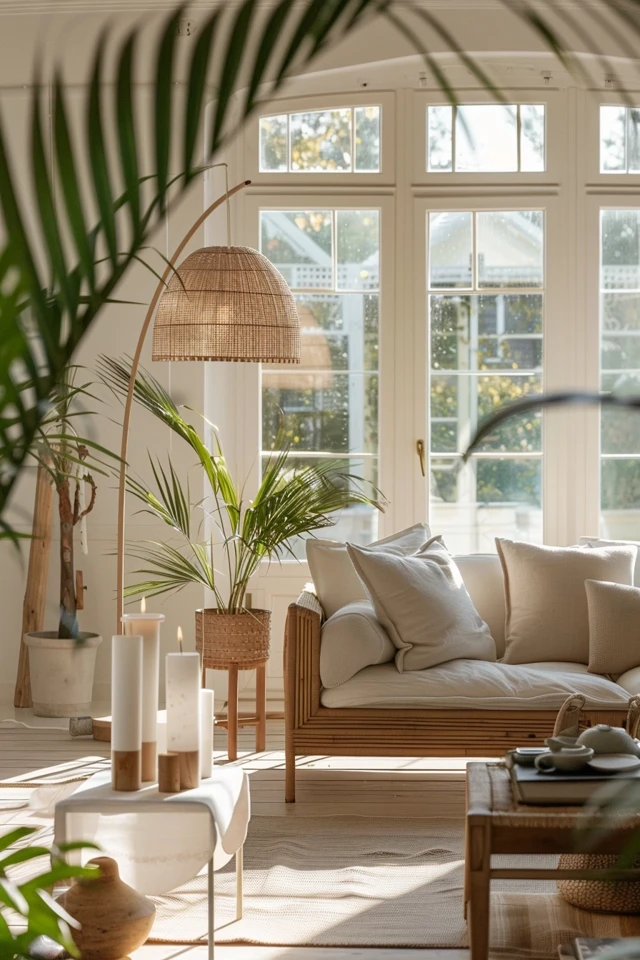
Title: How To Light Up A Room With No Overhead Lighting: Creative Solutions
How To Light Up A Room With No Overhead Lighting: Creative Solutions
Walking into a room that lacks overhead lighting can feel like entering a cave. This is a common frustration in older homes, pre-war apartments, and budget-friendly rentals where ceiling junction boxes are nonexistent. You might feel limited to a single sad lamp in the corner, but that does not have to be your reality.
As an interior designer, I actually prefer rooms without generic overhead fixtures. “Boob lights” and harsh recessed cans often flatten a room, whereas eye-level lighting creates warmth, dimension, and intimacy. By layering different light sources, you can create a space that feels intentional and architectural rather than dark and dreary.
In this guide, I will walk you through the exact formulas I use to light up living rooms and bedrooms that have zero ceiling wiring. If you are looking for visual inspiration, scroll down to the bottom of this page to see the Picture Gallery with real-world examples.
The Golden Rule: Layering Your Light Sources
The biggest mistake homeowners make is buying one bright floor lamp and expecting it to do all the heavy lifting. This creates harsh shadows and makes the room feel smaller. The secret to professional lighting is layering.
You need to think about lighting in three distinct categories: ambient, task, and accent. Ambient light is your general illumination that replaces the overhead fixture. Task light is specific to activities like reading or cooking. Accent light adds drama and highlights art or architectural features.
In a room without overheads, you need at least three to four distinct light sources. These sources should be placed at varying heights to draw the eye up and around the room. This technique prevents the “campfire effect,” where only the center of the room is bright while the corners disappear into darkness.
Designer’s Note: The Kelvin Scale
Before buying a single lamp, you must understand color temperature. Light color is measured in Kelvins (K).
- 2700K: Warm, cozy, slightly yellow. ideal for living rooms and bedrooms.
- 3000K: Soft white, crisp but not blue. Good for bathrooms or kitchens.
- 4000K+: Daylight or cool white. Avoid this in residential living spaces; it looks like a hospital or a garage.
Common Mistake: Mixing color temperatures. Do not put a 5000K bulb in one lamp and a 2700K bulb in another. It creates visual chaos. Stick to 2700K or 3000K for all lamps in a single room to create a cohesive glow.
Utilizing Floor Lamps for General Illumination
When you do not have a ceiling light, the floor lamp is your best friend. However, not all floor lamps are created equal. You specifically need a style that directs light upward to bounce off the ceiling.
The Torchiere Advantage
A torchiere floor lamp features a shade that opens upward. This directs the light beam toward the ceiling, which then reflects back down into the room. This mimics the effect of an overhead fixture by raising the overall brightness of the space without harsh direct beams.
Place torchieres in the darkest corners of the room. By brightening the corners, you visually push the walls back, making the room feel larger. For a standard 12×14 living room, I usually recommend two torchieres placed in diagonal corners.
The Arc Lamp Solution
If you need light over a specific area, like a coffee table or a sectional sofa, an arc lamp is the standard designer solution. These large, curved lamps plug into a wall outlet but arch over the room to drop light centrally.
Pro-Tip on Measurements:
- Clearance: Ensure the bottom of the arc lamp shade is at least 60 to 66 inches off the floor so people don’t bump their heads.
- Reach: Measure the distance from your outlet to the center of your coffee table. Make sure the arc arm is long enough to reach that center point. If it falls short, it looks visually unbalanced.
- Base Weight: If you have pets or children, ensure the base is heavy marble or metal (20+ lbs). Arc lamps can be tippy if the base isn’t substantial.
Wall Sconces: No Electrician Required
Wall sconces add sophistication and save precious floor space. Many people assume sconces require cutting into drywall and hiring an electrician, but plug-in options are vastly superior for retrofitting.
Plug-In Sconces
These fixtures mount to the wall with a simple bracket and have a cord that hangs down to the outlet. To make this look high-end, you need to manage the cord. I recommend using metal cord covers (raceways) that can be painted to match your wall color. This makes the cord disappear and gives the illusion of hard-wired lighting.
The “Puck Light” Hack
If you absolutely cannot stand visible cords, use the puck light trick. Buy a standard hard-wire wall sconce. Instead of wiring it, mount it to the wall and place a battery-operated LED puck light inside the shade.
This is strictly for accent lighting. Battery puck lights rarely offer enough lumens to light a whole room, but they look fantastic flanking a piece of art or a mirror.
Placement Rules of Thumb:
- Height: Generally, mount sconces so the center of the light source is 60 to 66 inches from the floor.
- Bedside: If using them as bedside lamps, sit in the bed and measure. The bottom of the shade should be at your shoulder height so the bulb doesn’t shine in your eyes.
- Spacing: If flanking a sofa or art, leave at least 6 to 10 inches between the edge of the object and the fixture.
Table Lamps and Shade Selection
Table lamps are the jewelry of the room. They provide mid-level lighting that bridges the gap between floor lamps and the ceiling. The most critical factor here is not the base, but the shade material.
Translucent vs. Opaque Shades
If your goal is to brighten a dark room, choose translucent shades. Linen, white cotton, or light-colored silk allow light to pass through the sides of the shade, creating a 360-degree lantern effect.
Opaque shades (metal, black paper, dark heavy fabric) force the light only up and down. These are excellent for mood lighting or task lighting, but they will not help increase the overall ambient brightness of a room.
Scale and Sizing
A common issue I see is “tiny lamp syndrome.” A robust sofa or a large console table needs a lamp with presence.
- Height: The total height of the lamp should generally be between 28 and 32 inches for a living room side table.
- Shade Width: The width of the shade should be roughly equal to the height of the lamp base.
- Eye Level: When seated on your sofa, the bottom of the shade should be at eye level. If you can see the bare bulb while sitting, the lamp is too tall or the table is too high.
Mirrors and Reflective Surfaces
You can double the effectiveness of your lamps by using mirrors strategically. A mirror does not generate light, but it amplifies whatever light you currently have.
Placement Strategy
Place a large floor mirror or a wall-mounted mirror directly opposite your main window. During the day, this bounces natural light deep into the room. At night, it reflects the glow of your floor lamps.
If you cannot place a mirror opposite a window, place it behind a table lamp. This is a classic trick used in restaurants and hotels. The mirror reflects the light from the lamp back into the room, effectively doubling the brightness of that single fixture.
Paint Finishes
While matte paint is trendy, it absorbs light. If your room is truly dark, consider using an eggshell or satin finish on the walls. These finishes have a slight sheen that helps bounce light around the room. For the ceiling, a standard flat white is best to diffuse the light cast upward by your torchiere lamps.
Managing Controls and “Smart” Solutions
One of the inconveniences of having five separate lamps instead of one overhead switch is turning them all on. It can be annoying to walk around the room flipping five switches every evening.
Smart Plugs and Bulbs
This is where technology saves the design. I recommend putting all your major ambient lamps on smart plugs. You can group them in an app so that one tap on your phone—or one voice command—turns on the “Living Room” group instantly.
Dimming Capabilities
Without overhead dimmers, you lose control over mood. Smart bulbs allow you to dim lamps that ordinarily only have an on/off switch. This is crucial for transitioning a room from “bright workspace” to “cozy movie night.”
Common Mistakes + Fixes
Mistake 1: Relying on Exposed Edison Bulbs
The Fix: While trendy, Edison bulbs are very dim and amber-colored. They offer almost no functional light. Use them only for decorative accent lamps, never for your main light source.
Mistake 2: Ignoring Dark Corners
The Fix: Shadows in corners make a room feel claustrophobic. Place a small uplight (a “can light” that sits on the floor) behind a large potted plant in the corner. It creates beautiful shadows on the ceiling and eliminates the dark pocket.
Mistake 3: Using Cool White LEDs
The Fix: As mentioned earlier, stick to 2700K or 3000K. 5000K “Daylight” bulbs will make your living room feel like a dentist’s office.
Final Checklist: What I’d Do in a Real Project
If I were hired to light a 15×15 living room with no overhead lights, here is the exact step-by-step process I would follow:
1. Establish the Anchor (The Ceiling Substitute)
I would place one tall torchiere floor lamp in the corner furthest from the entrance. This bounces light off the ceiling to raise ambient brightness.
2. Define the Zone (The Centerpiece)
I would place a large arc lamp behind the sectional sofa, arching over the coffee table to provide central light for board games or drinks.
3. Add Mid-Level Warmth (The Eye Level)
I would add two substantial table lamps with white linen shades on the side tables flanking the sofa.
4. Add Sparkle (The Accent)
I would install two plug-in wall sconces on the wall behind the TV or above the sideboard to create depth.
5. Unify Controls
I would plug the torchiere, the arc lamp, and the table lamps into a smart hub system so the client can say “Turn on Living Room” and everything glows at once.
FAQs
Q: How many lumens do I need to light a room with no overheads?
A: A general rule of thumb for a living room is 20 lumens per square foot. For a 200-square-foot room (10×20), you need roughly 4,000 lumens total. A standard 60-watt equivalent LED bulb provides about 800 lumens. So, you would need about 5 bulbs’ worth of light distributed throughout the room.
Q: How do I hide the cords from floor lamps floating in the middle of the room?
A: This is tricky. If possible, run the cord under a heavy area rug. You can buy flat cord protectors specifically designed to go under rugs so you don’t feel a lump. Never run a cord across a walkway where it becomes a trip hazard. If the lamp must be near a sofa floating in the room, tuck the cord along the leg of the sofa.
Q: Can I use outdoor string lights inside?
A: Generally, no. While they look cute in dorm rooms or patios, heavy black-corded bistro lights often look messy indoors. If you want string lights, look for “fairy lights” (copper wire with tiny LEDs) and put them inside a glass vase or along a bookshelf for a subtle glow rather than stringing them across the ceiling.
Q: What if I have very low ceilings?
A: Avoid tall floor lamps that look like they are touching the ceiling. Focus on lower-profile table lamps and wall sconces. Uplighting is still good, but make sure the light doesn’t create a harsh “hot spot” on the ceiling right above the lamp.
Conclusion
Lighting a room without overhead fixtures is not a disadvantage; it is an opportunity. It forces you to think about how light affects the mood and function of your space. By layering floor lamps, table lamps, and wall sconces, you create a rich, textured environment that is often far more welcoming than a room lit by a single ceiling fixture.
Remember to check your bulb temperature, vary the height of your light sources, and never underestimate the power of a good dimmer. With these tools, you can transform even the darkest rental into a bright, inviting home.
Picture Gallery


